

Fostering a vibrant, inclusive, and global community dedicated to science and society. Join us: https://xitter.twitterapi.xyz/t.co/Jvs055fiDM
- Tweets18.7K
- Following254
- Followers256K
- Likes9.6K






ALT Three smiling young physicists wearing APS meeting lanyards sit together with coffee cups. Text: APS. Join a society that supports your physics journey. Undergraduate and graduate students receive free APS membership for their first year.

ALT Physicists talk at a laptop and in a busy poster session at an APS meeting. Text: Join a society that helps you grow. Find resources, mentorship, and opportunities to support your personal and professional goals in physics.

ALT A student explains her research poster at an APS meeting, and two researchers stand by their poster. Text: Join a society that puts your work in the spotlight. Share your research, ideas, and achievements with a global community of physicists.

ALT Attendees add stickers to a wall, and two physicists look at a laptop together. Text: Join a society that sparks connection. Build relationships with other physicists who share your interests, and join an APS Unit.

ALT A tabletop device built from black 3D-printed parts, vertical metal rods and stacked plates. Rows of small round black discs line the plates, a clear box sits in the middle, and bundles of colorful wires and rainbow ribbon cables run through it.

ALT Inside a vacuum chamber, two small metal mounts face each other on a flat metal platform. Lenses, fittings and thin copper wires surround them, lit in green and purple.

ALT A keynote speaker shares their research at a large session.

ALT A digital poster presenter shares their research on a large screen with another attendee.

ALT A poster presenter shares their research with another attendee.

ALT A speaker gives an oral presentation in front of a crowd.

ALT Illustration of a laboratory plasma experiment. Glowing orange, pink and purple plasma rises in finger-like plumes above a wavy teal surface. A row of transparent vertical panels cuts through the plasma, and white arrows on the front panel point in opposite directions.

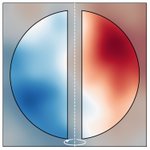
ALT Color map of cosmic microwave background temperature around stacked galaxy clusters, drawn as a circle split down the middle by a dashed vertical line. The left half is shaded blue and the right half red, over a faint blue and red background. A small curved arrow at the bottom marks rotation around the dashed line.

ALT Simulation of two colliding red giant cores. A turbulent cloud of glowing gas fills the frame against a dark background, shading from dark red at the edges through orange to a white-hot center, where two small black circles sit side by side.

ALT A keynote speaker shares their research at a large session.

ALT A 3D rendering showing many black holes with orange accretion disks against a black background.

ALT Title slide reading "A Snapshot of PRL's Nobel Legacy" with a swirling blue and green particle image inside an oval frame, and "Swipe for discoveries through the years" below it with a forward-arrow icon. Two entries are shown: “2026, High-Energy Astrophysical Neutrinos,” illustrated with a vibrant 3D visualization showing colorful vertical columns made of stacked spheres glowing in yellow, orange, red, and green against a white background, citing PRL 111 021103 (2013) and PRL 113 101101 (2014). “2025, Macroscopic Quantum Tunneling,” illustrated with a schematic of an apparatus with a Pt-195 NMR thermometer, citing PRL 53 1260 (1984), PRL 55 1543 (1985), and PRL 55 1908 (1985).

ALT Four Nobel-linked discoveries: “2023, Attosecond Pulses,” illustrated with a diagram of a wave packet and two green V-shaped curves, one straight and one tilted, with pink spheres above, citing PRL 42 1127 (1979), PRL 48 1814 (1982), PRL 73 2180 (1994), PRL 77 1234 (1996), and PRL 81 297 (1998). “2022, Quantum Nonlocality,” illustrated with a schematic of a photon entanglement experiment using polarizing beam splitters and detectors, citing PRL 23 880 (1969), PRL 28 938 (1972), PRL 47 460 (1981), PRL 49 91 & 1804 (1982), PRL 71 4287 (1993), PRL 80 3891 (1998), and PRL 81 1345 (1999). “2021, Complex Systems,” illustrated with a grid of green dots with arrows showing a disordered spin system, citing PRL 43 1754 (1979), PRL 50 1946 (1983), PRL 52 1156 (1984), PRL 109 205501 (2012), and PRL 127 038001 (2021). “2020, Black Hole Formation,” illustrated with an artist's rendering of warped spacetime around a glowing blue sphere, citing PRL 10 66 (1963) and PRL 14 57 (1965).

ALT Four Nobel-linked discoveries: “2019, Cosmology,” illustrated with a split image of a smooth sphere transitioning into a starry, clustered universe, citing PRL 16 410 (1966). “2018, Optical Tweezers,” illustrated with a laser beam trapping a chain of green spheres, citing PRL 24 156 (1970), PRL 40 729 (1978), and PRL 57 314 (1986). “2017, Gravitational Waves,” illustrated with an artist's rendering of two orbiting compact objects warping a grid of spacetime, citing PRL 116 061102 & 241103 (2016) and PRL 118 221101 (2017). “2016, Topological Phases of Matter,” illustrated with a thermometer-style diagram showing matter transitioning through plasma, gas, liquid, solid, and quantum condensate states, citing PRL 39 1201 (1977), PRL 49 405 (1982), PRL 50 1153 (1983), and PRL 61 2015 (1988).

ALT Four Nobel-linked discoveries: “2015, Neutrino Oscillations,” illustrated with a photo of workers inside a large spherical particle detector, citing PRL 81 1562 (1998), PRL 87 071301 (2001), and PRL 89 011301 (2002). “2014, Super Resolved Fluorescence Microscopy,” illustrated with a fluorescence microscopy image of a cell with red and green glowing branching structures, citing PRL 62 2535 (1989). “2013, Higgs Boson,” illustrated with a starburst labeled "Big Bang" connecting to a ball-in-a-bowl diagram labeled "10⁻¹¹ seconds," citing PRL 13 321 & 508 (1964). “2012, Manipulation of Individual Quantum States,” illustrated with a Schrödinger's-cat-style silhouette of a black cat and its shadow, citing PRL 76 1796 & 1800 (1996).


ALT A detailed image of the Milky Way galaxy, showcasing a bright, luminous center and a dense band of stars and cosmic dust stretched across the dark expanse of space. The surrounding area is dotted with numerous stars and faint celestial bodies.