

I choose balance. First-level balance. mi pinxe lo crino tcati https://xitter.twitterapi.xyz/t.co/gCQrmCby7P
Earth
Joined May 2011
- Tweets22K
- Following551
- Followers7.9M
- Likes12.2K







vitalik.eth retweeted

What are the visions of the post-AGI future in San Francisco? Many think we're all going to die, but even the "positive" visions seem rather dystopian. Here, I wrote about "handoverism," which involves handing control of the future to an AGI God, with humans outside the loop.
ruxandrabio.substack.com/p/h…
We are on the cusp of RSI or recursive self-improvement: this means that AI systems can self-improve, without the need for human intervention. This means our world stands to be transformed in what many call “the singularity”. I moved to SF around three weeks ago and one of the things I have been trying to understand is where we are heading, at least according to those developing the tech.
The worst scenarios are plainly bleak: all of us, or vast numbers of us, die. But what is striking to me is how little reassurance even some of the happiest scenarios offer. But one common and ostensibly optimistic vision is known as “handoverism”: humanity cedes control of its future to a godlike AI and we become the comfortably maintained inhabitants of a civilisation whose direction is no longer ours to decide. It is difficult to see what democracy would mean in such a world, or where the consent of most of humanity to the instantiation of such a regime enters the picture.
The permanent displacement of human labour is treated almost as a given. At the same time, there is scarcely any satisfying answer to the question of how we might remain useful to one another. Even our relationships seem uncertain. The promised utopia looks to me much closer to a kind of dystopia.
“It’s not my preferred outcome,” someone working at one of the big labs told me, “but once we achieve superintelligence, which we cannot stop at this point, I cannot see any other option for where humanity will go.” Then, after a pause, he added: “It is still much better than what I actually fear most, which is that we might all die.”
He sounded resigned, as if the question of what humans would be for (apparently not much?) had already been settled somewhere else and by someone else. All that remains, it seems, is to wait for this pre-destined fate to unfold before our eyes.
But I do not think that is the case. I believe we always have a choice and that we should try and steer this technology in a way that maintains our agency and control. And even if that looks hard and daunting, the immensity of the stakes here make it worth trying at least.
I do not know whether the handoverist vision will come to pass. That the people building this technology consider it plausible, and often desirable, guarantees nothing: proximity to a technology does not correlate that well with predicting its impact on society.
But they are the ones closest to it, and what they say deserves to be at least taken seriously. The rest of society, including some very intelligent people, has been far too quick to wave these scenarios away and not even get involved in the debate. Whether or not the belief is correct, it is sincerely held, and it is not “marketing hype.” I am writing this because I think it is high time that more people, inside San Francisco and out, engaged with the arguments about what our future will look like, and answered them.

vitalik.eth retweeted

🪇🎉 Announcement 🎉🪇
An Epistemics Fund, sponsored by @oughtinc
Ought plans to make between $500k and $5M in grants to top recommendations in community notes, reliability tracking and more.
Apply! Or Ask Me Anything on the fund/my grant evaluations
epistemic.fund

I agree! Lots of pareto improvements.
Top few I see are:
1. DC available chain (current PQ roadmap) only has a few hundred validators in the hot path of each slot. Consensus time ~= log(validator count), so going from 30k vals -> 500 is plausibly a 2x speed boost.
2. Erasure coded P2P improves expected propagation time of big objects with no downside except some code complexity (which is manageable, esp given that this is not consensus code)
3. Few-slot finality. PQ sig aggregation is able to handle a message from every validator per round, and even at very conservative params (eg. ~5 rounds of aggregation, 1m validators) current math/simulations imply finality in under a minute (compare: 2.5 epochs = 16 min avg finality today)
So effectively, significant efficiency gains are part of the (currently understood) PQ security roadmap "for free"
that's just the vitalik.eth address, you wanna ask etherscan what is the last thing I paid for onchain *using a privacy protocol* 😛
Slowing down data centers is not the same thing as "taking away our access".
Even other forms of compute restriction are among the mildest things we can do in terms of impact on access.
We should be careful as many people are highly motivated to conflate these two things.
3. Optimizing for ETH as SoV is aligned with decentralization and CROPS
Whenever I ask what people appreciate the most about Ethereum (as opposed to either other blockchains, or anything outside the blockchain world), the most common answer is: decentralization and CROPS (censorship and capture resistance, open source, privacy and security).
Decentralization and CROPS have a lot of value, even to institutions. For individuals, privacy is often viewed as an abstract ideology. For institutions, it's prudent risk management, data protection law compliance, and a number of other things. Likewise for security. And likewise for running your own node (enterprise buzzword: "on-prem deployment").
But what about for the ETH holder? Well, it depends why you're an ETH holder. If you want ETH to optimally chase financial trends and collect fees from them, then you want a Fearless Leader™ who bravely shouts on the socials that Ethereum loves [insert opportunity here] and will pragmatically reconfigure itself to give it explicit protocol support.
But if your primary reason to hold ETH is as an SoV, then you will be judging ETH by SoV-ish metrics. And what is the first and most important SoV-ish metric?
To survive.
That's what a big chunk of this last Devcon was about ("post-quantum and post-AI"). You want a chain that is taking conservative tradeoffs ("hash-only security, all formally proven, >3x more rounds than known to be necessary for security"). You want a chain that is aiming for at least partial ossification, where the great balance of work will move to higher levels of the stack once the core is complete. You want a chain that aims to minimize protocol politics, by having a very high bar before it accepts either precompiles that bloat the protocol or new kinds of in-protocol rewards that could get captured.
What other SoV'ish metrics?
The ability to easily hold it safely (hence, work on multisigs).
The ability to hold it privately (hence, kohaku work).
The ability to hold it privately *and* safely (hence, 8288 and private-AA workstreams already starting).
The guarantee that if you have coins, you can send them, and block builders can't stop you (FOCIL)
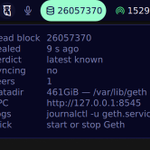
Minimized infrastructure dependence (basically the whole decentralization roadmap, including the fact that I am able to currently run a node on this laptop, and it synced in < 6 hours and takes up only 1/8 of my hard drive - better stats than in 2019!)
Now, are there "adoption" goals that are highly synergistic with SoV?
Very much so.
The more assets there are natively issued on L1, including both RWAs and native decentralized assets, the larger a set of things you can "do" with your ETH, the better. Being able to easily (including safely, trustlessly) convert back and forth between ETH and other assets, use ETH as collateral to do things with other assets, etc, all forms part of the utility of holding ETH.
There are still some conflicts between serving these use cases and decentralization (eg. we want to be careful about fast slots and impact on centralization), but on the whole much less than what you get if you maximize fees.
Conclusion:
The best social reason to care about Ethereum is because it makes decentralization and CROPS properties a reality for more people and uses.
The best private reason to hold ETH is its SoV properties, which are a direct consequence of that decentralization and CROPS.
2. Optimizing for ETH as fee-burning token would demand compromising decentralization and capture resistance
If we decide we actually want to optimize ETH for burning fees to justify a present-day ~$270B market cap, then Ethereum would essentially be functioning as a world-scale major corporation - it would be somewhere around L'Oreal (#55).
Now, what do *real* major corporations have to do in order to maintain their positions in the long term?
1. They spend. AI estimates L'Oreal as spending ~0.58% of its market cap per year on R&D. This would bankrupt the EF almost immediately. So this would require in-protocol funding to the tune of ~700k ETH per year, with all the political issues that it entails (so validator revenue would get cut by 2/3). And that's just R&D. Corporations have to spend on all kinds of things beyond just cranking out more units of their pre-existing product.
2. They govern. To survive new waves of technology and culture, you have to make highly opinionated choices to go after new markets, make new kinds of products with new features to appeal to people who think in new ways and use the newest technologies. Ethereum would need to have highly interventionist governance, for the long term.
Needless to say, both of these are far from conducive to optimizing capture resistance and decentralization.
On top of this there is another concern: optimizing for fee burning means optimizing for high gas prices to some degree. This may price out users, including some users who may need privacy and security the most. The price that maximizes price * usage leads to less usage than the price that allows as much usage as possible subject to safe blockchain resource limits.
# 1. ETH as fee-burning token never was as strong as it seemed
Let us re-cap the economic theory behind valuation of a fee-burning token. This is the "net present value" (NPV) theory.
Formula: market cap = fees burned / discount rate
Imagine you have a token of which $1 billion is burned per year, and this is a long-term stable equilibrium. Now, imagine the discount rate is 4%; that is, people value having $1B today as much as $1.04B in one year.
The idea is that $1B / 4% = $25B serves as a natural "floor" for the valuation: if the valuation drops lower than that, then someone could buy an asset expected to pay $1 per year forever for less than $25 (by buying some tokens, and then selling >4% of their supply each year so their share of the total pie remains the same), and so by buying the asset you reliably beat the market.
In 2021-23, Ethereum burned millions of ETH per year in this way.
But here's the problem: this was never a true floor. The reason is that the bulk of that burn was crypto-internal use cases. If ETH had dropped by 10x, then the profits from those use cases would have also dropped, because all the buyers would have had much less money to pay with. This applies both to things like that infamous $180m-fees-burned-in-one-day digital monkey sale (yes, this happened; if you don't remember look it up!), and to more "normal" things like lending. The floor argument only works if the backing of the revenue stream is external.
Today, Ethereum actually has a better claim to this external backing, because of the growing RWA economy, but on the other hand, perhaps precisely because it's a normal stable mature business, it's not going to randomly go crazy and burn $180m on a digital monkey sale.
Expanding on why I believe "ETH as store of value (SoV)" makes much more sense to focus on than "ETH as fee-burning token".
Three primary reasons:
1. ETH as fee-burning token never was as strong as it seemed
2. Optimizing for ETH as fee-burning token would demand Ethereum and ETH function in ways that are very hard to make compatible with decentralization and capture resistance.
3. Meanwhile, optimizing for ETH as SoV is aligned with Ethereum focusing on its unique strengths (decentralization and CROPS)
EIP-1559 (including its burn) is fine and good, we should keep them. But we should not feel sad if fee burn is < 10% of breakeven indefinitely; the value of ETH comes from elsewhere.
The core idea: the big thing that people appreciate about Ethereum is decentralization and CROPS. The main pragmatic benefit that these things translate into is stability. SoV is the category where that is not an unneeded extra we merely put effort into for ideological reasons, but rather a pragmatic strength from the perspective of people putting in their assets. And in the era of AI disruption, stability will be highly valued.
I know this is a predictable opinion from me but I don't agree with the strong emotional reaction against the anti-data-center movements that I've seen this week.
As I see it, algorithmic progress means that whatever you would be able to do with more and bigger data centers in 2 years, you will be able to do with the data centers we have today in 4 years - probably sooner. So nothing remotely apocalyptically bad will happen from even extreme levels of success by anti-data-center people.
Meanwhile we need all the time we can get to better harden the world against both already-visible cybersecurity issues and any bio and other risks soon to come. Science applications are bottlenecked by many things other than AI, so slowing AI down by one year will slow those down by much less than one year.
Given this, a slowdown in compute hyper-scaling seems quite net good? Notice this is without any controversial "doomer arguments", RSI etc. Even if net-bad, it's certainly not worse than like 10+ other political things.
vitalik.eth retweeted

L2BEAT is now ETHBEAT.
5+ years of keeping L2s accountable, now extended to privacy, interop, staking and beyond. One goal: transparency on the guarantees users get on Ethereum.
Thank you to the community that got us here. The next chapter starts today!



I would describe my worry as: what if the equivalent of quadratic sieve for ECDLP or pairings (and similarly, more-powerful-than-today algorithms for breaking lattices) exist, and we've just not yet managed to find them - but AI speedrunning 50+ years of math in 5 years will.
vitalik.eth retweeted

Quantum computing poses a serious threat to the cryptography blockchains currently rely on, while advances in AI compress best estimates for the threat's timeline.
That's why experts gathered in Cambridge to coordinate research upgrading our cryptography to be quantum-resistant.
India is 17% of the world, including a huge number of talented developers working on ethereum and ZK not to mention other kinds of secure, private and open technology, and it has so far had 0 of 11 devcon(nect)s.
I'm excited to engage with the community here.
Just arrived in Mumbai!
Looking forward to seeing familiar faces and new faces and all the wonderful Ethereum and open/secure/private/decentralized tech projects that everyone is working on over the next week.
vitalik.eth retweeted
高兴见到你们了!
我觉得做你们这样结合不同的领域很重要:以太坊安全需要硬件,生物科技需要密码学能给我们带来的保障和隐私,开源+可验证的硬件也很重要
所以在一个房间里有所有这些领域的人一起工作和共享想法能带来很大的收获
高兴见到你们了!
我觉得做你们这样结合不同的领域很重要:以太坊安全需要硬件,生物科技需要密码学能给我们带来的保障和隐私,开源+可验证的硬件也很重要
所以在一个房间里有所有这些领域的人一起工作和共享想法能带来很大的收获
Digital minimalism
vitalik.eth.limo/general/202…