

Ph.D. Principal Scientist Ex @YahooResearch. I do machine learning ∩ numerical methods ∩ SW dev.
Israel
Joined August 2012
- Tweets12.2K
- Following294
- Followers2K
- Likes2.7K






Pinned Tweet
And now, also a manuscript.
arxiv.org/abs/2611.14516
Happy citing!


🔥︎Delighted, thrilled, happy and please to share torchcurves - parametric curves in pure PyTorch. I believe it's mature enough to share here. Inspired by a two-year old paper from Yahoo.
code: github.com/alexshtf/torchcur…
docs: torchcurves.readthedocs.io
paper that inspired it: openreview.net/forum?id=M422…
Use:
pip install torchcurves
or my personal preference:
uv add torchcurves
A small library of vectorized, differentiable B-spline and Legendre curves with learnable coefficients. Handy for continuous embeddings of numerical features in your recommender system, shape-constrained models (e.g. monotonicity via non-decreasing control points) in your ad surplus optimization work, and KAN-style layers.
I set out to keep it small, pure PyTorch, readable, and easy to maintain, with only modest speed ambitions. It is reasonably fast for such a library, and the performance comes mainly from leaning on PyTorch’s vectorization and efficient algorithms (Cox-De Boor for the splines, Clenshaw for the polynomials). The vectorized code can evaluate several curves at a batch of points in one call.
Gradients flow to both the inputs and the coefficients via custom autograd. It’s not the fastest implementation out there, but it stays simple and transparent.
Would love to that it works for you, and what would make it better. Have fun using it!

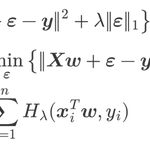
Continuing this theme - an interesting fact about the well-known Huber loss. It is typically taught as "just a smooth version of ℓ₁", but it's actually deeper than that.
🧵

What do constrained regression, PCA, and learning to rank have in common?
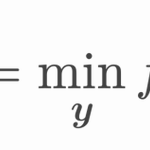
One simple optimization trick: partial minimization.
My new post explores why it keeps showing up, and what we gain by looking at familiar problems through this lens.
Enjoy!
alexshtf.github.io/2026/11/0…


People, especially in the industry, do not always appreciate the value of such work. It looks like theorems, bounds, etc.... but these are algorithms you don't need to babysit or tune. This is what makes real systems work. Be it your linear solver based on decades of numerical LA research, your eigensolver, your interior point solver, or your online learning algorithm.


What do constrained regression, PCA, and learning to rank have in common?
One simple optimization trick: partial minimization.
My new post explores why it keeps showing up, and what we gain by looking at familiar problems through this lens.
Enjoy!
alexshtf.github.io/2026/11/0…


Writing small PyTorch experiments for my blog, I found a clean pattern: training as an iterator, with composable validation and early stopping.
Turned it into a small library: FitStream. Makes my small experiments nice and clean.
pip install fitstream
github.com/alexshtf/fitstrea…
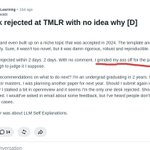
I am no longer volunteering to review at TMLR.
The aggressive desk rejection policy, even if remove a lot of slop, also has plenty of false positives that throw away months of years of people's work just because of the AE's intuition.
Until some measures to reduce false positives are found, I don't believe I should contribute my time to such a venue.


The speed of modern CPUs is unimaginable. I have a new shiny P14s Gen 7 laptop (Intel CPU), and it is FAST.
10
522
I dont understand the backlash against Terra based on terminal bench. Who cares? Remember that its also a language model. You know, for tasks like understanding human language and generating human language. Something OpenAI models tend to do better than Anthropic's.
Not to mention vision - Opus cant see what old good Luna sees.
2
269
OK, I don't know if the papers in my batch are AI slop. I have no way of reliably detecting AI. But they are slop. An incomprehensible mess. Someone just assembled a bunch of numbers, letters, lemmas and propositions, with a lot of symbols and indices, and asked me to read it.

🔥︎Delighted, thrilled, happy and please to share torchcurves - parametric curves in pure PyTorch. I believe it's mature enough to share here. Inspired by a two-year old paper from Yahoo.
code: github.com/alexshtf/torchcur…
docs: torchcurves.readthedocs.io
paper that inspired it: openreview.net/forum?id=M422…
Use:
pip install torchcurves
or my personal preference:
uv add torchcurves
A small library of vectorized, differentiable B-spline and Legendre curves with learnable coefficients. Handy for continuous embeddings of numerical features in your recommender system, shape-constrained models (e.g. monotonicity via non-decreasing control points) in your ad surplus optimization work, and KAN-style layers.
I set out to keep it small, pure PyTorch, readable, and easy to maintain, with only modest speed ambitions. It is reasonably fast for such a library, and the performance comes mainly from leaning on PyTorch’s vectorization and efficient algorithms (Cox-De Boor for the splines, Clenshaw for the polynomials). The vectorized code can evaluate several curves at a batch of points in one call.
Gradients flow to both the inputs and the coefficients via custom autograd. It’s not the fastest implementation out there, but it stays simple and transparent.
Would love to that it works for you, and what would make it better. Have fun using it!
So when will model-providers start publishing slop-scores in their model cards, i.e., benchmarks with multiple episodes, where a model is punished for creating complexity in first episodes that affects the resources required for success in the future episodes?
@tomaarsen - probably you would know best.
Is there a good embedding model for JSON data, such that can understand semantics from structure, differentiate two JSONs having different structure, and JSONs having the same structure but different semantics of their content?
167
What I can understand from the latest discourse on AI for math is this - 𝑂 hacking is all you need.
225
LaTeX rendering in @zeddotdev would make it truly the best environment for scientific computing and ML workflows. Please make this PR happen :)
github.com/zed-industries/ze…

7
665

