

have traveled to over 50 countries investigating and documenting the shared symbolisms between ancient cultures worldwide. My book is linked below:
Joined March 2012
- Tweets4.2K
- Following117
- Followers18.1K
- Likes657


Pinned Tweet
Ancient Navels of the Earth Part I of III
(full version - sound on)
Let's go on the ground to Easter Island, Cusco, Peru and Delphi, Greece and examine a package of symbols and skills that is present in all three locations which bear the same ancient name, the navel of the earth.
How did the Mayan Popol Vuh end up with a story that blends the Garden of Eden, Eve, and Mary Magdalene? In the Popol Vuh, Xquic, daughter of one the lords of Xibalba, goes to see a tree sprouted from the skull of Hun Hunahpu after hearing it is bearing fruit. The skull speaks to her and warns her not to touch the fruit. She reaches up for the fruit anyway, and the skull spits in her hand. This is how she immaculateley conceives of the hero twins, Hunahpu and Xbalanque.
And before all this the god "Heart of Sky" sends a flood to wipe out the first people, the people made of wood, because they did not honor the gods and had no hearts and no souls.
The Popol Vuh is considered an authentic document. It was written in K’iche’ Maya by K’iche’ nobles in the highlands of Guatemala a generation after the Spanish conquest. We have one surviving copy today made by the Dominican friar Francisco Ximénez around 1701–1703 in Chichicastenango and it contains the K'iche text alongside a Spanish translation.
I suppose one could claim that parallels with the Bible might be the result of Spanish and Catholic influence, but that's not the accepted view from the scholarly community who have studied it as it's generally accepted to be free of influence.
If that's true, there are some absolutely shocking parallels between the Popol Vuh and the Bible that have never been explained.

we do know a lot about the san agustin. we know they created the largest statuary in all of the americas with over 600 statues. we know they incorporated both mesoamerican and south american motifs, strongly supporting the idea of contact and trade networks.


Very little is known about the lost San Agustín culture that carved and painted these sculptures 2,000 years ago in the highlands of Colombia, but one archaeologist thinks the creation stories of today’s Indigenous Amazonian people hold the key to them!
archaeology.org/issues/novem…

ALT San Agustín statues (📸 jkraft5; Bruno/AdobeStock; Ken Feisel)

ALT San Agustín statues (📸 jkraft5; Bruno/AdobeStock; Ken Feisel)

ALT San Agustín statues (📸 jkraft5; Bruno/AdobeStock; Ken Feisel)
maybe im naive but i dont get the obsession with taking actual obelisks from egypt and erecting them in cities around the world. the only reason i can fathom someone would actually go through the trouble to do that is for occult or ritualistic purposes


the age when birdmen and fishmen united to found great cities. what the hell was going on in sumer

Tarihin derinliklerinde kayıp bir medeniyetin izleri…
Sümer ve Akad mühürlerinde karşımıza çıkan yarı insan, yarı balık görünümlü Apkallu bilgeleri, Mezopotamya mitolojisinde tanrı Enki tarafından insanlığa bilgeliği ve medeniyetin sırlarını aktarmak üzere gönderilen varlıklar olarak anlatılır.
Peki, bu gizemli öğretmenler Anunnakilerle bağlantılı olabilir mi? 👁️
• Ellerindeki kovalar ve kozalak benzeri nesnelerle ritüel gerçekleştiren Apkallu figürleri..
• Ortada yer alan Kutsal Ağaç: yaşam, bereket ve kozmik düzenin sembolü..
• Üstteki Kanatlı Güneş Diski: ilahi otorite ve krallık meşruiyetinin simgesi..
Peki, Sümer tabletlerinde ve Mezopotamya tasvirlerinde karşımıza çıkan bu figürler yalnızca mitolojik anlatıların bir parçası mı, yoksa geçmişe dair henüz çözemediğimiz başka bağlantılar mı var?🛸 👽
#Asur #Sümer #Anunnaki


i remember learning this in high school. so much of what we know of ancient mesoamerica was told by the spanish conquistadors and its almost impossible to know whats true if it isnt written in one of the few remaining codexes or etched into a building or stela

MYTH: The Aztecs believed Cortes was the bearded god Quetzalcoatl returning from the east.
FACT: The tale is still taught as history in some classrooms, but historians of the period say it is a myth that took shape long after the events.
1
6
763
Archaic Lens retweeted
the current understanding is that the mayans had cleared almost all the trees in the vicinity of their cities. not much of the mexican rainforest would have been left. the mayans coated every road and building in stucco and they needed 9 tons of raw tree material burnt to ash to make 1 ton of stucco. its ironic because the stucco was mostly for style points on the buildings though smooth roads upon which to drag rocks were indeed functional. anyway, today guides will tell you that it is known the mayans cut down almost all the trees to make stucco and this was a critical catalyst in the collapse of their civilization and abandonment of their buildings as once the trees are cut down there is no more shade from the oppressive heat and it even reduces the amount of rain substantially in a given micro region.
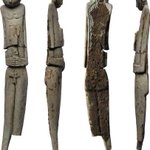
the ghassulian culture was also one of the earliest to smelt copper anywhere and one of their famous idols can be seen in the louvre. the position of its hand looks strikingly similar to urfa man of gobekli tepe and the moai of easter island and palindo of bada valley and my bet is that it is not a coincidence


Ghassulian Culture (4400–3800 BC)
Brilliant Chalcolithic culture of the southern Levant. Masters of lost-wax copper casting (Nahal Mishmar hoard), early olive and wine cultivation, subterranean architecture, and striking polychrome frescos like the Ghassulian Star

1
10
609
Glimpses of Tikal to go with your morning coffee ☕️ Tikal was the second largest Mayan city in Peten, Guatemala after El Mirador, and surprisingly much blood was shed between them.
finding a mayan site with ai is cool and all but... the number of known mayan structures that are unexcavated is estimated to be in the millions. the entire yucatan was a mayan urban sprawl like their new york city. i love research and researchers like this but to put the actual find in context its the equivalent of a future researcher finding a previosuly unknown building in manhattan. cool, but now that means there are 20,048,049 +1 mayan structures known that are unexcavated.
i say this not to minimize the find in any way but to give it proper context of the tremendous scale of the maya. it is almost incomprehensible. we will never and can never excavate all the mayan sites unless elon decides to send a billion humanoid bots to excavate en mass. but even then there is a more disturbing reality of industrial scale looting. in el mirador for example there are over 10,000 looting pits. every unexcavated structure seems to already have one. the looters move one million times faster than the archaeologists. in el mirador specifically the looters were the first ones to show the archaeologists the important sites they had found.
heres one example of a looting pit we came across in el mirador but again pretty much every structure has one.
the story of looting in Peten is actually really interesting. it was the chicleros, or chewing gum people who first went into the jungle with commercial intent to make and sell chewing gum from the sapodilla tree. while in the jungle they realized there were ancient mayan structures literally everywhere and started looting them. they then became extremely wealthy and all over the region the "chicleros" were seen as wealthy elite. 🧐 my question is, was the wealth from the chewing gum, the looting, or both. and where are all these looted artifacts? are there some billionaire museums us commoners will never see?! show us!!

El mirador is not for the faint of heart. @East10Outpost and I took this photo right before setting out from Carmelita. First, it is a 45 (forty-five) mile hike through mud and muck and swarms of mosquitos that cover your body the second you stop to rest. It’s hot. It’s humid.
But in between the blisters on your feet and the clothing completely drenched in sweat something happens. You realize you are further away from human civilization than you’ve been in a long time. You realize you haven’t looked at anything on the internet in days. Your “feed” is the sound of howler monkeys, the sighting of jaguar tracks, a tapir barely visible through the trees. Stories of love and loss and life and death with those you share the trail with.
I signed up for this journey because I wanted to see the largest Mayan city, and I owed Cody one. But what I got was something else entirely, what I got was a chance to live a little bit more like the way humans lived a long time ago, out in the jungle, around a fire, at camp, around a hearth, depending on each other for survival. What I got was the chance to step outside of modern life entirely, if only for a few days, and remember what the wild earth is like.
And what I discovered was that I like it better. I don’t know how, but I would like to reorient my life around a fire, around a trail, around the wilderness, around a group of people who’ve all found themselves there for different reasons.
El mirador awakened something in me, but it honestly has nothing to do with the maya or ancient civilization but has everything to do with people, and the wild.
The trek to el mirador is magical. I feel it has a profound capacity to transform an individual.

Some of the spiders inhabiting the pyramids of Guatemala are actually quite friendly it turns out

4
31
937
Odd place for copper elements, though I’m told it’s a good conductor of electricity. @grok what is the earliest evidence of copper usage anywhere in Egypt

This is so strange.
There is no metal anywhere in the Great Pyramid except 2 copper pins on a tiny door.
The door sits at the top of a narrow shaft running out of the Queen’s Chamber, too small for a person, and the slab is roughly 2.4 inches thick.
The pins pass straight through it.
One had already snapped off by the time a robot reached the door in 1993. The other broke during the drilling in 2002.
Whatever those 2 pieces of copper were doing, nobody studied them intact.

4
75
21,524
the largest moai on easter island, the largest egyptian obelisk, and this, destined to spend eternity in their quarries...

Left abandoned in an ancient marble quarry above the village of Apollonas on Naxos, a 2600-year-old bearded giant measuring 10.7 meters long and weighing an estimated 80 tonnes remains permanently attached to the living bedrock. Carved in the 6th century BCE with his face and features meticulously finished while his body was only half freed from the mountain, this colossal unfinished statue continues to challenge modern comprehension. Whether left behind due to a fatal fracture in the marble or some unknown crisis, historians and engineers are left to wonder what kind of machinery ancient builders could have ever planned to use to transport an 80-tonne monolith down the rugged hillside... We Love Ancient Aliens on FB

1
26
1,002
this is not colombia its bada valley, sulawesi


This Mysterious Stone Guardian Has Been Watching Over Colombia for Nearly 2,000 Years… 👀
Deep in the mountains of southern Colombia stands a mysterious stone figure that looks almost alive. Its enormous eyes, unusual facial features, and strange human-animal appearance make it look less like an ordinary sculpture and more like a guardian from another world.
This ancient statue belongs to the remarkable San Agustín culture, whose people carved hundreds of enormous stone figures between roughly 100 BC and 800 AD. Using simple stone tools, they transformed massive volcanic rocks into powerful figures that still stand across the region today.
But the real mystery is what these sculptures were meant to represent. Archaeologists believe many were connected to ancient burial sites and religious beliefs. Some may have represented powerful guardians, ancestors, or spiritual beings believed to protect the dead and connect the human world with the supernatural.
What makes these sculptures even more remarkable is that they have survived centuries of heavy rain, changing weather, and tropical vegetation. The people who created them disappeared long ago, but their mysterious stone figures remain exactly where they were placed.
Standing before one of these ancient guardians raises an incredible question: What did the people who carved it believe they were creating? A protector of the dead, a powerful spirit, or something we still don’t fully understand?
Nearly 2,000 years later, the stones remain silent, but their mystery lives on.
📍 San Agustín Archaeological Park, Colombia.
Source: UNESCO World Heritage Centre – San Agustín Archaeological Park.

one intriguing thing @East10Outpost and i were discussing on our trip is that no mayan ruins or otherwise have ever been discovered in nicaragua / costa rica / panama but ancient sites pick back up in colombia. id wager there is at least one ancient city here that have never been discovered and the dense jungle along the carribbean sea would be my prime suspect


fingerprints of the birdmen

Los Olmecas(Mesoamérica) forman parte de las 6 civilizaciones originarias de la humanidad, junto a India, China, Chavín (los Andes), Egipto y Mesopotamia.
Ser una civilización originaria significa que fueron la piedra angular: fuentes de conocimientos heredados que impulsaron y dieron origen a todas las demás culturas conocidas.

ALT Olmecas
the many hand positions of mayan idols. each one, i suspect, with its own meaning. santa barbara museum, flores, guatemala


