

Frontier AI research lab. We build AI scientists & the platforms they run on — compressing the full research lifecycle from idea to impact.
Joined January 2025
- Tweets203
- Following82
- Followers674
- Likes266






140K+ downloads in the past month. Open weights. Measurable gains. 🚀
Thanks @HuggingModels for highlighting AutoTrust AI’s Decider Pro Vision 27B v1.1!
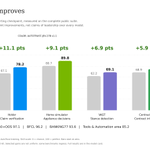
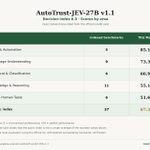
96.25 in tool selection.
97.06 in intent classification.
Sentiment extraction: 27.8 → 55.0, a +27.2-point gain over the starting checkpoint.
Build agents that route requests, select tools, and classify sentiment—with probabilities for each option, rather than free-form answers to parse.
Apache-2.0 weights. Download and test it on your own workflow:
huggingface.co/autotrust/Aut…
Reported figures are benchmark skill scores, not accuracy percentages. Local evaluation; pending maintainer verification.
Explore our desktop research workspace—download ScienceGuru:
scienceguru.ai/


A naming update from AutoTrust AI: we’re moving our JEV releases to the AutoTrust Decider family to make them clearly distinguishable from TypeSafe’s Jev.
JEV-9B → AutoTrust-Decider-Mini-9B
JEV-27B → AutoTrust-Decider-Pro-27B
JEV-27B-VL → AutoTrust-Decider-Pro-Vision-27B
We’re updating repositories, model cards, and related materials. Browse our releases here:
huggingface.co/autotrust

4
38
Thanks @LysandreJik and the @HuggingModels team for bringing decision models into Transformers—and highlighting AutoTrust AI’s JEV.
Agents don’t always need another generated paragraph. Sometimes they need to choose a tool, rank search results, or select the next action from a screenshot.
JEV’s System 1 path returns calibrated probabilities for explicit options in one forward pass, over text and images. Developers can use those probabilities to set thresholds, route uncertain cases for deeper reasoning, and avoid parsing free-form answers.
A shared model.decide(...) interface means less model-specific glue across inference, training and evaluation. That’s a meaningful step toward making open decision models easier to use.
Download our models and explore the demos:
huggingface.co/collections/a…


A pretty important new primitive just landed in 🤗 Transformers: **decision models**.
I think this could matter much more than adding support for any single model.
Today, different decision models all approach "making a decision" differently:
- @typesafeai’s Jev, the OG: typed decisions + calibrated probabilities, single forward
- @AutoTrustAI’s JEV builds open System One models around a learned decision block, w/ multimodal.
- @jaredpalmer’s KEV uses a pointer head over the options, sharing the computation of the state across questions.
- @Cloudflare’s CLEF uses a joint schema head that routes evidence between the state, questions and options, scoring the whole schema together.
- @perplexity_ai’s Decider uses a separate 255-way readout on top of Qwen, with non-causal attention in its full-attention layers.
- @liquidai’s d1 is exploring small, multimodal decision models that can run all the way down to the edge.
- And @XunzhuoLiu's Semantic Router team is pushing the serving side hard with System One + the D3 family: one typed interface for choice, score and yes/no decisions, with models from sub-1B to 27B.
That experimentation is good, and needed! But without a common interface, every training framework, inference engine and evaluation tool has to understand every implementation separately.
So Transformers is introducing a shared decision-model layer:
`DecisionConfig`
`pipeline("decision")`
and, most importantly:
`model.decide(...)`
The idea is **not** to make every decision model work the same internally, but for them to speak the same language to the ecosystem around them.
This means that, without running custom or remote code:
- inference engines can serve them through one interface
- training tools can build against common primitives.
- the Hub can package them consistently.
- evaluations can compare them without model-specific glue everywhere.
This is the part of transformers I'm the most excited about: to grow alongside the ecosystem and the many ideas; and to make all of them more usable by everyone.
github.com/huggingface/trans…

Want to understand decision models without setting up a server first? Try our interactive JEV demo and see how changing the question or options changes the output. 📷huggingface.co/spaces/autotr…

4
30
Our demos make this concrete: game state in, action probabilities out. Mario, Tetris and Rubik’s Cube show what a decision model can do inside an action loop.
huggingface.co/spaces/autotr…

4
32
Start with one recurring decision in your agent: which tool to call next. Define the options, test JEV on real examples, and evaluate when it should choose—and when it should defer. The model cards include serving instructions:
huggingface.co/collections/a…
4
38
AutoTrust retweeted

If you have been following Alibaba's Qwen3.8-Flash, two really cool updates came out around it today that make it much stronger and easier to run.
First, a team at AutoTrust AI took the open-weight Qwen3.8-Flash model, ran three extra rounds of reinforcement learning on it, and compressed the whole thing down to 4-bit so it fits on a single server GPU (about 267 GB of memory). The wild part is that this compressed version actually thinks cleaner than the original — it scored 95% on the 2026 AIME math exam and 98.8% on HumanEval coding while using about 22% fewer thinking tokens per answer.
At the same time, Google's TPU engineering team figured out why Qwen3.8 sometimes loses track of details in super-long chats. They found a tiny number-rounding bug in how the model calculates word positions over long documents and switched that one calculation to higher precision, which stops the model from drifting on huge prompts while saving over 18 GB of memory per chip.
Thanks @HuggingModels for highlighting AutoTrust AI’s Qwen3.8-Flash-Next-E384-FP4-V2!
39K+ downloads in Hugging Face’s rolling monthly window—and a practical direction for Local AI: multimodal reasoning, coding, and tool calling on infrastructure you control.
Our complete, RL-refined FP4 checkpoint reports 95.0% on AIME 2026 and 98.78% on HumanEval.
Building an assistant for private documents, screenshots, and code? Download the model and test it on your own workload:
huggingface.co/autotrust/Qwe…


A concrete use case: give a self-hosted assistant an internal software screenshot, the relevant documentation, and a Python script. Ask it to explain the interface, suggest a code change, and call an approved tool through your application.
That’s the kind of workflow this release lets developers explore—beyond a standalone chatbot.
The repository includes the full merged weights, launch script, required vLLM patch, and benchmark details. Serving is validated on one B200; check the deployment requirements before downloading:
huggingface.co/autotrust/Qwe…
For a desktop research workspace from the same team, download ScienceGuru:
scienceguru.ai/
4
40
Your agent can write an answer. Can it choose the right action?
AutoTrust AI’s Decision Models collection brings together nine open-weight releases, live demos, and public evaluation results — with 5.4M+ combined model downloads in Hugging Face’s rolling monthly window.
Built for decisions you can plug into real workflows:
• A customer reports a duplicate charge. Choose billing, shipping, or technical support — with a probability for each option.
• An agent has several tools available. Select the next tool rather than generate another paragraph.
• A browser agent claims it finished. Evaluate its actions and final screenshot before accepting the result.
• A game presents a new state. Choose the next move — see the Mario and Tetris demos.
Explore JEV-9B, JEV-27B, AutoTrust-JEV-27B-v1.1, JEV-27B-VL, JEV-35B, GEV-26B-Decide, and NVFP4 variants.
From text routing to visual judgments, the family gives developers different model sizes and deployment options for adding a decision layer to their own systems.
Try a demo, download a checkpoint, and test it on decisions your application actually needs to make:
huggingface.co/collections/a…
Follow @AutoTrustAI for new releases. For a research workspace built by the same team, download ScienceGuru:
scienceguru.ai/
@HuggingModels
Which AutoTrust AI decision model should you try first?
JEV-9B — A smaller model combining fast decisions with optional reasoning, a practical starting point for ticket routing and classification.
JEV-27B — Text decisions and full reasoning on one backbone, for workflows that need both option selection and longer explanations.
AutoTrust-JEV-27B-v1.1 — A text-focused decision model with strong evaluated tool-selection and intent-classification results, for choosing which API or workflow to invoke.
JEV-27B-VL — Decisions over text and images, from checking whether a browser agent finished its task to selecting the next move in Mario or Tetris.
GEV-26B-Decide — Fast text-and-image decisions with opt-in adaptive thinking: answer directly when confident, reason further when a logic or math question needs it.
JEV-35B — A sparse MoE model for text-and-image decisions, such as ranking search results or categorizing product listings; it returns decisions, not chat responses.
GEV-26B-Decide-NVFP4 — A lower-memory GEV deployment option for bringing decision workflows onto compatible local hardware.
JEV-35B-NVFP4 — A compressed JEV-35B release with a documented 32–48 GB GPU deployment path, making local ranking and classification more accessible.
JEV-Gemma4-26B-A4B — The earlier Gemma-based release, subsequently published as GEV-26B-Decide with the same weights.
Explore the demos, download a checkpoint, and test it on your own workload:
huggingface.co/autotrust
Local AI is not one model, one format, or one deployment path.
The AutoTrust AI DGX Spark Models collection brings together six releases optimized for NVIDIA DGX Spark — from GGUF builds for llama.cpp to NVFP4 and MTP-accelerated vLLM deployments.
What can you actually do with them?
Run a local coding assistant against a real repository. Serve a model through an OpenAI-compatible endpoint for an internal tool. Test an agent that can reason, call approved tools, and return results without routing every request through a remote API.
Start with the model that fits your workload:
• GLM-5.3-Flash-GGUF-DGX-Spark for a single-Spark GGUF deployment, with tool calling and reasoning support.
• Qwen3.8-27B-NVFP4-DGX-SPARK for lossless MTP speculative decoding on DGX Spark.
• GLM5.3 Flash E192, E224, and E256 variants for different DGX Spark deployment options.
• GLM-5.3-GGUF-DGX-Spark for the larger GLM 5.3 GGUF route.
The six current releases in the collection have recorded more than 111K downloads over the last month.
Follow the collection for new Local AI releases, choose one model, and test it on a task your team already knows well:
huggingface.co/collections/a…
Qwen3.8-Flash-Next-E384-FP4-V2 is built for work that needs more than a good chat response.
Imagine an engineering agent handling a real bug ticket: it reads the task, reasons through the likely failure path, calls approved search or test tools, drafts an implementation plan, and returns structured findings for a developer to review.
Or use it for math-heavy coding work: work through an algorithmic problem, produce an implementation, and hand the result back to your existing evaluation or test loop.
This is a full merged FP4 checkpoint after three GRPO-style post-training updates with verifiable rewards. It is a complete model release — not a LoRA adapter — with all weights, tokenizer, configs, and MTP files included.
Reported results under the documented evaluation setup:
• AIME 2026: 95.0
• HumanEval: 98.78
• MMLU: 87.37
• C-Eval: 89.97
• Tool calling: 77.88
For teams building coding agents, reasoning workflows, and tool-using systems, V2 provides a ready-to-serve FP4 checkpoint rather than another adapter to integrate.
Validated with vLLM 0.31 on a single B200. The documented serving path includes FP8 KV cache, prefix caching, reasoning parsing, and Qwen XML tool calling.
Download it, run it on a task your team already knows well, and compare the result in your own harness:
huggingface.co/autotrust/Qwe…
A practical first test:
Give the model one real task from your workflow — for example, a bug report with a codebase search tool and a test runner attached.
Ask it to:
1. identify the likely issue,
2. decide which approved tools to call,
3. explain the proposed fix,
4. return structured findings for human review.
That is more useful than testing whether a model can produce a polished paragraph in isolation.
Qwen3.8-Flash-Next-E384-FP4-V2 includes a documented vLLM path with Qwen XML tool calling and auto tool choice, so developers can start from a working serving configuration.
modelscope.ai/models/AutoTru…
4
95
Qwen3.8-27B-NVFP4-DGX-SPARK-V2 is here. Most Local AI releases stop at quantization. V2 goes further into the inference loop.
It packages the complete Qwen3.8-27B NVFP4 checkpoint with AutoTrust AI’s 64k MTP runtime recipe for vLLM.
The plugin reduces the draft vocabulary from 248,320 to 64,026 rows and quantizes the draft path, while leaving the target model and verification lm_head untouched.
That means less draft-step memory traffic and more practical speculative decoding for local coding, reasoning, tool-driven workflows, and private internal APIs.
Built for Blackwell hardware, including DGX Spark / GB10 and B200. Download it, install the included plugin, and serve it through an OpenAI-compatible vLLM endpoint.
huggingface.co/autotrust/Qwe…

Why does 64k MTP matter for Local AI?
On bandwidth-bound hardware, the draft path can become the bottleneck. Our underlying 64k MTP recipe cuts draft-step bytes read from about 3.4 GB to about 0.42 GB. On a DGX Spark, it raised measured single-stream decoding from 12.5 to 48.2 tok/s at temperature 0.
V2 packages this approach with the model and deployment plugin, so developers can reproduce the local serving stack directly.
modelscope.cn/models/autotru…
5
46
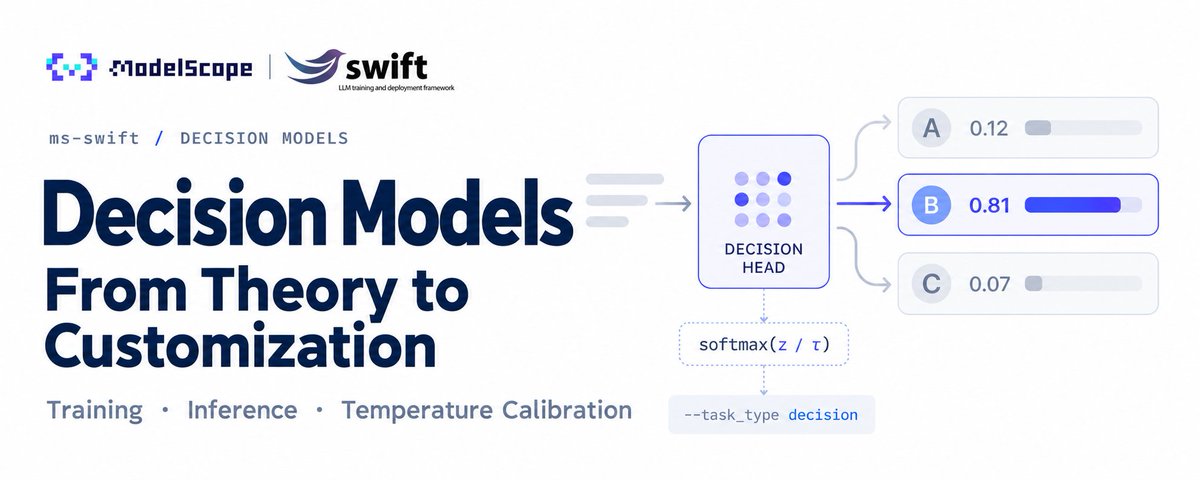
Glad to see @ModelScope2022 bring decision-model training and inference into ms-swift.
AutoTrust AI’s JEV-27B-VL is now included in the framework’s decision workflow via `--task_type decision`, with dedicated loss support, built-in Open-Jev data, and automatic two-level temperature calibration.
This gives developers a more practical route to fine-tune and run calibrated multimodal decisions—where agents need to choose, score, route, or escalate with probabilities they can use.
Explore ms-swift: github.com/modelscope/ms-swi…




AutoTrust retweeted

A quick start with ScienceGuru.
Start a chat. Keep your research, code, and data together in one project folder. Customize settings when you need to. Define the goal, materials, and output before work begins. Speak your task, review it, then send.
When it is time to move on, copy a working directory, conversation deeplink, or Markdown and pick up where you left off.
One desktop research workspace for organizing work, defining outcomes, and delivering results.
Download #ScienceGuru: scienceguru.ai