

Videos: https://xitter.twitterapi.xyz/t.co/vy9r4V6aOZ
Pittsburgh, PA
Joined October 2011
- Tweets759
- Following0
- Followers8.1K
- Likes1.6K


Pinned Tweet
I'm releasing a series of videos called "Quantum Computer Programming in 100 Easy Lessons".
youtube.com/playlist?list=PL…
It will cover the 'usual' content (...CHSH, Grover, Factoring), but with some expositional innovations that I *hope* will make it easier for beginners.
I finished the proof of "ETH false" (#3SAT in subexponential time) in my grad complexity class at CMU today (mod some easy exercises).
I think it's nice that it can be done just using classical complexity theory ingredients - it fits well in the course!
youtube.com/watch?v=3CdlC4XO…
I lectured on the "ETH false" (#3SAT in subexponential time) result in my grad complexity class at CMU today.
Didn't have time in 80 mins to do the full proof, but I hope I got across the main plan, and some of the basic TCS ingredients going into it.
youtu.be/_HlQGMcQWhA
#ETH: I hit the annoying max-chat-length, so good time to pause.
cs.cmu.edu/~odonnell/some_et…
Still badly written, but I'm happy with this progression of ideas for # 3SAT (sparse permament) in time ~2^(n/sqrt(log n)).
It's 5-page overview, 10 pages of stuff, 5 page bonus appendix.

Making some progress on simplifying the '#ETH false' proof, I think. In latest version, the key algebraic construction comes from elementary analysis of Boolean functions.
cs.cmu.edu/~odonnell/some_et…
A couple of my course lectures about ETH and SETH and related things:
youtube.com/watch?v=dVQrj52J…
youtube.com/watch?v=NMOMDz3x…
(From last week!)
I will be the first to admit, I was repeatedly on the record as believing SETH :-)
William Hoza on the BPL=L result:
youtube.com/watch?v=2hVv47LO…
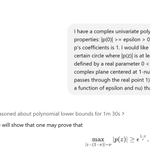
I looked forward to this cleanup! Nikloai Chukhin (eccc.weizmann.ac.il/report/2…) significantly cleans and extends the OpenAI 2^(ω(sqrt(n))) lower bound for depth-3 circuits:
The (4n-1)-bit function sum_ij a_{i+j}x_iy_j mod 2 needs depth-d circuits of size 2^(Ω~(n log n)^{1/(d-1)}).
STOC 2027 Call for Papers is out:
acm-stoc.org/stoc2027/stoc20…
Note quite a lot of changes from previous STOC CfPs.
Outstanding progress towards the Unique Games Conjecture posted by Yumou Fei, Dor Minzer, and Shuo Wang: eccc.weizmann.ac.il/report/2…
👀
Am teaching grad complexity theory at CMU; about 1/3 of the lectures will be new (vs. last time), 'modern' results. Videos are going onto youtube.com/@ComplexityTheor… which will later also feature student videos.
We did Williams (/Cook-Mertz/Shalunov) TIME(t) in SPACE(~√t) today.

I gave a talk at Carnegie Mellon about the recent proof (by OpenAI) of the existence of a non-sofic group:
youtu.be/uOQvzLjJK6c
FOCS 2026 Test of Time call for nominations is out:
tc.computer.org/tcmf/2026/05…
Please submit your nominations! More info on the award here:
tc.computer.org/tcmf/focs-te…
and here's DBLP links for FOCS '16, '06, '96:
dblp.org/db/conf/focs/focs20…
dblp.org/db/conf/focs/focs20…
dblp.org/db/conf/focs/focs96…
In case you're in Cambridge, MA on Tue. Dec. 10, I'll give a talk at 4pm (MIT 32-G449) about coboundary expansion in high-dimensional expanders.
It's kind of about group theory, though.
toc.csail.mit.edu/node/1671
Besides coauthor @singerng_, here's the cast of characters:

Student I know wants to apply for a PhD program doing quantum computing. But she also wants to be in the *math* department.
My brain couldn't do the lookup "QC person but in Math dept." Any suggestions for universities having such a person? Diverse suggestions (by DM) welcome!🙏
I just posted the 100th and final video in my YouTube course, "Quantum Computer Programming in 100 Easy Lessons".
If you're interested in learning quantum computing, and you have some 100 consecutive days with a half-hour free, maybe check it out :-)
youtube.com/playlist?list=PL…
In case you're in the Boston area, I'll talk about "Quartic quantum speedups for planted inference" tomorrow (Sep. 13) at Harvard at 4pm.
This is at the Freedman CSMA Seminar. cmsa.fas.harvard.edu/event/f…

Final quantum course tidbit #10: In the course, we do Grover's algorithm (i.e., SAT in (√2)ⁿ quantum time) before doing the Factoring algorithm.
Always seems funny to me that most courses do them in the other order. (Why is this? To follow the historical order?)
Not only is Grover much easier than Factoring, there's a straight through-line:
1. Distinguishing two 1-qubit states.
2. Distinguishing two 1-qubit rotations (or reflections).
3. Elitzur-Vaidman Bomb.
4. Grover.
5. Grover when you don't know the fraction of satisfying assignments, by binary search.
6. Rotation (Phase) Estimation for 1-qubit rotations.
7. Very high-precision 1-qubit Rotation Estimation, if you can do any power of the rotation efficiently.
8. General Rotation Estimation when you don't know the plane of rotation (i.e. Phase Estimation with an input eigenvector).
9. Applying Rotation Estimation to the permutation induced by "multiply by B, mod N".
10. Factoring N.
Quantum course tidbit #9:
So if there are no complex numbers in the course, how do we do Shor's Algorithm?
We don't; we do Kitaev's version of the Factoring algorithm, which just uses Phase Estimation.
Well, not Phase Estimation, but "Rotation Estimation" as we call it, since no complex numbers in the course means no "phases"...
For every real unitary operation U (including the operation "increment a number modulo L" which arises in Factoring), space breaks down into a bunch of orthogonal 2-d planes, where U acts as a 2-d rotation in each plane. (There can also be 1-d axes where U acts as reflection or as identity.)
(In 3-d, this is "Euler's Rotation Theorem", which says that any 3-d rotation is actually a 2-d rotation around some axis.)
"Rotation Estimation" is the quantum algorithm that -- given a real unitary U and a state |v> that's in one of U's 2-d planes of rotation -- outputs the angle by which U rotates that plane. To get the angle to k digits of precision, the algorithm uses U roughly 10^k times.
Contrary to the way Phase Estimation is usually presented, you don't need QFT for this either. It's basically just binary search.
youtube.com/watch?v=YZ7_U3pr…
Probably the largest set of different home countries I've gotten the chance to lecture to. :)
Thanks to Jan Hązła and the rest of @AIMS_Next for inviting me to participate!


We are privileged to have three distinguished lecturers leading courses on the theory of computation (Ryan O'Donnell, Carnegie Mellon University), Error-correcting codes (Venkatesan Guruswami, UC Berkeley) and combinatorial statistical mechanics (Amin Coja-Oghlan, TU Dortmund).


31
3,146