

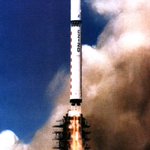

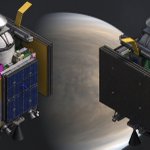


Onboard today’s CZ-2D are 4 tech-demo satellites for China’s next wave of space science through 2030:
• HongMeng — 10 sats in lunar orbit, ultra-long wavelength view of the early Universe
• Kuafu-2 — first imaging of the Sun’s poles
• Earth 2.0 — hunt for real Earth-sized planets around Sun-like stars from L2
• eXTP — X-ray timing & polarimetry of extreme physics

🤔 Long March 12A launch + recovery attempt again
> This month?
> Before year end?
> Later?


🇯🇵 Interstellar Technologies DECA


Japan’s Interstellar Technologies test-fired their COSMOS methalox engine. Burning liquid biomethane derived from local Hokkaido dairy manure, COSMOS is slated to power the ZERO small-satellite launcher. Maiden flight targeted for 2027.
#JPSPACE
Nebula-2's 2nd stage is fully expendable and does not re-enter or recover like Starship, so the interstage is not needed as upper-stage engines protection.
It can therefore remain attached to the first stage to be recovered together, with stage-separation plane located high above the hot-staging vents and providing mounting volume for grid fins above the vent line.
But I'm also curious if this design pose challenges on the linking truss structure, as this arrangement routes aerodynamic and inertial loads from the grid fins and interstage through the it during descent.


Deep Blue Aerospace's Nebula-2 model on display.
Falcon-9 class, 5m stainless steel body, hot staging, tower catch.

🚀 Deep Blue Aerospace is making serious progress on heavy iron. The company just manufactured and rolled out the 5-meter stainless-steel first-stage propellant tanks—both cryogenic liquid oxygen and kerosene—for its reusable Nebula-2.
At 5 meters across, this is the widest rocket body currently in fabrication across China’s commercial space sector. With the second-stage tank already delivered, a Starship-style catch tower spotted under construction, and the 130-tonne Thunder-RS engine deep into hot-fire testing, the hardware is converging fast. Looking forward to seeing how quickly they turn this steel into flight reality.


It’s kind of unfair to put an engine that hasn’t been revealed publicly alongside the masterpiece SpaceX Raptor 3.
So, 👇 🇺🇸 Raptor 1 v. 🇨🇳 CASC YF-215
Like Musk said: first thing you should try is to create a working prototype.


Vintage photo: Long March 2C at Jiuquan


A vintage photo of Long March 3 before the AsiaSat 1 mission on April 7, 1990—China’s maiden international commercial orbital launch.
AsiaSat 1 was originally Westar 6, which was stranded in a useless orbit. It was retrieved by Space Shuttle mission STS-51-A in November 1984, brought back to Earth in Discovery’s cargo bay, refurbished by Hughes, and then sent back into GTO atop this Chinese booster.

Near year end — wondering if Space Pioneer’s Tianlong-3 is returning soon.
SPACE-PIONEER just released the Tianlong-3 failure report, which probably hints another launch attempt soon.
The report: LOX vented during ascent was aspirated into the aft end, leading secondary combustion of the first stage turnbine exhaust, which caused damage to the base thermal protection skirt. Hot plume gases were ingested into the first-stage aft compartment and ignite an internal fire, ultimately leading to a flight anomaly.
Epsilon S upgrades all three solid stages, and the liquid kick stage is now the default.
More performance and flexibility on the refreshed solid rocket.


JAXA has completed the Epsilon S launch rehearsal just several hours ago.
Demo flight now targeted for Japanese FY2026 (through March 2027).
Video from 読売新聞


After checking more slides, the Long March 12B engine-swap story looks like a typo.
YF-102 (open cycle) is still evolving — v3.0 already.
Thrust: 900kN / 1000kN (vacuum)
Specific impulse: 2764m/s / 3243m/s
Throttling: 50~105%
TWR: 130


Correction: the recent slide shows 203,000 mega-constellation satellites through 2034.
Same slide reiterates the following timeline:
• Dec 2027 — CZ-3B asteroid defense test
• 2028 — CZ-5 Tianwen-3 Mars sample return
• 2030 — CZ-5 Tianwen-4 Jupiter
• 2049 — Edge of the solar system
