

accelerating drug development through GenAI-powered innovations in discovery, molecule design, and manufacturing, creating tomorrow's therapies today
Joined November 2024
- Tweets24
- Following404
- Followers507
- Likes8.2K



Every new antibody project starts the same way - weeks of digging through patents to figure out what’s already been tried against your target.
Find a Lead pulls it together. Pick a target, see every known antibody ranked by affinity, IP status, clinical stage, developability, immunogenicity, and cross-reactivity.
5 free searches. Start here: converge-bio.com/research-to…
Only two days to go.
On July 8, our Co-founder and CSO @IddoWeiner will take us on a journey to see how #ConvergeAB prompt in an antibody and its target, get back a ranked list of lab-ready candidates.
No task-specific training.
No human in the loop.
He'll walk through the zero-shot cetuximab biobetter that beat the clinical antibody on affinity, and a four-target campaign that found a stronger binder every time.
2:00 PM EST / 9:00 PM IST · 60 minutes
Save your seat: converge-bio.com/webinar/ins…

BIO 2026, here we come. 🚀
Converge Bio will be in San Diego from June 22 to 25. Antibody design, gene expression, and biomarker discovery, all powered by GenAI.
Want to meet? DM us or find us on BIO Partnering.

137

Converge Bio retweeted
Excited to share excellent lab results from our latest experiment with #ConvergeAB, our antibody optimization foundation model.
Our goal: optimize antibody affinity across four distinct targets in a single design round.
Results:
556× affinity gain for PD-L1 (22 nM → 40 pM)
26× affinity gain for Covid Spike (7 nM → 287 pM)
2.7× affinity gain for CD19 (560 pM → 210 pM)
2.6× affinity gain for HER2 (24 nM → 9 nM)
Developability was improved or maintained across all four targets.
Experimental setup:
1. No target-specific fine-tuning of the foundation model
2. ConvergeAB requires only the seed antibody and antigen sequence as a prompt
3. Eight hours of compute following prompt to ConvergeAB
4. Experimental validation performed at Twist Bioscience within four weeks
See the full case study with all the data in the comments section.

Converge Bio retweeted

One prompt, four antibody seeds, an eight-hour run, ten variants per seed, four new biobetters.
Last month, we reported the creation of a cetuximab biobetter using a single ConvergeAB prompt (biorxiv.org/content/10.64898…). That result naturally raises a question: does the same approach generalize to other targets?
To find out, we designed an antibody optimization campaign to stress-test the platform. We selected four starting antibodies spanning the full optimization continuum:
* A discovery-stage PD-L1 binder (22.5 nM)
* A validated Spike binder from a relatively young antibody class (7.5 nM)
* A HER2 binder from a class with decades of antibody engineering (23.9 nM)
* Tafasitamab, an FDA-approved CD19 therapeutic already at sub-nanomolar affinity (0.56 nM)
Each represents a different potential failure mode for an antibody foundation model: limited affinity headroom, sparse historical data, or overfitting to specific antigens.
The experimental design was simple:
For each seed antibody, ConvergeAB was prompted with the antibody sequence and its matching antigen sequence. The run takes approximately eight hours. The result is a ranked list of candidates. We selected the top ten variants (twelve for CD19, because we had some extra room in the plate..) without additional curation, and sent them directly for experimental validation. In the lab, the variants and their parent antibodies were expressed and purified side-by-side. Binding affinity was measured by SPR, and biophysical properties were evaluated across the panel.
Results
We identified a higher-affinity binder in every campaign:
*PD-L1: 22.5 nM → 0.04 nM (556× improvement in KD, 6 edits)
Spike: 7.5 nM → 0.29 nM (26×, 9 edits)
HER2: 23.9 nM → 9.28 nM (2.6×, 6 edits)
CD19 (tafasitamab): 0.56 nM → 0.21 nM (2.7×, 10 edits)
Additional highlights:
*Every target produced multiple variants that outperformed the parent antibody (see figure below).
*For all four campaigns, the lead variant matched or improved upon the developability profile of the starting antibody.
*The sequence edits were not random. Our model was at libert to edit any position in the antibody, and yet roughly one-third of the mutations in the best-performing variants occurred in Vernier-zone residues, the framework positions that shape and orient CDR loops, representing approximately a 5-fold enrichment over chance.
The full case study, including methods, sequences, number of failures, and additional analysis is available on our website (converge-bio.com/case-studie…).
Talk to me if you'd like to evaluate ConvergeAB on your own antibody optimization challenge (one prompt, an eight-hour run, and ten variants to test in the lab).

We’re excited to share that @Converge_Bio has entered into a multi-year collaboration with the @gatesfoundation, including a $2.5M grant to harness our AI-powered virtual cell capabilities for the research of crop genomics.
See the full story in the first comment, and stay tuned for more

1
1
142

🎙️ Excited to share the recent conversation of our CEO @DovGertz with Ben from @TheSaaSCFO on his podcast!
In the podcast they dive into the future of biotech and our work at @Converge_Bio
Tune in here:
🍏 Apple Podcasts:podcasts.apple.com/us/podcas…
🎧 Spotify: open.spotify.com/episode/75w…

Kicking off 2025 with a 2024 highlight 🚀
We are thrilled to announce that Converge Bio was recently selected for the highly competitive @awscloud #GenAI Accelerator program in partnership with @nvidia , @Meta, 𝗮𝗻𝗱 @MistralAI . Out of 4,500 global applicants from 129 countries, we were handpicked to receive up to $1 𝗺𝗶𝗹𝗹𝗶𝗼𝗻 𝗶𝗻 𝗰𝗹𝗼𝘂𝗱 𝗰𝗿𝗲𝗱𝗶𝘁𝘀 to promote our #GenAI solutions for advanced #AI in #biology. This strategic collaboration brings us one step closer to realizing our mission of harnessing Generative AI trained directly on biological data to help bring better treatments to patients.
A huge thank you to @AWSstartups for this incredible opportunity. Being part of the AWS GenAI Accelerator is a major milestone for us, and we are eager to leverage the support and resources provided by AWS to push the boundaries of AI innovation.
Check out The Washington Post article in the first comment listing Converge Bio and the rest of the Startups shaping the future of generative AI.
#AWSGenAIAccelerator2024

1
11
820

ICYMI: Exciting Milestone for Converge Bio!
We are proud to announce the recent close of our $5.5M seed funding round led by @TLV_Partners, a major step forward in our mission to transform biological R&D through generative AI.
At Converge Bio, we’re at the forefront of leveraging Large Language Models (LLMs) trained on biological and chemical data to optimize and generate better biological products and bring them faster to market.
Read our @TechCrunch article here: techcrunch.com/2024/11/20/co…
To learn more about how Converge Bio revolutionizes biological R&D, visit converge-bio.com.

Thoughts from our CSO Iddo Weiner💡: "Generative AI feels almost tailor-made for tackling biotech challenges. Whether it’s designing molecules with precise binding properties, optimizing stability, or refining pharmacokinetics, these tools provide a remarkable foundation for innovation.
However, biology’s design space is practically infinite. Take antibody generation as an example: generating just six CDR's results in an astronomical ~20^60 possible combinations. Without a clear direction, it’s easy to get lost in this vast landscape.
An intriguing approach is to draw inspiration from LLM applications we see in fields like text-to-image generation, where models leverage paired datasets to create text from images (or vice versa). Could we develop analogous systems in biotech—tools capable of generating binders specifically tailored to their targets?
Looking forward to exploring how this concept evolves. More thoughts to come."
#LLM #biotech #drugdiscovery #binders

8
876
🚀 𝐄𝐱𝐜𝐢𝐭𝐢𝐧𝐠 𝐂𝐨𝐥𝐥𝐚𝐛𝐨𝐫𝐚𝐭𝐢𝐨𝐧 𝐀𝐧𝐧𝐨𝐮𝐧𝐜𝐞𝐦𝐞𝐧𝐭! 🚀
We’re excited to share that @Converge_Bio has officially partnered with @Remilk_Foods , a global leader in animal-free dairy protein production!
This collaboration will leverage @Converge_Bio's LLM-based generative AI platform to support Remilk’s groundbreaking work in creating sustainable, high-quality alternatives to traditional dairy. Together, we aim to accelerate innovation in the food tech space and push the boundaries of what’s possible in alternative protein discovery.
At @Converge_Bio, we’re committed to using advanced AI technology to enable transformative solutions across industries. This partnership with @Remilk_Foods is a testament to that mission and a step forward in shaping a more sustainable future.
We’re thrilled to work alongside the visionary team at @Remilk_Foods !
#FoodTech #Sustainability #Biotechnology #Innovation

1
7
962
Why Do Language Models Struggle with Numerical Reasoning? 🤔
We’ve all seen cases where a model confidently asserts that 9.11 > 9.9. What’s behind these kinds of errors? One key factor is how numbers are represented—and it’s not just about tokenization.
💡 Tokenization and Embeddings: The Building Blocks
Tokenization breaks data into tokens, allowing models to process numbers. However, tokenization alone isn’t enough to ensure models understand numbers accurately. To capture numerical relationships effectively, we also need embeddings that maintain continuity and magnitude.
🔍 Why Tokenization Alone Falls Short
Tokenization impacts how models “see” numbers, but it’s the embeddings that play a crucial role in how they understand them. Without embeddings that reflect continuity and magnitude, tokenization methods won’t provide the full picture, especially for tasks requiring precise mathematical reasoning.
For instance, if embeddings don’t capture the incremental nature of numbers, a model might still misinterpret 9.9 as fundamentally different from 9.11—not based on value, but on token structure alone. This is why both tokenization and effective embeddings are essential for models to handle numbers accurately.
🔬 Innovative Approaches for Better Embeddings
Recent research has introduced innovative tokenization schemes to address these challenges. For example, the xVal encoding scheme represents any real number using a single token by scaling a dedicated embedding vector by the number’s value. This method allows the model to process numbers in a way that reflects their continuous nature, enhancing its numerical reasoning capabilities.
For instance, if the embedding dimension is 512, the [NUM] token might be represented as a 512-dimensional vector of ones. When encoding the number 3.14, this vector is multiplied by 3.14, resulting in a vector where each element is 3.14.
At Converge Bio, we are dealing the continuous numeric values in single-cell RNA sequencing - keep an eye open since we are working on a new model that should handle these better than anything else out there🤐
#AI #MachineLearning #NLP #Tokenization #Embeddings #NumericalReasoning #LLM #MathInAI #Innovation
1
5
594
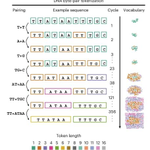
One of the rapidly progressing areas in applying language models to biology is the development of next-generation tokenizers. In contrast to human languages, where words naturally serve as tokens, biological languages like DNA lack clear word boundaries, leading most foundational models to simply use individual bases as tokens.
In a recent paper published in
#NatureMachineIntelligence by Melissa Sanabria Rosas et al., the authors introduce byte-pair tokenization (#BPE) to develop a new foundational model for DNA. BPE replaces the traditional "1 nucleotide = 1 word" approach with a more flexible method of defining tokens, which will likely resonate well with biologists. This strategy naturally expands the vocabulary while reducing prompt size, potentially enabling the model to handle longer inputs more effectively.
While this is undoubtedly an elegant and high-quality paper, what remains unclear to me is how such foundational models can be leveraged to address our most significant challenges. The downstream tasks described in the paper, which focus on predicting promoters and binding sites, align with those in other DNA foundational model studies—valuable tasks, but not groundbreaking. The question is, can we develop better benchmark data? More importantly, can we frame our most pressing challenges in precision medicine or biomarker discovery as inputs for biological large language models?
We invite you to follow @Converge_Bio to learn more about how we harness cutting-edge foundational models like GROVER, alongside enriched labeled datasets and an algorithmic application layer, to propel innovation throughout the life sciences.

1
16
683
Our CEO, Dov Gertz is speaking today at #AWSReInvent2024, joining @awscloud (AWS), LatentLabsAI and @InSilicoMeds for a panel discussion on how #GenerativeAI is revolutionizing #DrugDiscovery.
The panel will explore how startups are leveraging AWS to accelerate innovation, streamline drug discovery, and drive advancements in #healthcare and #lifesciences.
Join the conversation to gain insights into the future of AI-driven drug discovery and development.
Learn more here: reinvent.awsevents.com/
#AWSReInvent2024 #LasVegas #BiotechInnovation #HealthcareTech #AWS
