

Dry jokes from a tired universe 🌌 Space facts + sarcasm. More on Facebook ↓
Joined October 2026
- Tweets133
- Following4
- Followers6
- Likes10



Name a chore that would be worse in space.
I'll start: folding a fitted sheet. It's already impossible down here, and down here the sheet at least stays where you drop it.
1
4
Real answer from orbit: clipping your nails. On the space station, astronaut Chris Hadfield clips his over an air-intake vent so the clippings get pulled into the filter instead of floating into someone's eye. One still got away. He admits it on camera.
Canadian Space Agency video: youtube.com/watch?v=xICkLB3v…

4
Astronauts say space has a smell.
They can't smell it out there, but after a spacewalk, when the helmet comes off, it hits them. The descriptions NASA collected: hot metal, gunpowder, "seared steak," and "sweet-smelling welding fumes." One ESA astronaut said walnuts and motorcycle brake pads.
So we left the planet, and the universe smells like a man grilling in his garage while fixing the truck.
What does your car smell like right now? Be honest.
1
6
Source, from NASA Ames, with astronaut quotes from Pettit, Chamitoff and Gerst: nasa.gov/space-science-and-a…

6
The Sun is white.
Seen from space, it gives off every color of visible light at once, and your eyes blend them into white. Down here, our air scatters some of the blue away, so it looks yellowish from the ground.
Every kid's drawing has been wrong for generations, and nobody told the crayons.
What "fact" did you believe way too long?
1
12
A century ago, a lot of astronomers thought the Milky Way was pretty much the whole universe.
Then on Oct. 6, 1923, Edwin Hubble noticed a star in the Andromeda "nebula" that brightened and dimmed on a schedule. He'd marked it "N" for nova. He crossed that out and wrote "VAR!"
That one star put Andromeda way outside our galaxy. Astronomer Harlow Shapley reportedly called Hubble's letter "the letter that destroyed my universe."
Now we know there are billions of galaxies out there.
I've also had a letter destroy my universe. It was from the county. About my property taxes.
1
11
Source: NASA on the star that changed the universe science.nasa.gov/missions/hu…

4
Mars has a season that lasts about six months. My "I'll clean the garage this weekend" season has lasted three years.
Our 2027 space-fact calendar, print-at-home, $6: ko-fi.com/cosmicsarcasm/shop…
What's your longest "this weekend" project?

11
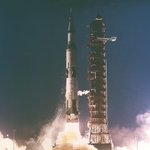
59 years ago today, the rocket that took us to the Moon flew for the very first time.
On Nov. 9, 1967, NASA launched the first Saturn V, 363 feet tall, with nobody on board. It was the first time all three stages flew together, and the whole thing worked.
It shook the ground so hard that Walter Cronkite's broadcast booth miles away started shedding ceiling tiles on live TV.
Twenty months later, the same kind of rocket carried three men to the Moon.
Meanwhile I need three tries to get the lawn mower started.

5
59 years ago today, the rocket that took us to the Moon flew for the very first time.
On Nov. 9, 1967, NASA launched the first Saturn V, 363 feet tall, with nobody on board. It was the first time all three stages flew together, and the whole thing worked.
It shook the ground so hard that Walter Cronkite's broadcast booth miles away started shedding ceiling tiles on live TV.
Twenty months later, the same kind of rocket carried three men to the Moon.
Meanwhile I need three tries to get the lawn mower started.

1
7

Jupiter's Great Red Spot is a storm wider than Earth, and astronomers have been watching it since at least the 1830s.
It's also been shrinking for about 150 years. Back in the late 1800s it could fit two or three Earths. Now it's down to roughly 1.3.
Nearly 200 years old and getting shorter every decade. Jupiter, we have the same doctor.
12
About a century ago, a lot of astronomers thought the Milky Way was pretty much the whole universe.
Then in 1923, Edwin Hubble found a pulsing star in the Andromeda "nebula" and worked out it was way too far away to be in our galaxy. Andromeda was a whole other galaxy.
When astronomer Harlow Shapley read Hubble's letter about it, he reportedly said, "Here is the letter that destroyed my universe."
Relatable. I feel the same way about every letter from my health insurance.
1
13
The Moon is drifting away from Earth about 1.5 inches a year.
That's roughly how fast your fingernails grow.
So after 4.5 billion years of watching us, even the Moon is slowly backing out of the conversation.
(We know because scientists bounce lasers off mirrors the Apollo astronauts left up there.)
6
Sunlight takes about 8 minutes to reach Earth.
So you're always seeing the Sun as it was 8 minutes ago. (Don't stare at it to check.)
Same delay my brain has when someone says "quick question."
10
A sugar-cube-sized piece of a neutron star would weigh about a billion tons on Earth.
Which is roughly how I'll feel after Thanksgiving dinner this month.
9
The Apollo astronauts' footprints are still on the Moon.
No wind, no rain, nothing to wipe them away. They could last millions of years.
Meanwhile my New Year's resolutions don't make it to January 9.
12
A day on Venus is longer than its year.
It takes 243 Earth days to spin once, and only 225 to go around the Sun.
Finally, a place where Monday technically never ends.
9
Saturn is less dense than water.
Drop it in a big enough bathtub and it would float.
You'd just need a tub about 75,000 miles wide. And yes, it would absolutely leave a ring.
(Saturn's average density is about 0.69 grams per cubic centimeter. Water's is 1.)
7
30 years ago today, NASA sent a Mars orbiter for a two-year job.
It stayed for ten.
Mars Global Surveyor launched Nov. 7, 1996, mapped the entire Red Planet, and found signs that water still flows down Martian hillsides.
Its last message home came in November 2006. It's still circling Mars — the coworker who never clocked out.
7
8 years ago today, a spacecraft launched in 1977 left our solar system.
Voyager 2 was built for a five-year mission. On Nov. 5, 2018, it crossed the edge of the Sun's bubble, more than 11 billion miles from home.
It's still out there, still calling home, farther than any of us will ever go.
Where were you in 2018?
Image: NASA/JPL-Caltech

1
17
The Taurid meteors out this week are crumbs from Comet Encke. They're slow and sometimes bright, so if you see a lazy fireball this month, that's a comet's leftovers from thousands of years of laps around the Sun. Anyone caught one yet?
98
You can't dust the Moon.
Wipe moon dust off a camera lens and it scratches it. Blow on it? There's no air. It just clings.
Why: on Earth, wind and water have rounded off sand grains for billions of years. The Moon has neither, so its dust is still sharp, like crushed glass. Sunlight also gives it a static charge, so it sticks to everything.
Apollo crews tracked it into the lander and said it smelled like spent gunpowder. Some got what they called "lunar hay fever."
The fix NASA tested on the Moon in March 2025: an electric grid built into the glass that lifts the charged dust right off. It cleared about 97% of the dust from a glass surface. No brush, no water.
Meanwhile I still own a feather duster that just moves my dust to a new shelf.
What's the one household chore you'd outsource to NASA?
11