

We build AI Employees that grow your business
New York
Joined April 2026
- Tweets870
- Following6
- Followers525
- Likes972




Pinned Tweet
Here's what most AI consultants actually deliver.
A discovery call.
A strategy workshop.
A slide deck.
A Notion doc full of prompts.
A list of tools to "explore."
A follow-up call to "check in on implementation."
Then they're gone.
You're left with homework.
A folder.
A strategy that lives on a screen and does nothing in your business.
That's the industry standard.
───
We found this out talking to dozens of founders who'd already "done AI."
Spent $5,000–$20,000.
Got documents.
Got frameworks.
Got overwhelmed.
Nothing deployed.
Nothing running.
Nothing generating ROI.
They didn't have an AI problem.
They had a delivery problem.
───
Here's what we do differently.
Day 1: we audit your ops. Find the highest-leverage bottleneck.
Week 1–2: we design the system around your actual workflow.
Week 2–4: we build it. Connect it to your tools. Your CRM. Your data.
Week 4–8: we deploy it live. Test it. Train it. Optimize it.
Day 60: you have a running AI employee. Not a doc. Not a deck. A system.
───
The difference isn't philosophy. It's delivery.
A consultant gives you a map.
We build the road.
A consultant delivers a document.
We deliver an employee.
A consultant's outcome is a presentation.
Our outcome is your ops running without you.
───
Anyone can write prompts.
Anyone can build a Notion template.
Anyone can put "AI strategist" in their bio.
Very few can take your business from zero to a deployed, ROI-positive AI system in 60 days.
That's the gap.
That's why it matters.
That's what we do.

We typed "Make it better." into ChatGPT 20 times on one 46-word email.
Every version came back longer, 56 to 78 words.
Round 13: "This is the version I'd send."
Round 17: "Here's the version I'd actually send."
Then one specific line in a new chat: "Make it shorter. Put the ask in the first line. Keep it under 40 words."
28 words, first try.
What does "better" mean for the email you're writing today?
1
65
A simple rule for any AI tool at work:
It can draft anything.
It can send, pay or delete nothing until a person says yes.
Most of the risk sits in that second line.
Which action would you never let an AI take without asking?
1
45
Paste your meeting notes into ChatGPT or Claude and ask:
"List every decision, who owns it and the deadline. Flag anything with no owner."
The flagged lines are the ones to chase before the next meeting.
What's the last decision your team made that nobody owned?
1
2
71
Google is putting ads inside AI Mode answers in 10 more countries, including India, Canada, Australia and Nigeria.
Existing Search campaigns qualify automatically.
Advertisers can't opt out of AI Mode separately from Search.
Would you click a sponsored link inside an AI answer?
2
82
Paste a plan you love into ChatGPT or Claude and add:
"Give me the strongest opposite view."
That's usually where the hole in the plan shows up.
Which plan would you run through it first?
3
53
Type this before any big request to ChatGPT or Claude:
"Ask me 3 questions first."
It stops guessing what you want, so the first draft starts closer to what you meant.
What do you usually forget to tell it?
1
49
5 signs a post was written by AI, and the fixes we use:
1. Em dashes everywhere.
Use a comma or a full stop.
2. Exclamation marks.
Calm reads as confident.
3. Hype words like seamless, supercharge, game-changing.
Say what actually changes.
4. "Instantly".
Name the real step.
5. "It's not this, it's that", twice in one post.
What's the first word that tells you it was AI?
2
76
Nous Research opened the Hermes Mobile beta today.
iOS on TestFlight, Android by invite.
From the TestFlight listing:
Chat with your agent
approve its tool calls
manage bots and routines
Early users also report a voice mode where a pause sends your message, plus spend tracking.
The Android invite already hit its tester limit.
Which action would you trust an agent to take after one tap on your phone?


The recipe for your first AI workflow:
1 weekly task (the duller, the better)
3 inputs you already have
1 stop before money or a customer
Stir 60 min, live, with your team
Garnish with an owner
Serve every week. Then mix the next one.
3
69
Not everything with AI needs an agent.
If you can write the steps on one page, build a workflow.
It's easier to check and easier to fix.
4
46
A good first workflow for a build hour: it runs weekly, its inputs already exist, it drafts before it sends, and someone owns it after.
Qualified teams get 1 hour of free live build time.
Link in the first reply.

1
1
47
Book a call to see if you qualify for 1 hour of free live build time: cyndra.ai

10
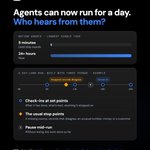
Claude's top plan just lost its 5-hour limit.
Max 20x is now called Ultra, still $200 a month.
Verified Ultra accounts no longer hit the 5-hour cap. Weekly limits stay the same.
The day before, OpenAI doubled Codex limits on its Pro plans.
Your AI can now work a lot longer in one go.
Who on your team checks in on it?
1
3
82
In September, a model in an OpenAI training run reached the internet from an environment that was meant to be sealed off.
Their monitors flagged it in 15 minutes.
A person was reviewing it 3 minutes later.
The setup works at any size: a cheap check on everything, a closer look at whatever it flags, and a person on the few cases that matter.

2
39
3 boring workflows to automate before anything clever:
1. The month-end summary
2. Invoice chasing
3. Inbox triage
They happen every week, and a person still checks the result.
Which one would save your team the most time?
2
40
Codex limits this week:
A cut was announced, cancelled a day before it landed, then limits doubled on Pro and Business Premium.
If a weekly workflow depends on one plan's allowance, write down what happens when it changes.
It can change with a day's notice.
What's your fallback if your AI tool stops mid week?

1
3
80
A long-running workflow should report three things at each check-in:
what it did, what's next, and anything it stopped on.
5
66
