

I'm just a tool builder. • Elon Musk - “Worth following” • Charlie Kirk - “You're a must follow” • Contact: datarepublicanx@proton.me • Substack: datarepublican
Joined October 2020
- Tweets36.7K
- Following5.2K
- Followers1M
- Likes109K







Pinned Tweet
🚨🚨 THE DEMOCRACY FILES / THE INSURRECTION PLAYBOOK, SPECIAL EDITION: ON CROSSING THE RUBICON 🚨
Many people on 𝕏 are calling for elections to not to be certified, or for Trump to not to seat the new Congress on January 3rd.
In a sense, attributing 2026 results to cheating is too narrow of a way to look at a much larger and a much worse problem.
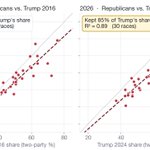
The problem isn't that machines decided to flip 15% of Republican votes and stole the 2026 midterms from us.
The problem is that our elections are untransparent, monopolized by mysterious NGOs, and set up institutionally such that they are impossible to challenge or audit honestly.
I wrote a book, UNELECTED. It lays out the whole NGO Administrative Complex and how they have monopolized virtually every facet of our ordinary society and perform functions through, above, and despite Congress. This is what they do. They cut off every single plausible path to their own reform.
The last two chapters explain my remedy, but I do not believe these chapters are easily approached without reading the other 300+ pages first. And I've had fans compare it to "A Brief History of Time" in complexity ... while I wouldn't go that far, it is an enormous problem with an enormous network that developed over an enormous amount of time.
The good news is that our anger at finding out about this, and our lashing out at all this is the epistemic bubble popping. Regimes don't last long after that.
The bad news is - to borrow a phrase my friend uses - there are many ways to lose, and few ways to preserve our Republic.
I'm not here to tell you that President Trump shouldn't use the 2026 elections to force a showdown.
I'm here to tell you what happens if he does. If he goes down this route, he better treat it like crossing the Rubicon.
Pray for peace and wisdom for the administration as they deal with the many difficult decisions ahead.
Watch the video with an open mind and heart.
DataRepublican (small r) retweeted

Last week, during MIDTERM VOTING a White woman was beaten, kicked, and hit in the head INSIDE THE POLLING LOCATION by multiple Black women.
Not a single media outlet covered this.
Not one.
...but 2 White girls make monkey gestures and it's the #1 story today
DataRepublican (small r) retweeted

🌾 CONGRESS IS SLIPPING AMNESTY INTO A FARM LABOR BILL
Don't take my word for it. Read the official summary from the Congressional Research Service.
H.R. 9535, the "Securing Agriculture's Workforce Act." Sponsored by House Agriculture Chairman Glenn Thompson. 61 cosponsors, 52 of them Republicans.
One line tells you everything. The bill "establishes an H-2A visa pathway for current unauthorized agricultural workers who otherwise meet requirements."
Current unauthorized workers. People who are here illegally right now.
The sponsor's pitch: "With the border now secure, it is time to address these shortcomings."
The border is more secure because we finally started enforcing the law. You don't reward that by handing a visa to the people who broke it.
And the timing couldn't be worse. Monday night the President said, "We haven't put the same pressure on waitresses and on farmworkers, etc. Not even close." That's exactly the opening this bill's supporters have been waiting for.
We've seen this movie before. In 1986 Congress created the Special Agricultural Worker program, and it was riddled with fraud, with applicants claiming farm work they never did. My career taught me that every carve-out turns into a business model. Make farm work the safe lane and the fake employment letters will show up by the truckload.
Farmers have a real labor problem and I'm not dismissing it. Fix H-2A. Speed it up. Cut the red tape. Let it run year-round. That's legal labor and I'll support it.
But a visa for people who are here illegally isn't a workforce plan. It's amnesty in overalls.
Call your representative and ask one question: are you one of the 61?
@POTUS @StephenM @RealTomHoman @SecMullinDHS @ICEgov @HouseAgGOP @CongressmanGT @Jim_Jordan @JudiciaryGOP @Phase2Deport @NICEnforcement @itsyourgov

DataRepublican (small r) retweeted

So let me get this straight.
Are you alleging that everyone up and down the chain of command from Trump to the drone operator killing narcoterrorists has committed "war crimes"?
Answer the question.


DataRepublican (small r) retweeted
Amazing article here by @iamlisalogan.
lisalogan.substack.com/p/the…
Reject multipolarity in all its forms. It’s not “America First.”

🔥BREAKING: Here are the texts between Tucker Carlson @TuckerCarlson when he was in Moscow, Russian intel-linked "Elizabeth Lane" @imelizabethlane and Tucker's producer
Lane arranged for Tucker to receive Russian GRU disinformation agent John Mark Dougan's book.
Dougan is a fugitive who was embroiled in scandals as the deputy sheriff in Palm Beach County.
He claimed that he stole Epstein Files and brought them to Russia.
Lane was trying to arrange for those "Epstein Files" to be transferred from the Russian GRU to Tucker & @SenRonJohnson (R-WI)
✅Many more stories like this have been broken on my new podcast that started in June, "The Counteroffensive." It is 100% viewer-supported so if you want it to continue, please help out at RyanMauro.com.


DataRepublican (small r) retweeted

REPUBLICAN STATES DARE TO REWRITE THE CONSTITUTION / THE AUDACITY!!! /
If you are not already livid with the Republican Party, this video will make your blood boil.
The National Popular Vote Interstate Compact (NPVIC) is an agreement under which participating states pledge to award all of their electoral votes to the winner of the national popular vote once those states collectively hold at least 270 electoral votes.
If activated, would decide the presidency by national popular vote (mob rule).
Legal scholars posit that this violates the Constitution on multiple grounds, and the Supreme Court would have substantial grounds to review and potentially invalidate it. The Court has never decided the issue, but the arguments are well developed in legal scholarship and are non-frivolous.¹
The leading objection rests on the Compact Clause of Article I, Section 10, which bars states from entering any agreement or compact with another state without the consent of Congress.
Supreme Court precedent requires consent for political compacts that increase the power of the participating states relative to the federal government or non-participating states, as recognized in Virginia v. Tennessee and U.S. Steel Corp. v. Multistate Tax Commission.
Derek T. Muller has argued in detail that the NPVIC is precisely such a compact: it becomes operative only upon reaching a critical mass of states, restricts unilateral withdrawal near an election, and enhances the political power of member states at the expense of non-members and the constitutional design of presidential selection.²
Ian J. Drake reaches a similar conclusion in Publius: The Journal of Federalism, contending that the compact is the type of agreement the Supreme Court would find requires congressional approval because it alters the federal structure of presidential elections and affects the interests of non-compacting states.³
Even under narrower readings of the Compact Clause, the NPVIC falls within the category of political agreements that encroach on the balance of power among the states and the federal system.
A second core argument arises under the Electors Clause of Article II, Section 1, which provides that each state shall appoint electors “in such Manner as the Legislature thereof may direct.”
While the Supreme Court has described this power as broad, including in Chiafalo v. Washington (2020), critics maintain that it does not authorize a state to appoint electors based on votes cast outside its borders.
Norman Williams has written that it is inconceivable the Framers empowered states to appoint electors according to popular sentiment outside the state, comparing the practice to outsourcing the appointment to an election in a foreign country.⁴
Joseph A. D’Angelo’s analysis in the University of Florida Journal of Law & Public Policy similarly concludes that directing electors to disregard a state’s own voters in favor of the national tally lacks historical precedent, conflicts with the state-based structure of the Electoral College, and exceeds the authority granted by Article II.⁵
The Framers considered and rejected a pure national popular election, and no state has ever appointed electors on the basis of out-of-state results.
Chiafalo itself tied state control of electors to the will of the state’s own voters and to settled historical practice, which undercuts rather than supports the compact.
Further objections include equal-protection and due-process claims under the Fourteenth Amendment.
By aggregating votes cast under differing state rules on felon disenfranchisement, voter identification, and ballot access, the compact treats similarly situated voters differently without a uniform standard.
It also nullifies the votes of citizens in a member state when their state’s popular-vote winner differs from the national winner.
Structural critiques, advanced in pieces such as Paul E. Godek’s Cato Institute analysis and a Harvard Journal on Legislation note on “Combination Among the States,” emphasize that the compact effectively amends the presidential-election provisions of the Constitution without complying with Article V’s requirement of ratification by three-quarters of the states.⁶
The Guarantee Clause and principles of federalism are invoked on the ground that the arrangement undermines the republican, state-based system established by the Constitution.
If the compact reached the 270-vote threshold and were applied in an election, litigation would be nearly certain.
Non-member states, voters whose ballots were overridden, or a losing candidate could bring suit, and state-versus-state controversies fall within the Supreme Court’s original jurisdiction.
The constitutional questions, particularly under the Compact Clause and a limited construction of Article II, are substantial enough that the Court would have solid grounds to take the case and potentially invalidate the compact.
The outcome would depend on the precise doctrinal theory adopted and the Court’s composition at the time.
Textualist and structural arguments weigh against the NPVIC. The proponents argue about the broad wording of the Electors Clause and the absence of an express prohibition supports their position.
Until the Court rules, the constitutionality of an activated compact remains an open and closely contested question, as noted by the Congressional Research Service and multiple election-law analysts.⁷
Advocacy for the compact has continued despite these legal obstacles.
Saul Anuzis, the former chairman of the Michigan Republican Party, serves as a consultant and public advocate for National Popular Vote Inc., the nonprofit organization promoting the interstate compact.
Over the five fiscal years from 2021 through 2025, the organization reported total revenue of approximately $8.45 million and total expenses of roughly $8.39 million, averaging about $1.69 million in annual revenue.
Anuzis has stated that he has spoken to thousands of Republicans and legislators across 32 states and has delivered hundreds of speeches on the subject.
According to Anuzis, before President Trump’s election the compact had seven states on the verge of passage, and he was actively canvassing Missouri, Tennessee, Utah, Nevada, and Nebraska.
Anuzis has further claimed that in Nebraska the measure came within two votes of overriding a veto.
Notes
1. For an overview of the principal constitutional objections, see “What Constitutional Challenges Have Scholars Raised about the National Popular Vote Interstate Compact?,” Factually.co, accessed November 2026.
2. Derek T. Muller, “The Compact Clause and the National Popular Vote Interstate Compact,” SSRN, April 2, 2012, papers.ssrn.com/sol3/papers.….
3. Ian J. Drake, “Federal Roadblocks: The Constitution and the National Popular Vote Interstate Compact,” Publius: The Journal of Federalism 44, no. 4 (Fall 2014): 681–701.
4. Norman R. Williams, “Why the National Popular Vote Compact Is Unconstitutional,” Brigham Young University Law Review 2012, no. 5 (2012): 1523–79.
5. Joseph A. D’Angelo, “Federalist Foundations: A Critique of the National Popular Vote Interstate Compact,” University of Florida Journal of Law & Public Policy 36 (2026): 347–64.
6. Paul E. Godek, “The Unconstitutional Compact to Nullify the Electoral College,” Regulation, Fall 2026; and “Combination Among the States: Why the National Popular Vote Interstate Compact Is an Unconstitutional Attempt to Reform the Electoral College,” Harvard Journal on Legislation (2018).
7. Rick Hasen, “Impending Legal Challenges Facing the National Popular Vote Compact,” Election Law Blog, November 9, 2026.
DataRepublican (small r) retweeted

This is one of the best Veterans Day gifts I’ve been given. From the kids of the Southern small town of Waveland #Mississippi

DataRepublican (small r) retweeted

The latest Counterlawfare interview features Jeff Clark, one of the sharpest legal minds in America. Elite lawyers rarely join MAGA, much less serve in a Trump administration. Jeff did both. I’m convinced they went after him so viciously because they could not allow him to be AG.

DataRepublican (small r) retweeted

You asked for a viable path forward. Here's one.
You're right that charts don't meet a court's standard. The reason is that the records that would settle it mostly aren't published. So make them public:
1. Every state reports how it checks citizenship and how many registrations it checked.
2. Every state reports what it flagged, confirmed, removed and referred, counted the same way.
3. Prosecutors publish how every referred case ends.
4. Every state makes the record of who voted available, with privacy protections.
5. Every county publishes its ballots counted against voters checked in.
6. In the closest races, the flagged names get matched against who voted, one by one.
All six can pass through legislatures, which is your point 4.
digitalgunny.substack.com/p/…
DataRepublican (small r) retweeted
Too many people like to throw accusations without actually reading what is written.
Election fraud ABSOLUTELY, POSITIVELY did happen in the 2026 election, and if you allege that I don't believe that, then you get an insta-block. I'm sick of the lies.
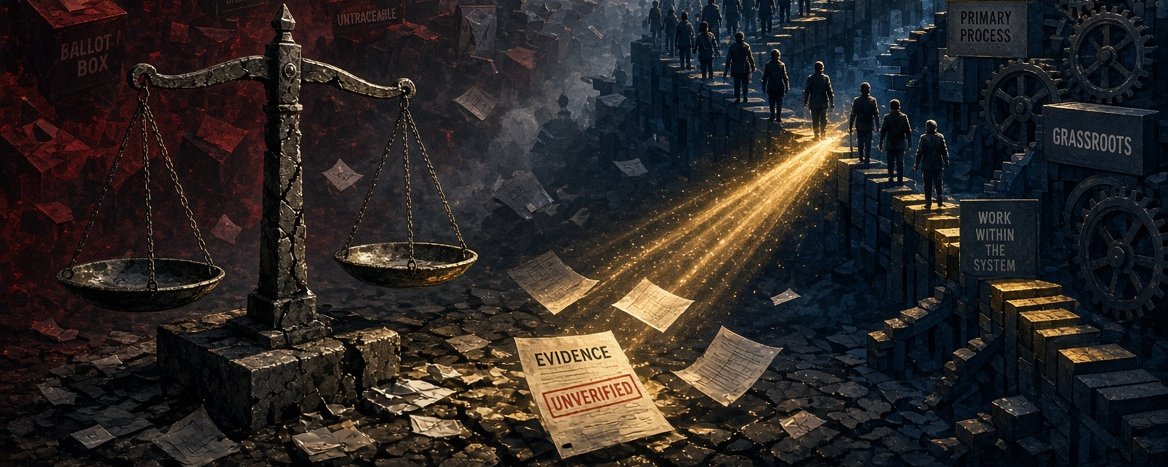
The issue is that the Democrats, over decades and through legislation at state and national levels, have engineered election procedures such that it is impossible to prove the fraud to a reasonable evidentiary standard in a court of law.
IMPOSSIBLE. The lack of accountability built into their laws not only makes fraud easy, it makes it basically impossible to prove the fraud in a way where results can be challenged legally in an effective way.
Make all the charts you want. If you cannot meet a court's evidentiary standard, you are accomplishing nothing productive.
Unfortunately--and this is the hard truth no one seems to want to address--the only way to undo this is the same way it happened, by winning elections and then passing reform legislatively.
(And yes, we CAN win elections, see 2024.)
My article explains.
DataRepublican (small r) retweeted

🚨EXCLUSIVE: PERSONAL TEXTS REVEAL "ELIZABETH LANE" @imelizabethlane WAS GO-BETWEEN FOR TUCKER CARLSON & RUSSIAN INTEL DISINFO OPERATIVE JOHN MARK DOUGAN🚨
Russia-linked Lane sought to deliver alleged Epstein Files from Dougan to Tucker & Senator Ron Johnson
Dougan's book was delivered to Tucker's producer while he was in Moscow
On July 31, 2026, Elizabeth & Tucker attacked me throughout their 2-hour podcast for exposing her ties to Russian intelligence. Both denied having links to Russia.
In September, we broke the story on my podcast that Tucker Carlson was listed on the media advisory board of a new Russian psyops supergroup known as MKNE led in part by Alexander Dugin.
MKNE leaders openly sought to wage "information warfare" on America through an aligned "family of podcasts." They explicitly named Tucker Carlson as someone whose help they sought.
✅Don't forget to subscribe to my podcast "The Counteroffensive" on YouTube, X, Spotify, FB, Rumble, etc. and please consider helping me continue this work with a tax-deductible donation at RyanMauro.com!

DataRepublican (small r) retweeted

Happy Veterans Day! Blessings and much thanks to all of our veterans! It's a calling and a sacrifice. I come from a long tradition of military service in my immediate family:
My dad and father-in-law (both WWII)
My brother
3 brothers in law
Husband
Nephew
Grandson
Much respect to all who have served and are serving! 🙏🙏❤️❤️🇺🇸🇺🇸
DataRepublican (small r) retweeted

The acting U.S. Attorney in western Washington has told the chief judge his office will no longer defend many ICE detention habeas petitions. If no government lawyer appears within seven court days, judges may treat the case as unopposed. It's already happening: one judge has called a petition "intentionally unopposed" and ordered release within 24 hours.
Look at the reason he gave: The petitions are coming in such volume, "often copying from other petitions," that the office can't keep up. That's dozens a week and roughly 2,000 in that district since January 2025, and the border czar puts the national figure around 85,000.
I've been pointing at this model: 10 lawyers on a single Norm Eisen filing, AstroNGOs™️ stacked on amicus briefs. Template litigation at scale turns volume into a resource war the government can't staff. Whoever is behind a given petition, habeas is real and every detainee is entitled to an answer. That's exactly why the answer can't be release by attrition.
The fix is on the government's side of the ledger. Main Justice should surge lawyers to the districts that are drowning, use consolidated responses where petitions are copied, and press the bond-hearing question the Supreme Court is set to take up, which could resolve much of this volume at once. An unanswered petition isn't neutral. It's a policy decision made by whoever files fastest.
DOJ should not be set to relive the punishments of Sisyphus in Hades.
DataRepublican (small r) retweeted

'Unelected' asks a pretty simple question:
How much power in America is exercised by people nobody voted for?
amazon.com/gp/aw/d/B0GGYQNWH…
DataRepublican (small r) retweeted

Everything in this video by @DataRepublican sounds correct to me. It does not mean there wasn't fraud or that there is no solution.
1. The comparisons are to past elections that also lie within the "Era of Electronic Fraud", which I estimate began no later than 2007, as states enacted HAVA electronic voting requirements.
2. This video illustrates certain avenues of redress that are effectively closed off due to institutional capture, thus negating their value and unfit for purpose. That doesn't mean there isn't hope. It means we must look elsewhere for a solution.
3. The video has a warning. That almost any action Trump takes will play into the hands of our openly hostile communist enemies and the many traps they have set. This represents conditions as they are now, given what is known. There are unknown factors and changing conditions that may alter the severity of risk. Regardless, this does not mean that surrender is the best option.
It means we pray, and ask the world to pray for us, pray that God recognizes our sincere repentance and desire to return to being a faithful people. And then we seek out the opportunities God has made for us and take them, however impossible they may seem. Whatever else we do, there is no question it is not righteous to allow evil to reign. We saw what liberal rule was like during the Biden years: it was non-stop blasphemy. That is an affront to our future, our past, and our Creator.

🚨🚨 THE DEMOCRACY FILES / THE INSURRECTION PLAYBOOK, SPECIAL EDITION: ON CROSSING THE RUBICON 🚨
Many people on 𝕏 are calling for elections to not to be certified, or for Trump to not to seat the new Congress on January 3rd.
In a sense, attributing 2026 results to cheating is too narrow of a way to look at a much larger and a much worse problem.
The problem isn't that machines decided to flip 15% of Republican votes and stole the 2026 midterms from us.
The problem is that our elections are untransparent, monopolized by mysterious NGOs, and set up institutionally such that they are impossible to challenge or audit honestly.
I wrote a book, UNELECTED. It lays out the whole NGO Administrative Complex and how they have monopolized virtually every facet of our ordinary society and perform functions through, above, and despite Congress. This is what they do. They cut off every single plausible path to their own reform.
The last two chapters explain my remedy, but I do not believe these chapters are easily approached without reading the other 300+ pages first. And I've had fans compare it to "A Brief History of Time" in complexity ... while I wouldn't go that far, it is an enormous problem with an enormous network that developed over an enormous amount of time.
The good news is that our anger at finding out about this, and our lashing out at all this is the epistemic bubble popping. Regimes don't last long after that.
The bad news is - to borrow a phrase my friend uses - there are many ways to lose, and few ways to preserve our Republic.
I'm not here to tell you that President Trump shouldn't use the 2026 elections to force a showdown.
I'm here to tell you what happens if he does. If he goes down this route, he better treat it like crossing the Rubicon.
Pray for peace and wisdom for the administration as they deal with the many difficult decisions ahead.
Watch the video with an open mind and heart.
DataRepublican (small r) retweeted

Did you read this screenshot carefully? It outlines in detail Jeffrey Epstein and Reid Hoffman creating a blueprint for Democrats to sabotage President Trump's federal budget cuts through a maze of billionaire-funded NGOs operating as a quasi-government. Now you know the real connection between Jeffrey Epstein's accomplice Reid Hoffman and the campaigns of Congressional Democrats that Hoffman funds.


The REAL Epstein Files: Bloated and habitually flatulent Rohit "Ro" Khanna, Congressional Democrats and the Democratic Party were so fattened from gorging on campaign contributions during the 2026 midterm elections from Jeffrey Epstein's obese bestie and Orgy Island visitor Reid Hoffman, that these same gluttenous Democrats found themselves unable to get up and scurry away from their Reid Hoffman-funded Release The Files Hoax.


DataRepublican (small r) retweeted
DATA REPUBLICAN: THE DEMOCRACY FILES / ILLEGITIMACY PLAYBOOK, PART 16: HOW THE MIDTERMS WERE PULLED OF!
In a previous podcast discussion with Dr. Paul Zeitz, political strategist and pollster Celinda Lake emphasized that preparation for the 2026 elections begins with a concentrated effort on massive voter registration across key underregistered populations.
Lake stressed the need to register everyone, pointing to substantial gaps in registration among several groups.
She specifically identified young people as the party’s strongest voting bloc yet massively underregistered, along with African American voters who remain massively underregistered in many locations.
Lake further highlighted Asian American Pacific Islander voters, noting that while few discuss this group, they voted 80 percent Democratic in New Jersey and Virginia and asking why that population would not be registered in large numbers.
Dr. Paul Zeitz raised concerns about potential risks surrounding the 2026 midterm elections in the event of a contested outcome and possible government overreach.
He noted that many people expected a contested election and that draconian measures could be employed by what he described as the MAGA Project 2025 regime, including possible invocation of the Insurrection Act.
One scenario he described involved invoking the act in a red state whose governor would readily comply, followed by the deployment of military forces, ICE officials, or National Guard units to blue cities within those states in order to suppress voter turnout and secure victory for a red candidate.
Zeitz asked what risks Lake saw in such developments and how democracy could be stabilized if those lines were crossed.
Dr. Paul Zeitz serves as a co coordinator of the Renew American Democracy (RAD) platform and enterprise, which forms a central element of the network of organizations and strategies that data analyst DataRepublican has mapped in her Democracy Files series.
RAD, developed in coordination with the Democracy Renewal Group of former USAID officers and linked to the Renew to Thrive initiative, advances a multi pillar approach organized around blocking perceived threats to democratic institutions, bridging divides, fostering belonging through civic engagement, and building new structures for governance, with power as a connecting element.
Zeitz, who also founded the "unifyUSA" movement, has participated in planning discussions, concept notes on reforms such as open primaries and ranked choice voting, and broader efforts toward what he has described as a third or fourth founding of American democracy through citizen led processes and deliberative methods.
DataRepublican’s reporting places these activities within a larger ecosystem of NGOs, federal worker alliances, and independent candidate efforts that, in her analysis, seek structural changes to American governance.
In the 2026 U.S. midterm elections, Democrats experienced large demographic shifts back in their favor, driven especially by substantial swings among young voters, Latinos, and Asian Americans relative to the 2024 presidential election.
National exit polls and early November 2026 voter surveys indicated that approximately seven in ten young Americans supported the Democratic candidate in their local U.S. House races, a sharp contrast to the near even split observed in 2024.
Latinos and Hispanics showed a dramatic 21 point swing toward Democratic House candidates compared with two years earlier, influenced by economic dissatisfaction with inflation under the sitting administration and backlash against strict immigration and deportation policies.
The Black population likewise registered a major backlash swing toward Democrats, fully reversing the inroads made by Donald Trump and Republicans in 2024. Black turnout reached historic levels resembling those of Barack Obama’s 2008 campaign, with total turnout in Alabama’s majority Black counties rising from 28 percent in 2022 to 44 percent in 2026, propelled by local organizing.
Thousands of NGOs had previously identified the groups they were targeting in an effort to produce a blue tsunami.
While election fraud remains possible, the scale and precision of this registration and mobilization operation, operating in connection with networks such as the RAD platform coordinated by Zeitz, largely explain why Republicans lost the midterms.
This video was published four months ago.
DataRepublican (small r) retweeted

@SeanParnellASW is a generational talent.

