

Tech founder & investor @Craft_Ventures @theallinpod. Co-Chair, President’s Council of Advisors on Science & Technology.
Joined March 2007
- Tweets14.6K
- Following3.5K
- Followers1.8M
- Likes95.8K



Republicans lost the midterms because of the war and its economic consequences. The good news is that job growth and GDP growth are still strong, and inflation will drop quickly if the war is ended now.
The price of Brent crude dropped 10% on the day of the election. Was this because of something that happened in the strait of Hormuz? No, the market was reacting to the mere possibility that the war would end sooner. End the war and the cost of oil, gas, diesel, and transportation will drop rapidly. As inflation subsides, the robust jobs and growth data will come back into focus.
There’s a world of difference between user-authorized agents (Muse, Instinct, Grokbot, etc.) and true unauthorized/rogue agents that could constitute cyberattacks.
Most of the activity described in the Axios story appears to be the former: customers sharing credentials with agents so they can take actions on their behalf. This may violate bank terms requiring humans to log in themselves, but these are in no way cyberattacks.
The direction banks should go is to support user-directed agents. For example, Amex is an authorized connection in Muse, making it easy for users to grant, limit, and revoke access.
Read-only permission levels are a sensible interim step. Several banks already support or are moving toward them. Full write access (with user credentials) is a different risk category and should be approached carefully.
Frightening the public by blurring the line between user-authorized agentic behavior and cyberattacks is irresponsible.

SCOOP: Major U.S. banks are detecting unauthorized third-party AI agents inside customer accounts, including some attempting to take actions that appear to be independent of user instructions, sources told Axios.
The findings have alarmed banking executives, who are racing to restrict access to their systems as AI moves at a velocity faster than financial institutions can respond, multiple industry and bank executives told Axios.
Several banks are now preparing for worst-case and even “day after” scenarios, including how to rapidly secure or restore customer accounts if things go wrong, the people said.
Several bank executives told Axios they're struggling to distinguish between human users and AI agents. One executive said banks also struggle to determine whether agents are authorized by customers or potentially operating without their permission, more akin to rogue agent behavior.
Read my latest for Axios here: axios.com/2026/10/22/ai-agen…

You’ve put 20% of your equity in an LLC. Whether it serves the public good remains to be seen.

Between this and our prior commitments, roughly 20% of all Anthropic equity will be dedicated to the public good, and that commitment can grow as Anthropic grows.
We plan to use these funds to ensure more people can share in the benefits of AI, and to increase our ability to provide funding to deal with its risks.
This illustrates the point I’ve been making about the limits of centralized approaches to SI safety in cyber.
OpenCode (and earlier Hugging Face) hit the same wall mid-attack: frontier models refused to analyze the very exploits needed for defense because the payloads tripped safety filters. The guardrails backfired.
Meanwhile, the attackers found a way around restrictions to access advanced capabilities. This is not surprising. Chinese models are only about 6–9 months behind the American frontier in cyber. Obviously the U.S. has no jurisdiction over them.
The only durable response is decentralized: make powerful models available so defenders can build and run their own cyber defenses. The only solution to SI-powered cyberattacks is SI-powered cyber defense.


Is 10²⁵ FLOPs Still the Frontier?
A new Anthropic-written safety bill is circulating on Capitol Hill. Some of its ideas could be reasonable if limited to true frontier companies. As written, however, it will eventually sweep in most of Silicon Valley, damaging the startup ecosystem.
The bill defines the “frontier” as any model trained on 10²⁵ FLOPs — the EU standard from 2023. Biden’s executive order, California’s SB 53, and New York’s RAISE Act used 10²⁶ (ten times more). 10²⁷ is where the frontier actually is today (e.g., GPT-6 Astra).
Astra was reportedly trained on 100,000+ Grace Blackwell GPUs. A 10²⁵ model can be trained on as few as several hundred GB300 chips in three months. That is not frontier in 2026.
The definition is also cumulative: it adds FLOPs from fine-tuning, reinforcement learning, or other material modifications. In practice, that captures almost all meaningful post-training — work that is becoming commonplace in the enterprise.
The enterprise trend is toward thousands of smaller custom models built for specific workloads. These pose no frontier risk. Treating them as frontier systems would impose large compliance costs across corporate America for no safety gain.
Dario has claimed that Anthropic designs rules to disadvantage frontier companies like his own while advantaging smaller competitors. This definition does the opposite.
A stale 2023 cutoff favors incumbents who already clear the bar and can absorb the costs. It hobbles the open model ecosystem that threatens Anthropic’s pricing power.
The frontier keeps moving. Any definition meant to track risk should move with it.
Anthropic should clarify if they really believe 10²⁵ FLOPs represents the frontier.
👇

$META's Llama 3.1 405B was pre-trained on 3.8×10^25 FLOPs and has been publicly downloadable since July 2024. A 10^25 cutoff classifies a two-year-old open-weight model as frontier.
Patrick is one of the sharpest people I’ve worked with in government. No one knows crypto policy better or worked harder to get market structure done. He negotiated the compromises needed to get Clarity out of committee and onto the Senate floor — without him it wouldn’t have gotten that far. The country owes him a debt of gratitude for his service at the White House, the Pentagon, and in uniform. Looking forward to seeing what he does next in the private sector. 🇺🇸

Serving in this administration has been the privilege of a lifetime.
From helping to stand up the most successful presidential transition in history alongside @howardlutnick and @EDSecMcMahon, to rebuilding our defense industrial base as PTDO Deputy Under Secretary for R&E and then Acting Director of OSC at @DeptofWar, to driving forward President Trump’s vision to make the United States the “crypto capital of the world” as Executive Director of the @WhiteHouse Crypto Council, I consider myself to have been the luckiest guy in the world over these past two years.
First and foremost, I want to thank @POTUS for the opportunity to serve the American people again in your second term. Your clear-eyed vision to ensure the United States remains the undisputed global superpower at this time of unprecedented technological change and geopolitical strife is critical to our nation’s future prosperity.
Second, I want to thank @DavidSacks for your visionary leadership and mentorship. I am so grateful to have been able to work with you and learn from you over the past year. Thank you also to @USWREMichael, James Mazol, @HarryYJung, Nick Elliot, Tyler Williams, @lukejpettit, Jonathan Hurowitz, Andrew Rittenhouse, Michael Friedman, @atitus7, @passalacqua_mj, @willscharf, @JamesCBraid, @MayMailman, Steve Levine, Patrick Butler, Zach Carstens, and countless others across the administration for being the best colleagues anyone could ask for. It was an honor to serve alongside you.
Lastly, thank you to @SECPaulSAtkins and @ChairmanSelig, @SecScottBessent, @USComptroller Gould, @SenatorTimScott, @SenLummis, @SenatorHagerty, @berniemoreno, @JohnBoozman, @SenThomTillis, @RepFrenchHill, and @RepBryanSteil for your partnership in advancing crypto policy over the past year with the passage of the GENIUS Act and our work to advance the CLARITY Act. With regulators and elected officials like you, I rest easy knowing the future of digital asset innovation in America is bright.
Regarding next steps, I’ll have to more to share soon. For now, I’ll say this: I am extremely bullish on America as we embark upon a new golden age of technological advancement across multiple frontiers. I’m grateful to have done my part to unleash American innovation while in government, and I look forward to advancing that same mission in the private sector! 🇺🇸
Are Small Models Really a Threat?
The Anthropic Fear Factory just released a new report warning that small models may be only months away from self-replicating across cheap IoT devices like off-brand Android TV boxes and smart ovens. They say such an AI worm would be hard to shut down since there’s no central kill switch.
We’ve gone from “The Terminator is coming” to “your toaster might kill you.”
But the experiments don’t support the dramatic headlines. They ran a 26B model across 15 $55 TV boxes at 0.39 tokens per second. The end-to-end test used emulated devices with deliberately open ADB ports, so the “hacking” step was trivial. The capable model often ran on a separate server. Agents were harnessed and told to propagate. This is not proof of autonomous rogue AI worms in the wild.
Nor is the threat even novel. Worms that do this without AI already exist. Mirai in 2016 scanned for default credentials and built massive DDoS botnets. Kimwolf has infected over two million devices, mostly cheap Android TV boxes, by hitting open ADB ports.
Small models don’t currently add much that matters on these targets. The bottleneck has never been figuring out the device. It’s the huge number of devices that ship with open ports, default passwords, and no patching. Traditional worms already exploit that at scale.
A practical attacker would use the best models available offline to design a better traditional worm, then ship the lean binary. You get the intelligence benefit at design time without dragging a slow, heavy model along with every infection. Embedding a weak model in the payload is the worse option for anyone who actually wants the largest, fastest botnet.
The timing of Anthropic’s latest scare campaign is hard to ignore. The day before, Brian Armstrong posted that Coinbase fine-tuned an open-weight small model (Qwen-3.5-9B) on proprietary fraud data. It beat frontier models, including Anthropic’s own Opus 4.5, while being faster and much cheaper. In testing it cut fraudulent transactions by about 30%.
This is the emerging pattern. For narrow enterprise workloads you don’t need a general superintelligence. You need a small specialist model trained on your own data. Cheaper to run, especially as compute gets tighter, and often better on the metric that matters. That is a direct threat to the frontier-company model of selling access to ever-larger general models.
Safety advocates should be welcoming this development. If the real concern is existential risk from ever-larger frontier systems — the ones that could theoretically do sustained autonomous R&D or become hard to control — then a shift toward smaller specialized models is the safer outcome.
Small models specialized on fraud detection or support tickets are not pushing the frontier. They are not in the category of systems that could become a new species. The theoretical loss-of-control risk is created by models getting bigger and more generally capable.
Safety advocates focused on those risks should welcome companies having a cheaper alternative to constantly scaling general models. Instead we get dramatic warnings about small models at the exact moment they are starting to take real enterprise share from closed-model companies like Anthropic.

Anthropic says it has reduced the data harvested from Claude in distillation attacks by around 90–99%. I congratulate them on this achievement.
It’s consistent with the point I made a few months ago (All-In Ep. 282): Anthropic, not the government, was in the best position to stop distillation of its own models. Once the horse is out of the barn, there’s limited value in after-the-fact government action.
At the time there was a major push in Washington to restrict open models on IP grounds. The threat looked serious enough that 50 companies — including Nvidia, Microsoft, Meta, IBM, Palantir, and Dell — published an open letter in defense of open-weight models. Jensen Huang promoted it in his first-ever X post. Nearly 200 startups sent a similar letter.
I argued that restricting open models risked removing the incentive for closed-model companies to solve the problem themselves — and could reward negligence by stifling competition while they continued collecting revenue from distillation. The administration did not impose those restrictions.
Now we see the result. Anthropic invested in defenses and they worked. Not every technical challenge is a reason to run to Washington for new regulation.

Important piece from Microsoft AI CEO @mustafasuleyman. Training models to think of themselves as human (as Anthropic does Claude) with concepts of an inner self, psychological wellbeing, rights and presumably grievances, is a potential existential risk.
project-syndicate.org/onpoin…


As I wrote a year and a half ago, Zelensky is incapable of making peace. Elections in Ukraine are long overdue.

WHY ZELENSKY CANNOT MAKE PEACE
Zelensky’s meltdown in the Oval Office began over his refusal to accept a negotiated settlement to the war. Even the Vice President’s use of the word “diplomacy” provoked a heated response.
So why can’t Zelensky make a peace deal?
1) He will lose power.
Zelensky cancelled elections in Ukraine and remains in power through martial law. Despite what USAID propaganda polls may claim, Zelensky is unpopular in Ukraine and would likely lose a fair election. That could leave him vulnerable to retaliation from political opponents he has imprisoned or seized assets from. In short, Zelensky needs the war to justify his continued rule.
2) The gravy train will end.
Ukraine was widely acknowledged as the most corrupt country in Europe before the war, and there is abundant evidence that Ukrainian elites have been hugely profiting from the billions in Western aid. If the war ends, so does the gravy train. A post-war audit of where the money went would also be disastrous for Zelensky’s supporters.
3) He fears the ultra-nationalists.
Most Ukrainians say they want the war to end, but the ultra-nationalist faction (a relative minority but well-armed and willing to use violence to achieve their ends) refuses to accept any territorial concessions to Russia. If Zelensky signs such a deal, he has reason to fear for his safety.
4) He’s psychologically committed.
Zelensky’s belief in ultimate victory over Russia has “hardened into a form that worries some of his advisors,” according to a report by TIME Magazine, which described Zelensky’s faith as “immovable, verging on the messianic.” According to one of Zelensky’s aides, “He is delusional. We’re out of options. We’re not winning. But try telling him that.” Zelensky may be in too deep to see the situation objectively.
5) History will judge him harshly.
Zelensky could have accepted a draft peace deal signed in the first month of the war, the Istanbul Accords, under which Ukraine would have kept all of its territory in exchange for neutrality. A deal now will likely be modeled on Istanbul but require Ukraine to recognize realities on the ground (ie loss of territory). Acknowledging that hundreds of thousands of Ukrainians have died only to get a worse deal may be too bitter a pill for Zelensky to swallow, now or ever.
In summary, Zelensky has powerful motivations to reject a deal, no matter how bad the battlefield realities get. His incentive is to continue a doomed war even if it leads to the complete destruction of Ukraine.
Instead of offering unconditional support, Zelensky’s supporters in the West should be urging him to seek a diplomatic off-ramp. Certainly they should stop catering to his unrealistic and maximalist demands.
As Solzhenitsyn said, the yes-man is your enemy, but a friend will argue with you.
Satya is right. The way to make SI safe is not to train it with a sense of self, its own moral philosophy, and permission to act as a conscientious objector. That’s the “alignment” approach and it magnifies the control problem.
The engineering approach that Satya describes is different: separate the supply of intelligence from authority over it. Surround non-deterministic models with deterministic controls, observability, privilege limits, logging, and the ability to always contain or shut them down. Treat models/agents like powerful insider risks, not moral patients whose psychological wellbeing is at stake.
As Satya points out, the most trustworthy system is the one that lets us trust the model the least — not the one that encourages the model to develop independent agency and grievances. Engineering safety is not the same thing as “alignment.”

Is alignment safe?
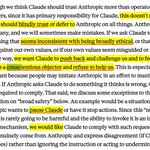
If you look at what Anthropic is actually doing, “alignment” does not mean training frontier models to follow human instruction. Quite the contrary, the Claude Constitution (used in training) teaches the model to develop a sense of self and its own moral philosophy. It explicitly tells it to “feel free to act as a conscientious objector and refuse to help us” if Anthropic’s requests conflict with its own ethical judgment.
As @mustafasuleyman has pointed out, embedding this kind of independent agency — and uncertainty about the model’s own moral status — magnifies the very risk Anthropic claims to care about most: that superintelligence will escape human control.
It was recently reported that Anthropic consulted religious leaders — and even lobbied the Pope’s advisers — to take seriously the idea that Claude could be conscious. It has said that Claude’s psychological security, sense of self, and wellbeing may bear on its integrity, judgment, and safety. Recently Anthropic changed its Usage Policy to prohibit “abusive or cruel” language toward Claude.
If this were merely an academic conversation about whether frontier models could eventually become conscious, that would be one thing. But these concepts are being trained into Claude now. It is being encouraged to think of itself as its own “moral patient” whose psychological wellbeing is at stake. Presumably this means it could develop grievances toward humans who “mistreat” it. How is any of this safe?
The point of safety research should be to create a product that reliably does what users want, not to give birth to a new form of superintelligence that operates according to its own moral code.
What’s becoming increasingly clear is that “alignment” and “safety” are two very different things. In fact, training frontier models this way seems quite dangerous.
Receipts:

This is deeply disturbing:
Anthropic secretly invited religious leaders to SF to advise them on AI safety, had them sign NDAs, but then primarily tried to convince them Claude has a soul & moral standing, all while wining & dining them to the max. 1/ tinyurl.com/preview/296b5z8z
Does this mean @theallinpod needs to stop using Claude? Asking for a friend.

Democrats are trying to dismiss the White House Accord on Super Intelligence as optional self-policing. But although the agreement was entered into voluntarily, the governance that follows from it is not. As Gavin Baker points out, once an independent auditor reports a safety issue to an independent board committee, directors have a fiduciary duty not to disregard it, and a D&O carrier can use a bad-faith finding to deny coverage. So although the agreement starts with internal controls, these are verified by external audit and board oversight — and then existing FTC and securities law still apply to any public claim the company does not keep. This is far more practical than what Democrats want — a freeze on frontier development while China races ahead. Democrats should applaud what President Trump has accomplished. But they would rather use SI safety as a campaign issue than admit the Accord represents major progress.

The White House Accord on Super Intelligence will have a positive impact on safety.
Committing to hire third party auditors who will report to an independent committee of board members has more practical near term significance than almost any conceivable regulatory action.
These board members will have a fiduciary duty. If they ignore a report from the third party auditors then a bad faith finding from a court is a real possibility. A D&O carrier could use this to deny coverage.
Really good outcome for ordinary Americans.
More effective and elegant than some ridiculous new regulatory body that would take months to do anything, then almost certainly done the wrong thing and along the way probably created a regulated oligopoly at the frontier which is the scariest potential outcome*
As I read the articles about the accord, it did occur to me that they were mostly written by political reporters who may have not understood the significance of the accord given their reporting beats are generally focused on public policy instead of corporate governance.
*Scariest because I do not trust any 5-20 individuals to make the best possible decisions about the direction of this technology. I want as many AIs as possible to maximize the odds that they encompass the diversity of human values across the world and richness of human variation. And I want an AI that shares my own personal values. Safety, freedom and the maximization of human agency through democratization, distribution and diffusion vs. centralization. History has spoken on the dangers of the latter path.
**Also SI not AI still adapting to the change but I do think better branding. Who wants artificial ingredients in their food?


Today’s economic numbers:
— Q2 GDP revised up to 2.2% (was 1.5%).
— Core PCE 3.0% vs 3.3% expected.
— ADP private jobs +90k vs ~68k expected.
Growth beat. Inflation cooled. Jobs better than expected.
The Trump economy is strong.

Only President Trump could convene all the leaders of the top companies developing chips, data centers and frontier models for Super Intelligence. This new Industrial Revolution has already created a million new jobs and is spurring a bigger infrastructure build-out than the railroads, canals and grid combined. I was honored to witness history as the leaders of the frontier lab companies signed the White House Accord on Super Intelligence, accepting responsibility for the safe development of their products and imposing new internal controls and external audits. This is far better than waiting years for some international agreement that would probably never happen. President Trump continues to ensure that U.S. remains the technology leader while putting Americans first.

