

Wachsende Dividenden | NASDAQ100 Fan
Freiburg
Joined May 2022
- Tweets4.7K
- Following2.6K
- Followers4.1K
- Likes17.1K






Was sind eure Top Werte YTD prozentual?
Bei mir:
🟢 Zcash +104%
🟢 Amgen +48%
🟢 Wolters Kluwer +46%
🟢 Warsaw Stock Exchange +43%
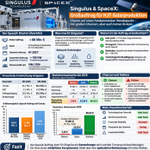
Die Aktie des deuschen Maschinenbauunternehmens Singulus geht heute steil +72%
Hintergrund ist ein Großauftrag von SpaceX für HJT-Solarzellen im Wert von über 60 Millionen Euro. Das entspricht ziemlich genau 70% des Jahresumsatzes
Ziel der Kooperation ist laut Elon Musk die Energieversorgung der Weltrauminfrastruktur für Starmind - künstliche Intelligenz im Weltall.
Als kleines, finanziell bislang fragiles Unternehmen macht der Deal für mich aber keinen Kauf aus der Aktie.
Eine so hohe Konzentration auf einen einzigen Kunden sehe ich eher als immenses Risiko - kann im Erfolgsfall natürlich aber auch hohe Chancen bieten.


Die Videos von @hi_personality stechen immer so krass aus meiner Timeline heraus

Auflösung!
Ihr habt gut geraten und einige waren nah dran.
Das Bild zeigt die Langer-Heinrich-Uranmine in Namibia, eine der weltweit bekanntesten und bedeutendsten Abbau- und Verarbeitungsanlagen für Uran im Tagebau.
Das australischen Bergbauunternehmen Paladin Energy betreibt die Anlage. Im Vordergrund sind die großen Eindicker- und Klärbecken (Thickener) zu sehen
$PDN.NE


Mal was anderes, was mich dieses Jahr sehr beschäftigt hat: Tigermücken!
Sind die Biester bei Euch auch schon ein Problem?
Bei uns hier in Südbaden war es dieses Jahr die Hölle. Die Dinger sind rund um die Uhr aktiv und hyperaggressiv.
Die Kommentare 👀

Glaube rechtfertigt keine Ausgrenzung. Glaube rechtfertigt keine Spaltung.
Stellungnahme zu Felix Nmecha: fanabteilung.bvb.de/de/de/ne…


Die Story zum Binance Hack hat das Potential für eine Verfilmung

We finally have more details about how attackers stole approximately $6.34 billion from Binance.
And the story is considerably more interesting than someone stealing a password.
According to reporting published November 3, the attack involved a months-long operation targeting employees responsible for cryptocurrency wallet infrastructure.
The first compromise reportedly happened in June.
A Binance engineer downloaded a malicious software package while searching for an AI coding tool.
The company replaced the affected computer and rotated credentials.
But the attackers had already learned something valuable.
They knew which employees worked on the systems responsible for managing cryptocurrency wallets.
Then, in September, the attackers approached another engineer through a legitimate job-search platform.
They posed as a prospective employer.
They conducted fake interviews.
And they persuaded the engineer to install malware as part of the recruitment process.
Think about that.
The attackers didn't need to send an obviously suspicious email promising a lottery prize.
They created an interaction that resembled a legitimate professional opportunity.
The engineer was participating in what appeared to be a normal hiring process.
That gave the attackers a reason to request technical work.
And a reason to ask the engineer to install software.
The attack reportedly continued through October.
On October 20, the attackers used compromised access and Binance's internal AI tooling to reach additional systems.
On October 29, they used a compromised developer's computer and previously stolen credentials to execute the transactions that drained the exchange's hot wallets.
The FBI has attributed the theft to North Korean hackers.
North Korea disputes the accusation.
Binance says approximately $2.85 billion of the stolen assets has been frozen or intercepted.
The company's investigation continues.
Here's what I find most interesting.
The attackers exploited several different forms of trust.
The engineer trusted what appeared to be a legitimate software installation.
Another employee trusted what appeared to be a genuine recruiter.
The company's internal systems trusted authenticated employees and services.
And the wallet infrastructure ultimately processed unauthorized transactions.
Each step helped the attackers reach the next one.
This is why cybersecurity can't depend exclusively on establishing that someone has valid credentials.
A legitimate employee can be manipulated.
A trusted computer can be compromised.
And an authorized application can be used for an unauthorized purpose.
The involvement of an internal AI tool adds another issue.
Organizations need to understand which information their AI systems can retrieve and which actions they can perform.
If an attacker compromises an employee account, what can the attacker do through the AI tools associated with that account?
Can the agent retrieve sensitive configuration information?
Can it interact with privileged systems?
Can it execute code?
And does the organization maintain records showing what happened?
These questions should be answered before an incident.
There's also a lesson for anyone interviewing for a technical job.
A recruiter asking you to install software or execute code during an interview should trigger additional verification.
Contact the employer through an independently established channel.
Confirm the recruiter's identity.
And avoid running unfamiliar software on a computer that contains sensitive company information.
The Binance incident is a particularly expensive demonstration of a familiar security problem.
Criminals don't always need to defeat sophisticated cryptography.
Sometimes they persuade someone with legitimate access to perform the first dangerous action.
3
343
Jensen, was hast du getan?

The story keeps getting crazier. To recap everything that has been reported so far:
- The US intelligence community discovered that Jensen Huang, the CEO of the largest company in the world, was sleeping with Alice Huang, a Chinese spy and an executive at Megaspeed. (FT)
- Multiple independent investigations have concluded that Megaspeed is likely a Chinese cutout, which helps Chinese companies access AI chips or circumvent export controls. (NYT and Bloomberg)
- The US intelligence community also concluded that Alice Huang’s goal was to convince Jensen to lobby the U.S. government to loosen export controls on advanced AI chips. (NYT)
- The intelligence community relayed this information to “a small group of top US government officials” earlier this year. (FT)
- Over the last year, Jensen Huang has repeatedly lobbied the U.S. government to loosen export controls on advanced chips. @BISgov has done so, not only by permitting the export of H200 chips to China, but also not enforcing export controls that would have required a license for exports of the most advanced Blackwell chips to Megaspeed and Southeast Asia.
- Although @CommerceGov leadership was presumably briefed on this information by the U.S. intelligence community, @BISgov has taken no actions to tighten controls on Megaspeed or Southeast Asia.
- Megaspeed remains a preferred cloud partner of Nvidia, and continues to receive Nvidia Blackwell chips despite employing a Chinese spy who reportedly is romantically engaged with the CEO of Nvidia.
- Tens of billions of dollars worth of AI chips have been exported to Southeast Asia this year alone, and Malaysia and Singapore are now two of the four largest importers of AI chips in the world.
What is going on here??? We need answers. The question of who gets the most advanced AI chips in the world is literally the defining strategic question of our time. And not only does it seem like the MSS may be directly influencing the debate on export controls in the United States, but also @CommerceGov is refusing to listen to the warnings of the IC on this issue. What is a POSSIBLE good explanation for why Megaspeed is still receiving chips? Why is there not a license requirement for AI chip shipments to all of Southeast Asia? This is beyond strange at this point.
The fallout from this story will be massive. Obviously, the motivations underpinning Nvidia’s policy views opposing export controls must now all be questioned. But also, how did @BISgov sit on this information and has still taken no actions? We need answers.
4
479