

The Fermi Explorer will be the first spacecraft to launch to another star. It will launch in 2029, on a journey that will take around 77,000 years, for USD 15M
United States
Joined July 2025
- Tweets345
- Following28
- Followers2.3K
- Likes566


Fermi Explorer retweeted

This!

Humanity's first mission to Alpha Centauri (the Fermi Explorer) could launch by 2029 (approximately):
youtube.com/watch?v=Wh7pFfMG…
Travel time is roughly 80,000 years. Ultimate verification that the mission actually reaches its target (the Alpha Centauri system) is "somewhat inconvenient".


Fermi Explorer retweeted

The data centre is evolving.
One is built like a ship. One cools itself like a tree.
Our shots for Atomarine's launch film by Story Engineering and Mike Wood, and a film made with Madrone.
Fermi Explorer retweeted
Me too, it’s the main reason we are doing the @FermiExplorer mission to Alpha Centauri launching in 3 years arriving in 77,000 years. We can knock off two more great filters for about $10M (that it’s too hard to get to another star, and that intelligent life doesn’t want to).
The main remaining options then are:
1. Intelligent life is absurdly rare
2. Intelligent life doesn’t last very long
Both would have near term implications for how we live in the coming years

Fermi Explorer retweeted

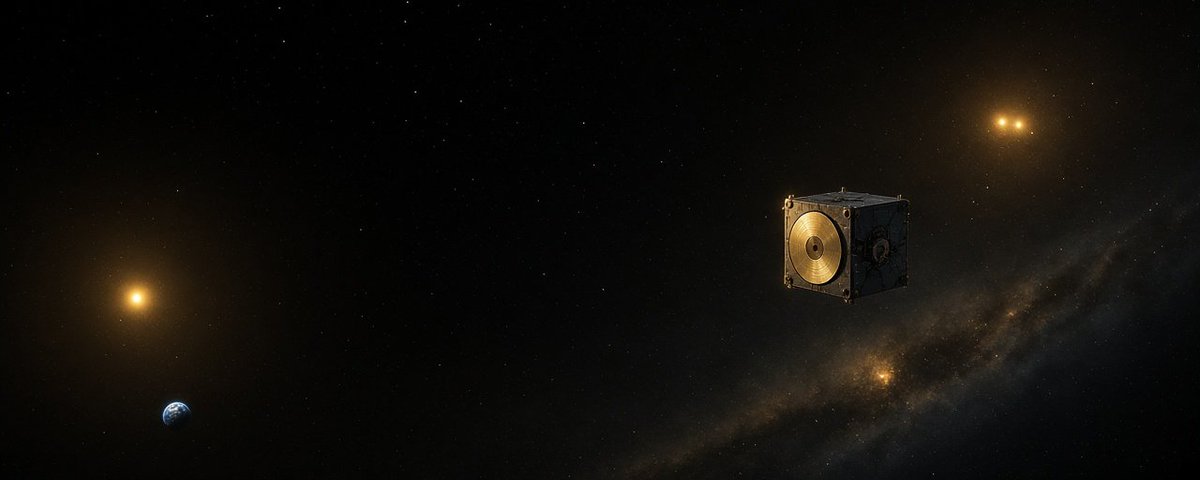
Everything you need to know about @FermiExplorer in 1 image


This is a great piece on the @FermiExplorer mission to another star! 👌🤓
aaronpickard.substack.com/p/…

Fermi Explorer retweeted
👌

The Voyagers cost billions in today's money and were never aimed at a star.
Fermi Explorer is aiming for Alpha Centauri on about $15M.
80,000 years from now, even silent, it will still be heading somewhere.
Here is my new article
@PhilipJohnston #SpaceTech #FermiExplorer @FermiExplorer @Starcloud_
Fermi Explorer retweeted

The Voyagers cost billions in today's money and were never aimed at a star.
Fermi Explorer is aiming for Alpha Centauri on about $15M.
80,000 years from now, even silent, it will still be heading somewhere.
Here is my new article
@PhilipJohnston #SpaceTech #FermiExplorer @FermiExplorer @Starcloud_
Fermi Explorer retweeted
This is a great piece on the @FermiExplorer mission to another star! 👌🤓
aaronpickard.substack.com/p/…
Fermi Explorer retweeted
Great to chat about our plan to send the first spacecraft to another star with @anu_bonth 🙌
@FermiExplorer 🚀
youtu.be/1OYbInkuIZk

Fermi Explorer retweeted
Agreed! We’ll send the first spacecraft to Alpha Centauri in 2029! @FermiExplorer


Fermi Explorer retweeted

78,000 years! That is how long it will take for a mission designed by the team at @FermiExplorer. But this isn't any ordinary mission. It is going out towards our first star, Alpha Centauri.
So when Philip Johnston, founder of Fermi Explorer, announced this once in a lifetime mission, I HAD TO bring him on the show.
The Fermi Explorer Mission has a goal of launching a minimum viable spacecraft to Alpha Centauri, the nearest star system, leaving in 3 years and arriving in around 80,000 years.
Chapters 📌:
A 78,000-year journey
Fermi Explorer’s mission to Alpha Centauri
The Fermi paradox and humanity’s future
The Voyager inspiration
Spacecraft design, power, and propulsion
The Oberth effect, explained
First Resonance (sponsor)
Solar escape and Jupiter gravity assists
The $10–15 million mission estimate
Communicating from deep space
Science, art, and messages from children
The team and potential collaborators
A community effort: how to get involved
We are proud to partner with First Resonance, the sponsor of today's video. Learn more about First Resonance here: hubs.ly/Q04Cd2s50
Learn more about how you can get involved in the Fermi Explorer mission here: fermiexplorer.org/
Fermi Explorer retweeted

Nobody alive will see it arrive. Someone still has to start.


78,000 years! That is how long it will take for a mission designed by the team at @FermiExplorer. But this isn't any ordinary mission. It is going out towards our first star, Alpha Centauri.
So when Philip Johnston, founder of Fermi Explorer, announced this once in a lifetime mission, I HAD TO bring him on the show.
The Fermi Explorer Mission has a goal of launching a minimum viable spacecraft to Alpha Centauri, the nearest star system, leaving in 3 years and arriving in around 80,000 years.
Chapters 📌:
A 78,000-year journey
Fermi Explorer’s mission to Alpha Centauri
The Fermi paradox and humanity’s future
The Voyager inspiration
Spacecraft design, power, and propulsion
The Oberth effect, explained
First Resonance (sponsor)
Solar escape and Jupiter gravity assists
The $10–15 million mission estimate
Communicating from deep space
Science, art, and messages from children
The team and potential collaborators
A community effort: how to get involved
We are proud to partner with First Resonance, the sponsor of today's video. Learn more about First Resonance here: hubs.ly/Q04Cd2s50
Learn more about how you can get involved in the Fermi Explorer mission here: fermiexplorer.org/
Fermi Explorer retweeted
🔥🔥🔥

More money, more time and flying less will not make spaceflight safer or make us more effective at achieving our objectives.
We are done defending the status quo. We are not going to compromise NASA’s effectiveness or capability trying to appease every constituency and, in the process, satisfy no one.
We are here for the mission, focused on executing @POTUS’ national space policy, achieving the objectives entrusted to us and delivering the kind of world-changing headlines worthy of America’s space program.
Fermi Explorer retweeted
🚀😃

Let's go! I am beyond excited to see this level of ambition coming up. We are entering our great ambitions era of the 21st century. @PhilipJohnston , excited to see where this goes!
Fermi Explorer retweeted
Great chat about or plan to send the first spacecraft to another star! @FermiExplorer
Thanks Anu!
78,000 years! That is how long it will take for a mission designed by the team at @FermiExplorer. But this isn't any ordinary mission. It is going out towards our first star, Alpha Centauri.
So when Philip Johnston, founder of Fermi Explorer, announced this once in a lifetime mission, I HAD TO bring him on the show.
The Fermi Explorer Mission has a goal of launching a minimum viable spacecraft to Alpha Centauri, the nearest star system, leaving in 3 years and arriving in around 80,000 years.
Chapters 📌:
A 78,000-year journey
Fermi Explorer’s mission to Alpha Centauri
The Fermi paradox and humanity’s future
The Voyager inspiration
Spacecraft design, power, and propulsion
The Oberth effect, explained
First Resonance (sponsor)
Solar escape and Jupiter gravity assists
The $10–15 million mission estimate
Communicating from deep space
Science, art, and messages from children
The team and potential collaborators
A community effort: how to get involved
We are proud to partner with First Resonance, the sponsor of today's video. Learn more about First Resonance here: hubs.ly/Q04Cd2s50
Learn more about how you can get involved in the Fermi Explorer mission here: fermiexplorer.org/
Fermi Explorer retweeted
I have a penchant for interstellar travel 😅
@FermiExplorer
Fermi Explorer retweeted

wait why weren't they doing this before? rofl
They are now teaching the Fermi Paradox as part of regulatory frameworks at Harvard @Kennedy_School 👀 🤓
Honestly not the worst take. @FermiExplorer

Fermi Explorer retweeted
They are now teaching the Fermi Paradox as part of regulatory frameworks at Harvard @Kennedy_School 👀 🤓
Honestly not the worst take. @FermiExplorer
Fermi Explorer retweeted
Wise words from Laura Kreidberg, Director of the Max Planck Institute for Astronomy on the Fermi Paradox:
“It may be that intelligence is not evolutionarily favourable.”
@FermiExplorer

Once we have the telescopes to look, signs of life in the galaxy will be more frequent than we expect. For this Forecast 2050 we discuss looking up to the stars for the sparks of life that might help us answer the question that has plagued humanity for centuries. Are we alone out here?
Laura Kreidberg, Director of the Max Planck Institute for Astronomy in Heidelberg, Germany, thinks that we are within 30 years of finding out whether humanity is all alone in the universe.
Appointed at the age of 30, Laura is one of the youngest directors in the history of the Max Planck Society. Her work uses the Hubble and James Webb space telescopes to explore the atmospheres of planets orbiting distant stars. Read more about the science behind this in the @SkyandTelescope article linked below.
We discuss:
- How astronomers study exoplanet atmospheres, including measuring wind speed.
- The race to find the first exomoon.
- Why Laura would bet more than a bottle of wine that Mars and Venus once had life.
- The smoking gun evidence for alien life.
- The Fermi Paradox & whether the universe is indifferent to our presence.
- Science as soft power on the world stage.
Enjoy!
TIMESTAMPS
0:00 Intro
3:10 The Atmospheres of Other Worlds
8:14 In Astronomy, Bigger is Better
10:50 Earth-like Planets
20:04 The Huge Variety of Exoplanets
26:03 Science Communication
27:30 Intelligence is Not Evolutionary Favorable
33:30 Signs of Life on Exoplanets
40:19 Discovering Aliens in 30 Years
45:44 Science as Soft Power