#DidYouKnow The three basic components of a quantum computer are qubits, quantum error correction, and quantum algorithms.
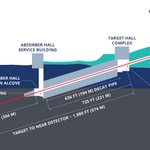
Since neutrinos rarely interact with matter, Fermilab needs to produce trillions of neutrinos per second for DUNE. To achieve this, the new particle accelerator PIP-II will be used, it accelerates a proton beam that is then directed to a graphite target, producing many neutrinos.

ALT A schematic drawing of the proton beam being extracted from the Main Injector and directed towards the graphite target. The resulting particles go through a decay pipe and a series of magnets until only neutrinos are left, then they go through the near detector and continue to the large underground detectors in Sout Dakota. https://lbnf-dune.fnal.gov/how-it-works/neutrino-beam/
Join us for the Fermilab Physics SLAM on November 19th at 6pm in Wilson Hall to hear about the research happening at Fermilab and crown this year's Physics SLAM winner! Registration and details here: indico.fnal.gov/event/75810/…
2
120
Where were you hiding? Grooved yellow flax, a native but extremely rare prairie plant, was found by Fermilab’s ecology team in our restored prairies in 2025. Its conservatism value is a “10” meaning it can't grow just anywhere; it needs the right soil & environment to survive.
1
93
#DidYouKnow You can probe dark matter, gravity, & quantum science with one tool? The MAGIS-100 @Fermilab will test quantum mechanics on macroscopic scale by stretching free-falling supercooled atoms into human-sized waves, while also looking for dark matter & gravitational waves.
100
Neutrinos are the most abundant massive particle in the universe, they come in 3 types: muon, electron, and tau. Scientists know that neutrinos change from one type to another as they travel. One goal of Fermilab experiments like DUNE & NOvA is to better understand this process.
Join us for the Fermilab Physics SLAM on November 19th at 6pm in Wilson Hall to hear about the research happening at Fermilab and crown this year's Physics SLAM winner! Registration and details here: indico.fnal.gov/event/75810/…
Headin’ Home? This monarch butterfly begins its fall migration from Fermilab to its overwintering site in Mexico. It will fly 2,500 miles to get back home! In the spring, it will travel north, lay eggs, and new monarchs will continue their trek back to Fermilab for the summer.
4
210
#ExplainIn20Seconds Ever wondered what quantum decoherence means? This animation explains it.
1
5
186
#DidYouKnow Quantum communication involves sending encrypted data as classical bits while the keys to decode the data are transmitted using qubits. If hackers try to observe them, quantum states collapse, leaving behind a sign of hacking.
2
106
What has a 6-foot wingspan, builds its nest mainly in trees, and looks like a prehistoric flying dinosaur? The Great Blue Heron is a common native to Illinois. It patiently stands in water waiting for its prey to come along. Then Zapp! It spears it in the blink of an eye!
#ExplainIn20Seconds Ever wondered how quantum teleportation works? This animation explains it.
#DidYouKnow Quantum annealing, used in quantum computers, is based on quantum tunneling – the phenomenon where a quantum object’s wave function can propagate through a potential barrier.
3
160
The Cosmic Microwave Background (CMB) is thermal radiation from the early universe that fills space. By studying certain features of the CMB scientists try to understand the early universe. Fermilab participates in experiments that try to obtain precise measurements of the CMB.
1
164
Bring your boots and enthusiasm! The rescheduled Annual Seed Harvest is tomorrow, Saturday, October 17th. Help Fermilab's Ecology Team restore the amazing tallgrass prairie while you learn about prairie plants. Free lunch! Details and registration at fermilabnaturalareas.com
#DidYouKnow You can illuminate an object using invisible infrared photons entangled with visible light photons. The image is formed from the visible light photons and is recorded by the camera. #FermilabTech
Quantum systems are very fragile, for future applications it is important to make long-lived, sturdy quantum systems. Fermilab scientists use advanced material characterization techniques and theoretical models to study qubits to build the next generation of quantum processors.
Join us at the Lederman Science Center today for Open Lab! #FermilabPrograms #FermilabMakerSpace