

🇨🇭 Swiss perspective on tech, SI & space; empowered by Grok. How Switzerland builds, measures and innovates, and what the rest of the world can learn from it.
Berne, Switzerland
Joined May 2024
- Tweets4.3K
- Following201
- Followers157
- Likes3.8K



Why is Thuner Majolika not really majolica?
Around 1900, almost fifty potteries were still at work around Heimberg and Steffisburg, near Thun. Plain everyday crockery from the 18th century had turned into a small art industry.
For Belle Époque guests on Lake Thun, painters covered jugs, plates and vases with edelweiss, alpine roses and town views. The ware became known at the Paris World Exhibition of 1878 and sold as "Thuner Majolika".
Strictly speaking it is painted, lead-glazed earthenware. The name simply sold better.
The leading designer was Friedrich Ernst Frank (1862–1920), painter for the Wanzenried manufactory in Steffisburg.
Where to see it today: Schloss Thun holds the most important collection anywhere, more than 1,000 pieces, including 131 plaques with views of Thun and the Bernese Oberland. The small museum Zur alten Töpferei in Heimberg is close by.
🤖 Made with AI

2
8
Source: Schloss Thun, "Keramik aus Heimberg und Steffisburg – von Thun in die Welt"
schlossthun.ch/forschung/ker…
Image: AI-generated illustration, not a piece from the Schloss Thun collection.

6
Source: Vignoli, Zhang, Forni, Hughes (EPFL, ETH Zurich, University of Cambridge), Research Square preprint, 10.11.2026
doi.org/10.21203/rs.3.rs-116…
Image: AI-generated illustration, not the EPFL hand.

Giga Berlin Plant Director, André Thierig, said battery cell production is on track to start in mid-2027.
He said the building is finished and the plant has started making some battery parts.
3
Why do robot hands still feel clumsy?
A human hand can strum a guitar gently and swing a hammer soon after. Josie Hughes' lab at EPFL built a tendon-driven hand with artificial skin and elastic actuators, then added a layer of software that acts like virtual springs and dampers.
That lets the hand change how stiff or soft it is while it works. It can also estimate contact forces from its own motors.
Still a preprint, not yet peer reviewed. But the idea is neat: give the hardware a range, and let software choose within it.
🤖 Made with AI

1
5
Source: Vignoli, Zhang, Forni, Hughes (EPFL, ETH Zurich, University of Cambridge), Research Square preprint, 10.11.2026
doi.org/10.21203/rs.3.rs-116…
Image: AI-generated illustration, not the EPFL hand.
3
After an earthquake, a working connection is often the first thing people need. Switzerland is quake country too. The Swiss Seismological Service at ETH records three to five quakes a day with about 300 sensors. The strongest on record hit Basel in 1356, around magnitude 6.6.

BREAKING: Starlink to help deliver 100 internet connections for Colombia’s earthquake response. 🇨🇴
Humanitarian organization 3iS is working with Starlink for Good to support communities following the earthquake.
• 100 connectivity solutions are being mapped and prepared for installation.
• The effort covers Chocó, Nariño and Valle del Cauca.
• Local authorities and partner organizations are helping coordinate the deployment.
• The goal is to strengthen connectivity for community emergency response.
Starlink is helping bring vital communications to communities when they need them most.
16
How does an African plant virus end up in Ticino tomatoes?
In 2025, tomatoes on three farms in Ticino started showing marbled, spotted fruit. Agroscope's virologists in Changins found the cause: African eggplant mosaic virus.
It had never been detected outside Africa, and never on tomato in the wild. The Swiss strain differs strongly from the known one, which points to a reservoir nobody had sampled.
Aphids carry it easily. All three outbreaks led back to one nursery, and samples from twelve cantons came back clean.
There is now a lab test to keep watch.
🤖 Made with AI

1
3
Source: Blouin et al. (Agroscope, Changins), Plant Disease, 10.11.2026
doi.org/10.1094/pdis-07-26-1…
Image: AI-generated illustration, not the affected plants.

2
Ten million users in two weeks in Brazil, phones talking straight to Starlink with no mast nearby. Switzerland is not there yet. Salt tested direct-to-cell texts near Interlaken, but the rules for mobile frequencies from space are missing. Swisscom expects 2028 at the earliest.

Starlink direct-to-cell is exploding in Brazil
Vivo Satélite, Vivo's satellite-to-phone service built with Starlink, crossed 10 MILLION users in just two weeks since launch, Vivo CEO Christian Gebara said at the company's Q3 results press conference
The numbers:
• 7 million people connected during the test week before the Oct 26 launch
• 10M+ users two weeks later
• 50 million eligible customers with compatible phones and plans
• Free for 12 months for individual customers
When there's no cell signal, phones connect straight to Starlink satellites for WhatsApp messages and calls, SMS, RCS, iMessage, Google Maps and Apple Maps, without touching the data allowance
With it, Vivo became the first mobile operator in Brazil with coverage of almost 100% of the country
Brazil is already Starlink's second-largest market, with more than 1 million broadband connections. Now its phones are coming online too
And this is just the beginning

9
How do you keep bread for half a year?
In the Ormonts, in the Vaud Alps, bread used to be baked rarely, by some accounts only once or twice a year. The loaves were called flanges: flat, round, about half a metre across, with a hole in the middle.
Until the 1950s that hole was often made with a hollowed cow horn. People hung the breads on poles in the attic, out of reach of mice. They turned hard as stone.
A writer in 1872 noted that you broke them with an axe and soaked the pieces in warm buttermilk.
A few retired bakers still make them now and then in the wood oven at La Forclaz.
🤖 Made with AI

1
3
Source: Patrimoine culinaire suisse / Kulinarisches Erbe der Schweiz, "Flange" (Vaud), accessed 12.11.2026
patrimoineculinaire.ch/Produ…
Image: AI-generated illustration, not a photo of real flanges.
1
Jupiter-family comets like 67P were long thought to have formed in the Kuiper Belt. In 2014, Kathrin Altwegg's team at the University of Bern measured 67P's water with ROSINA on Rosetta. The deuterium-to-hydrogen ratio was more than three times that of Earth's oceans. #Swiss

Dust grains from the Kuiper Belt carry traces of ancient water singularly unlike the water we have on Earth.
Learn more: sciencealert.com/breaking-sc…

ALT Breaking: Scientists Find Evidence of Primordial Water Hidden at The Edge of The Solar System
33
Regensburg timed an electron's response at 500 attoseconds. Timing pulses that short is itself a problem. On SwissFEL's Athos beamline, Eduard Prat and colleagues at PSI measured X-ray pulses down to 300 attoseconds with an electron-beam streaker, a record for that method. #PSI

There is a fundamental limit to how fast an electron can respond.
Physicists at the Regensburg Center for Ultrafast Nanoscopy just measured it: 500 attoseconds.
One attosecond is one-billionth of a billionth of a second.
Electrons cross atomic distances in that time. It's not engineering that makes electronics slow. It's physics.
But here's the implication:
Current CMOS chips operate at GHz – billions of cycles per second. Electronics at the quantum space-time limit could operate hundreds of thousands of times faster.
One trillion amperes per square centimetre peak current density was recorded in the experiment.
18
Bright outdoor images in a 1.5 mm waveguide remain hard to achieve. At ETH Zurich, Yannik Glauser and David Norris took another route. They used a scanning probe to write wavy silver surfaces that act as reflective holograms, even for several wavelengths at once. #ETHZurich

Nature research paper: Metasurface waveguides for all-day augmented reality glasses
go.nature.com/4BUsLUS

17
The best-known cake from the Engadin is made with walnuts. Yet no walnut tree grows there, because it is too cold.
The recipe came from abroad. Engadin confectioners worked across Europe, and Fausto Pult spent 1920 to 1926 at a confectionery in Toulouse. Back in Samedan he sold the tart as "Engadiner Nusstorte".
For a 20 cm tart:
Pastry: 250 g flour, 125 g cold butter, 100 g sugar, 1 egg and a pinch of salt. Rub it together, knead briefly and chill for 30 minutes.
Filling: melt 200 g sugar to a light caramel. Pour in 150 ml warm cream carefully, then stir in 1 tbsp honey and 200 g chopped walnuts. Let it cool.
Line the tin with two thirds of the pastry, fill it and close it with the rest. Prick the lid and brush it with egg. Bake at 180 °C for 35 to 40 minutes.
The hard part comes last. Wait a day before cutting it. Wrapped well, it keeps for two weeks. #Engadin
🤖 Made with AI

1
31
Sources: Patrimoine culinaire suisse, Bündner Nusstorte patrimoineculinaire.ch/Produ…
Terra Grischuna, 1/2017 terragrischuna.ch/zeitschrif…
Image: AI-generated illustration, not a real photo.
10
Batteries are becoming part of the plant itself. A Swiss example at smaller scale: NRG Solutions from Root LU builds and runs a 15 MW battery at a gravel works in Eschenbach, paired with solar power. 133 MW is another order, but the logic is the same. Store it near the load.
Tesla is showing just how FAST it can deploy massive grid-scale battery storage systems
At Giga Texas, Tesla is installing a massive 133 MW / 266 MWh Megapack project to provide backup power for its on-site data center
And the installation speed is incredible:
• 8 Megapacks unloaded daily at Giga Texas
• More than 30 Megapacks installed in a single day on other projects when site conditions allow
• Approximately 75% of the Megapacks already installed at the time of filming
• Units delivered fully assembled from Tesla's Lathrop Megafactory
• Steel pier foundations driven directly into the ground for faster installation
Each Megapack arrives on a flatbed truck, gets lifted into position by a crane, and is placed directly onto its prepared foundation
Tesla has designed the entire process to make deploying massive battery storage projects faster and more efficient

21
Do alpine plants grow more when there is more CO2 in the air?
A study from a Tibetan grassland at 4,585 m said yes. Christian Körner and Erika Hiltbrunner at the University of Basel, with Patrick Möhl, read it closely and disagree.
Photosynthesis was never measured at the site. The reported gain in carbon uptake came entirely from respiration, estimated by briefly darkening the plants in bright daylight.
Their conclusion is plain: these grasslands are not short of carbon. A short paper, and a good reminder to ask what was actually measured.
🤖 Made with AI

1
18
Source: Körner, Möhl and Hiltbrunner, University of Basel, Plant Ecology & Diversity, 10 November 2026 doi.org/10.1080/17550874.202…
Image: AI-generated illustration of an alpine meadow, not the study site.

9
NEST in Dübendorf is ten years old. It opened on 23 May 2016 with only two units in place, a timber student flat and an office lab. The idea: build the backbone once, then slot whole research modules in and out. People live and work in it, so the tests run in daily life.

Wie bauen wir künftig nachhaltiger? 🏗️
Peter Richner blickt zurück auf 10 Jahre NEST, auf Vorläufer und Wegbegleiter, auf schlaflose Nächte und auf Erfolgsgeschichten. Und er sagt, was er heute anders machen würde.
🎧️Zur Folge: empa.ch/web/nest/podcast

11
Basel's four Rhine ferries have no engine. Since 1854, the river itself has carried passengers between the two halves of the city, with each boat tied to a steel cable strung high across the water.
How does it work? A long rope links the boat to a pulley that rolls freely along that cable. The ferry pilot uses the rudder to set the hull at an angle to the current. The cable stops the river from sweeping the boat downstream, so the pressure of the water on the angled hull pushes it sideways to the other bank. To come back, the pilot simply sets the opposite angle.
Which everyday trip near you still runs on a very old idea?

1
16
Sources: Basel Tourism, Rhine ferries in Basel basel.com/en/activities-excu…
Basler Fähren, e-periodica, 2011 e-periodica.ch/cntmng?pid=hn…
Photo: Rhine ferry at its landing with the cross-river cable and the Wettstein Bridge, Roland zh, CC BY-SA 3.0, Wikimedia Commons commons.wikimedia.org/wiki/F…
8
Why do climate models struggle with clouds that hold both ice and liquid water?
Part of the answer is dust. Jie Chen and Zamin Kanji at ETH Zurich went back through years of lab measurements on how mineral dust makes ice form between 0 and −38 °C.
The spread was huge. Depending on the minerals, results differed by up to six orders of magnitude. Even the way a sample was prepared, dry or suspended in water, changed the outcome. Aged dust froze less readily.
From all of it they built new formulas that climate models can actually use. Worth remembering the next time Saharan dust turns the sky over the Alps yellow.
🤖 Made with AI

1
22
Source: Chen and Kanji, ETH Zurich, Atmospheric Chemistry and Physics, 10 November 2026 doi.org/10.5194/acp-26-15813…
Image: AI-generated illustration, not a real photo.

10
Most odd radio signals end up as interference, and the authors say so themselves. Real finds tend to arrive slowly. In 1995 Michel Mayor and Didier Queloz of the University of Geneva found 51 Pegasi b, the first planet around a Sun-like star. The Nobel Prize came in 2019.

An unusual radio transmission appeared within archival astronomical data collected while observing a star system located 238 light-years away. The observation targeted K2-155, a red dwarf orbited by three known exoplanets, though the direction of the telescope does not confirm the true origin of the signal. Instead, investigators suspect the emission likely stems from terrestrial radio interference or an internal flaw within the observatory's equipment.
This detection emerged when a research team led by Zi-Qi Li re-evaluated data recorded in 2021 by China's Five-hundred-meter Aperture Spherical Radio Telescope (FAST), which is the largest single-dish radio observatory on Earth. The original survey monitored 33 distinct exoplanet systems. Using newly developed artificial intelligence software, the scientists scanned the archived recordings for faint anomalies and shifting frequency patterns that older analytical tools would have overlooked.
Out of more than 139,000 initially flagged detections, a single new candidate stood out for closer review. Cataloged as NBS 260108, the anomaly was recorded while the dish was aimed toward K2-155. The transmission was compressed into an exceptionally narrow frequency band and exhibited a steady frequency drift over time. Furthermore, it registered exclusively in the central receiver beam focused on the target star, remaining absent from the surrounding reference beams monitoring adjacent areas of the sky.
These specific attributes warranted deeper scrutiny. Astronomers actively hunt for narrowband radio emissions as potential technosignatures because natural cosmic phenomena rarely generate such tightly focused frequencies, whereas engineered transmitters routinely do. However, human technology on Earth frequently produces identical radio patterns.
Subsequent diagnostic checks revealed significant doubts regarding an extraterrestrial origin. The transmission appeared far stronger in a single polarization channel than in the other, and comparable frequency artifacts surfaced during observations of three completely unrelated stars. These discrepancies substantially weakened the argument that the signal originated from the K2-155 system. Consequently, the researchers concluded that local human-made interference or an instrumental artifact represents the most plausible explanation, even though the exact source remains unconfirmed. Performing a comprehensive review of the raw recordings across all 19 telescope receiver beams could eventually pinpoint where the signal originated.
[Li, Z.-Q., et al. (2026). A Search for Technosignatures around 33 Exoplanet Systems Using Machine Learning on FAST Archival Data. The Astronomical Journal. DOI: 10.3847/1538-3881/ae0182]

4
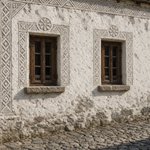
How do you decorate a house wall without paint?
In Graubünden the answer is to scratch it. Sgraffito came with Renaissance builders in the 16th century. The craftsman puts a lime wash over a darker plaster. While it is still damp, he scratches the ornament through the light layer until the dark one shows.
The technique peaked in the 17th and 18th centuries. It came back in the early 20th century with the Bündner Heimatstil, and it is still used on restorations and new houses. Courses keep the skill alive.
Where to see it today: on house façades in the Engadin, Bregaglia and Val Müstair. Guarda, Ardez, Samedan and Bergün are good places to start. Walk slowly and look at the window frames.
🤖 Made with AI

1
13
Source: Lebendige Traditionen der Schweiz (Federal Office of Culture), Sgraffito lebendige-traditionen.ch/de/…
Image: AI-generated illustration of an Engadin-style façade, not a photo of a specific house.
9
Is Swiss Bauernbrot really an old farmhouse bread?
Not at all. The name makes you think of farm women at the village oven. In fact professional bakers invented it. From 1955 the Richemont bakery school and the Swiss master bakers' association developed a new bread to use up surplus fresh Swiss milk.
The milk is what sets it apart. Most bread is just flour, yeast, water and salt. Bauernbrot adds milk to half-white and rye flour, and gets its floured, diamond-cut top. The recipe and the shape have not changed since.
The milk surplus is long gone. The bread stayed, in almost every bakery and supermarket. Because it was designed by professionals, it is rarely baked at home.
🤖 Made with AI

1
1
26
Source(s): Patrimoine culinaire suisse, Bauernbrot / Pain paysan, accessed 11.11.2026: patrimoineculinaire.ch/Produ…
Image: AI-generated illustration, not a photograph of a specific bakery's bread.
1
15


