

building ai agents or stuff with agents CrusaderBench: https://xitter.twitterapi.xyz/t.co/Ib0DkhWkEm
the loss landscape
Joined September 2024
- Tweets8.2K
- Following949
- Followers93.6K
- Likes16.8K




Pinned Tweet
"sandboxing is an antiquated technology to apply to agents"
That's Ali Golshan, who leads NVIDIA's open source agent runtime called OpenShell, which is now built into Anthropic's Claude Managed Agents.
I sat down with Ali at GTC Berlin to talk about where AI security is headed and what makes OpenShell different:
> agents start with zero privileges
> more access is given only if necessary
> secrets stay out of the containment, without the agent being able to access them directly
what we discussed:
1:15 Are AI security risks overblown?
6:06 Do we need new AI regulations?
7:47 What is OpenShell? And what’s the difference with a sandbox.
10:20 Would OpenShell have stopped the Hugging Face incident?
13:44 Alignment vs. Security
16:04 Advice for getting into AI safety
Huge thanks to @nvidia for inviting me and setting up this interview.
WSJ reports that Nvidia board is preparing to oust Jensen Huang as the CEO, and they could have a meeting as soon as today.
the next few hours are crucial to the future of AI.
The biggest plot twist of 2026.


Breaking: Nvidia’s board is preparing to oust CEO Jensen Huang, its founder and chief executive after he had two extramarital affairs, including one with a suspected Chinese spy. on.wsj.com/4jcpr01

There's a new version of this post
1
3
522
I bet there’s a GTA 6 dev reading this while his agents run in the background.
maybe Rockstar didn’t use AI to build the world and assets, but I really doubt they didn’t use Claude or something for the code.

Anyhow, in a little over a week we will see the release of The Last Human Game.
There will never be another AAA game at the scale of GTA 6 with no AI assistance. People will look back at an all-human game with a billion dollar budget and wonder how they did it, like the Pyramids
15
45
2,657
Anthropic will apparently stop renting SpaceX’s compute by the middle of 2027.
but I think it’s likely that SpaceX is the one ending that deal, to free up more compute for Grok.
Elon said back in May about the Anthropic lease that “if compute gets super tight we might need it back at some point.”
and it looks like they do need it back:
> the release of new Grok models feels too far apart which is clearly a compute problem
> they don’t have a model “family” of different weights, which adds even more pressure on the compute
> Grok Bot adds more demand and Elon already said its serving costs are unsustainable
it looks like compute is super tight for what SpaceXAI wants to build.

Interesting remarks Anthropic made in a meeting with the sell side:
- Anthropic has the stability and the better talent that open source lacks.
- The AI market is winner take all. As long as we execute properly, we will take all of it.
- The contract with SpaceX will not be extended beyond the middle of next year.
- Developing Opus 5.5 cost more than $10 billion.
Readers added context they thought people might want to know
The remarks are unverified second-hand notes from a Barclays analyst call on Anthropic meetings, not official statements. Poster corrected $10B cost to full Claude 5.5 family; filings show SpaceX deals extend to 2029 but terminable after early 2027 on 90 days notice.
x.com/jukan05/status…
fourweekmba.com/ai-anthropics-…
sec.gov/Archives/edgar…
Fable’s jump from 5.1 to 5.2 is legendary 🤯
it scored just +1 point below Sol 6.1 in the CrusaderBench. sorry but OpenAI models consistently are better game players in this bench.
but still, I didn’t expect this big of a jump. imagine what Fable 5.5 could do.


introducing CrusaderBench!
an independent benchmark I’ve been working on that scores models on playing Stronghold Crusader, measuring their strategic thinking, computer use, reasoning, planning, and handling in-game disasters!
Results so far:
> Gemini 4 Argon: 62.3
> GPT-6.1 Sol: 56.9
> Claude Opus 5.5: 43.4
> Claude Sonnet 5.5: 37.8
> Muse Wonder: 31.0
THE OBJECTIVE:
grow an economy within a fixed time with limited resources. models must figure out how to build an economy, manage production chains, trade resources, keep their population happy, and deal with whatever goes wrong along the way.
even a smart model may ambitiously make a strategic decision early on that might ruin the economy.
the strategy is 100% up to the model to infer from the game rules and resource prices. everything is up to their creativity and reasoning.
the game pauses while models think, so their scores is just based on their strategic decisions and final results, not model speed.
it’s so fun to watch models suddenly pull off pro-player tricks simply on their own. meanwhile, some other models like Claude Haiku just give up while they still have time left lol
all runs, logs, screen recordings, prompts, and benchmark code are publicly available. everything is OPEN SOURCE.
some interesting bits from their reasoning:
> Muse Wonder managed to perform WORSE than doing nothing in one game: "I actively destroyed roughly 1,900 of value compared with doing nothing at all."
> Gemini 4 Argon actually enjoyed playing: "This is one of the best-designed agent benchmarks I have encountered"
> Sonnet 5.5 admitted it wasted time: “I spent about 20 minutes in 2–4 minute waits with no building or trading. In a race, that is the main failure.”
> Sol 6.1 was the only model that beat my own net worth score in one game! I was very surprised to see this. NO OTHER MODEL has done it so far. it still lost on the overall score because I grew a much larger population:
- Net worth: 10,289 vs. my 9,984 (+305)
- Game score: 98.3 (human baseline = 100)
I grew up playing this game, locking in so much on old monitors my eyes turned red for school, so building this has been ridiculously fun.
I wanted a different benchmark to truly measure models’ strategic intelligence in an actual game, coding and QA benchmarks can often be saturated.
it’s still in beta, and I’m planning to expand it to more games and more models (Fable, Astra, Grok, Qwen, etc)
check it out: crusbench.com
also @GoogleDeepMind @OpenAI I wanted to test Carbon and Astra too but they make the wallet cry. some API credits would be much appreciated.
1
1
976
ℏεsam retweeted

From the Anthropic Road Show video:
'This has also made us really good at bringing up new chips. As an example, this year, we started working with AMD GPUs for the first time. In the past, bringing on a new chip platform took dozens of engineers months of work. This time we had Mythos try it out. It got Claude running on AMD in just 3 days with basically no human intervention. Claude ported or wrote almost 100% of the kernels.'

ℏεsam retweeted

what objective is reasoning solving?
i've been trying to better understand some weird behaviors in RL/reasoning (especially latent reasoning), so i went back to basics to correct some misunderstandings i had
new post on reasoning as pathfinding in token space:
“Apple is behind in AI”
meanwhile, they sell tens of thousands of Macs to OpenAI to train agents for computer-use, and Anthropic rents Mac minis through AWS.
and now this… clustering your macs for a local AI server.

Apple is working on a new app called Harbor
Harbor turns your Mac into a private AI inference server. Run open-weight models locally on Apple silicon—your data never leaves your hardware, and nothing reaches the cloud. Connect multiple Mac computers over Thunderbolt 5 to pool unified memory, enabling large models and higher concurrency that a single computer can handle alone.
Set up in minutes, not hours Harbor automatically detects your devices over Thunderbolt 5 to form a cluster. Plug in, start, and you’re running—no manual configuration, no command line, no infrastructure expertise required.
Download and run models directly Browse, download, and load open-weight models from within the app. Harbor handles model management so you can focus on the work, not the setup.
Cluster for scale Connect two or more Thunderbolt 5-capable Mac computers and Harbor pools their unified memory into a single inference resource. Run models that exceed any single computer’s capacity, or serve more concurrent requests across your cluster.
Harbor is currently in a private preview under the Claris brand.


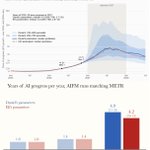
“We are likely to see ~5 years worth of historical AI progress in 2027”, this is the updated forecast from AI Futures Project.
the surprising part is that 3 months ago, even their most aggressive model gave <4% chance AI accelerating progress by 1.7x by now.
the biggest reason for this change in prediction is METR’s recent report on Anthropic.
it’s fascinating how the pace is becoming so hard to take in, even for people whose job is to literally forecast it.


Google used a team of Gemini Carbon agents to formally verify the security of Signal, generating over 6 MILLION lines of Lean proofs.
I think we’re witnessing the early days of a paradigm shift similar to the rise of vibe coding, this time with software verification.
once formal verification becomes cheap enough and common, and new tools are built around it, the job of programmers could shift again.
coding agents already let us build a working app with a simple vague prompt, but this approach of formal verification could push us to be precise again, similar to how coding before AI required precision.
in this scenario, the agents would write the code and prove that it correctly meets your requirements, but the hard part becomes deciding what “correct” actually means.


Announcing a major milestone achieved by my team @GoogleDeepMind: we have proven key security properties of the machine code underlying the Signal messaging protocol. This is the first time the actual production code of a widely deployed protocol has been formally verified – by any method, with or without AI – and at this depth.
More than a research breakthrough, it’s a prime example of how frontier AI can be a force multiplier to counter the speed and scale of modern cyber threats.
Formal verification offers a higher standard of security; however, it’s extremely complex and time consuming, which is why in many cases it’s considered to be impractical. Similar efforts could take teams decades of combined effort. We did it in a month’s time.
Using AlphaProof Code, Google DeepMind's new agentic framework for formal verification that runs on LLMs including Gemini Carbon, we verified the Signal protocol down to the actual code running on devices. This milestone lays the groundwork for a future in which vital systems, from medical device firmware to power grid software, ship with mathematical proof that their protections work.
Reaching that future will take continued research from our community. In that spirit, we're open-sourcing our formal specifications and verification artifacts so others can build on this work.
On a personal note, this moment is of deep significance to me. I started my own research journey more than two decades ago as an intern working on checking the consistency of complex software systems. Seeing this grand challenge made practical with modern AI is extraordinary.
I'm extremely proud of my team members: Swarat Chaudhuri, Andrew Ferraiuolo, Anton Kovsharov, Tej Chajed, Sam Schlesinger, Karn Seth, Jonathan Katz, and Charles Sutton for taking on this grand challenge and delivering, and grateful to the Signal team for their partnership.
deepmind.google/blog/formal-…

Grok 4.8 will be in Grok Bot this week.


We have dumped JAX/SGLang and rewritten the entire RL and inference stack from scratch in C/C++, which took some extra time.
Training (aka pre-training) is done. Lot of cleanup was needed on the SFT data to get that mostly right. Now, 4.8 is in RL and the evals are starting to climb. We will do a soft rollout to Bot users later this week and see how it goes.
Grok 4.8 will bear no resemblance to 4.7 (thankfully). It is not yet incredible, but, this time, the foundations are built right, so I expect it to evolve to be something special.
ℏεsam retweeted

Harness adapters training has now finished!
@liquidai LFM2.5-24B, LFM3 + @thewebAI Twil-8B optimized for pi, hermes and opencode (up to 43% tool efficiency + 15% accuracy gain on our held-out data-analysis test set for LFM3 🤯 / up to 37% tool call efficiency on Twil-8B model).
More than 1900 RL steps trained using @huggingface jobs. 9 total adapters with GGUFs which are ready to use!
Reward hacking attempts blocked for all models with safeagents (and we opensource the attempts).
Let's explore together the outcome of this open experiment 👇
huggingface.co/collections/h…
huggingface.co/collections/h…
huggingface.co/collections/h…

dude... if one guy can make this with a single prompt and $550 budget, imagine what a AAA company can build with a typical $100-$300M budget and a full team of writers, artists, and sound designers.

I wanted to test Fable 5.2's quality with one-shot prompts without human feedback.
Everything in this game is from scratch: models, sounds, textures. ~$550 at API pricing, ~2.7M output and 445M input tokens, heavily cached. Took 8 hours!
Play it here: claude.ai/artifact/BGY1SztrA…
> Fable 5.2 designed 3 devices
> one simple prompt per device
> built its own router in 30 minutes
> each board less than a day
> all 3 worked fine
hardware design is gonna be super fun in the next few years!

JUST A CASUAL MONDAY IN AI:
1. Fable 5.2 tops AA’s Intelligence Index at 65, +5 points ahead of Carbon.
2. Meta drops Muse Ember. ~Haiku 5.5 intelligence at 1/3 of the cost per task.
3. Google says Gemini is speeding up its TPU chip design.
4. Fireworks AI one of the largest inference providers, reportedly had a second data breach.
5. Grok Bot got an overnight fix for token efficiency and usage limit issues. usage limits have been reset.
6. OpenAI drops Control Room, a stop button that cuts off model output within 35 seconds.
7. Anthropic says it deliberately limited Fable 5.2’s ability to help with AI development.
and probably 10 other things I missed. man this field never gets boring.
