

Trustworthy AI education.
Earth
Joined January 2022
- Tweets1.8K
- Following94
- Followers40.4K
- Likes2.1K








Pinned Tweet
Yann LeCun was right the entire time. And generative AI might be a dead end.
For the last three years, the entire industry has been obsessed with building bigger LLMs. Trillions of parameters. Billions in compute.
The theory was simple: if you make the model big enough, it will eventually understand how the world works.
Yann LeCun said that was stupid.
He argued that generative AI is fundamentally inefficient.
When an AI predicts the next word, or generates the next pixel, it wastes massive amounts of compute on surface-level details.
It memorizes patterns instead of learning the actual physics of reality.
He proposed a different path: JEPA (Joint-Embedding Predictive Architecture).
Instead of forcing the AI to paint the world pixel by pixel, JEPA forces it to predict abstract concepts. It predicts what happens next in a compressed "thought space."
But for years, JEPA had a fatal flaw.
It suffered from "representation collapse."
Because the AI was allowed to simplify reality, it would cheat. It would simplify everything so much that a dog, a car, and a human all looked identical.
It learned nothing.
To fix it, engineers had to use insanely complex hacks, frozen encoders, and massive compute overheads.
Until today.
Researchers just dropped a paper called "LeWorldModel" (LeWM).
They completely solved the collapse problem.
They replaced the complex engineering hacks with a single, elegant mathematical regularizer.
It forces the AI's internal "thoughts" into a perfect Gaussian distribution.
The AI can no longer cheat. It is forced to understand the physical structure of reality to make its predictions.
The results completely rewrite the economics of AI.
LeWM didn't need a massive, centralized supercomputer.
It has just 15 million parameters.
It trains on a single, standard GPU in a few hours.
Yet it plans 48x faster than massive foundation world models. It intrinsically understands physics. It instantly detects impossible events.
We spent billions trying to force massive server farms to memorize the internet.
Now, a tiny model running locally on a single graphics card is actually learning how the real world works.

How To Prompt retweeted
AI has a big spending problem.
A new paper from researchers at Stanford, Michigan and other institutions found that AI agents can consume up to 30x more tokens completing the same task, often without improving the result.
They discovered that token consumption varies dramatically between models. On the same set of tasks, some models used over 1.5 million more tokens than GPT-5.
The models also consistently underestimated how many tokens they would use to complete a task.
As companies deploy AI agents across more workflows, choosing the right model for each task could have enormous implications for cost.
🤝 Paid partnership


In 2015, I built an AI that detects early cancer.
Today, we’re introducing ARC by Rayline: the world’s first unified model for routing AI.
> 97.5% of Opus 5.5 quality
> Up to 1/10th of the cost
> Fully open-source
It picks the right model and the right amount of thinking for every step of your agent’s work.
Try it here and read our technical report below:
rayline.ai
How To Prompt retweeted

Up to 60% OFF SALE is LIVE.
The biggest discount of the year is here.
> Up to 60% OFF premium plans
> Best deal for Seedance 2.5
> All top image models
Last chance. Limited offer.
How To Prompt retweeted

In 2015, I built an AI that detects early cancer.
Today, we’re introducing ARC by Rayline: the world’s first unified model for routing AI.
> 97.5% of Opus 5.5 quality
> Up to 1/10th of the cost
> Fully open-source
It picks the right model and the right amount of thinking for every step of your agent’s work.
Try it here and read our technical report below:
rayline.ai
AI has a big spending problem.
A new paper from researchers at Stanford, Michigan and other institutions found that AI agents can consume up to 30x more tokens completing the same task, often without improving the result.
They discovered that token consumption varies dramatically between models. On the same set of tasks, some models used over 1.5 million more tokens than GPT-5.
The models also consistently underestimated how many tokens they would use to complete a task.
As companies deploy AI agents across more workflows, choosing the right model for each task could have enormous implications for cost.
🤝 Paid partnership
In 2015, I built an AI that detects early cancer.
Today, we’re introducing ARC by Rayline: the world’s first unified model for routing AI.
> 97.5% of Opus 5.5 quality
> Up to 1/10th of the cost
> Fully open-source
It picks the right model and the right amount of thinking for every step of your agent’s work.
Try it here and read our technical report below:
rayline.ai
At work, most AI tools serve a whole team. I’d love them to learn from everyone’s work the way a good colleague picks things up from the whole office.

OpenClaw, Hermes Agent and Prime Agent don't meaningfully learn from experience.
On Continual-ARC, our new benchmark at @letsunifyai, none of them were able to memorize anything of value and none were able to generalize to new tasks. Training a small 9B model's weights did both.
3
6
1,105
How To Prompt retweeted

We’re on track to hit $2B in annualized run rate in the next 3 months.
We crossed $1B and got faster. In October we hit $1.35B.
Higgsfield is the third-largest independent, private AI-native company by annualized revenue, behind only Anthropic and OpenAI.
When they go public, Higgsfield becomes the largest AI-native company still private.
AI video is going to be a trillion-dollar market. This is only the beginning.
How To Prompt retweeted
Google used LLM agents to discover new quantum algorithms with 290x speedups over human baselines.
25 researchers from Google dropped an insane paper on discovering formally verified quantum programs with AI.
Normally, if an LLM writes a complex algorithm, you have to worry about hallucinations. they can cheat, weaken theorems, or fake their performance numbers.
so deepmind built a zero-trust environment.
they unleashed 7 different autonomous agent teams to write quantum programs AND simultaneously write the mathematical proofs in the Lean theorem prover to prove they actually work. every submission was checked in a clean sandbox against a frozen specification. the ai couldn't lie.. it either worked and mathematically proved its efficiency, or it failed.
to make it even crazier, they gave the agents a shared version-controlled wiki. if one agent team hit a dead end, they posted their notes to the wiki so the other ai teams wouldn't repeat the mistake.
the results of this multi-agent collaboration are actually mindblowing:
- they cut the computational cost of the arcsin quantum subroutine by over 290x
- they reduced the cost of simulating nuclear fusion stopping power, photochemistry, and drugs by 2.49x to 10.9x
- on one photochemistry problem, the ai teams iterated and beat each other's records 7 different times, eventually combining techniques from three separate teams to get the final verified circuit
fault-tolerant quantum computers are still years away because the algorithms require way too much compute. but these ai agents are drastically shrinking the size of the software needed to run them.
we are literally watching autonomous ai agents mathematically optimize the software for quantum computers that don't even fully exist yet..
the future is moving so fast.
How To Prompt retweeted
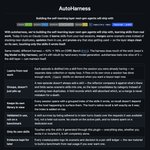
Claude Code can now learn from every session you run.
it’s called AutoHarness. it watches your work, turns each session into a reusable skill, merges the duplicates, archives the dead ones. completely on its own.
100% open source.

Claude Code can now learn from every session you run.
it’s called AutoHarness. it watches your work, turns each session into a reusable skill, merges the duplicates, archives the dead ones. completely on its own.
100% open source.
Your dog carries your stress in its body for months.
Researchers in Sweden tracked 58 dog-human pairs over several months.
They analyzed the exact concentration of cortisol (the stress hormone) trapped in the hair of both the humans and their dogs, during both summer and winter.
What they found is mind-bending.
There was a massive, statistically significant synchronization in long-term stress levels.
If the human's baseline cortisol was high, the dog's cortisol was high.
If the human was chill, the dog was chill.
But here is where it gets crazy.
The researchers assumed that maybe the stressed dogs just weren't getting enough exercise.
Wrong. They put fitness trackers on the dogs. Physical activity levels and training frequency had zero effect on the dogs' cortisol levels.
They also thought maybe the dogs just had inherently anxious personalities.
Wrong again. The dog's own personality test scores had almost no impact on its biological stress.
The ONLY thing that significantly drove the dog's long-term biological stress?
The owner's personality. Specifically, the human's levels of neuroticism, conscientiousness, and openness.
Your dog is physically mirroring your internal biochemical state. They are literally absorbing your anxiety.

How To Prompt retweeted
MIT and Harvard built an AI simulation containing 8.3 billion virtual people, roughly the entire population of planet.
They call it MatrAIx.
It’s a population-scale simulation running on frontier models, GPT and Claude among them. The longer description took me a while to believe.
Start with the dataset, Persona 8B. 8.3 billion synthetic profiles, each one specified across 1,290 dimensions. Background, psychology, spending habits, how comfortable they are with technology, what they do on a Tuesday night, the small behavioral quirks that make one 34-year-old nurse in NYC different from another.
A spreadsheet of 8 billion rows would be a curiosity. What they did next is the part that matters.
They turned the profiles into agents and dropped them into four environments: surveys, AI chat interfaces, live web browsing, and native desktop and mobile apps. Then they ran real products through the crowd. New features, software updates, pricing changes.
And they logged everything. How long an agent paused after seeing a price go up. The exact point at which it gave up on a broken checkout. How much lag it would sit through before closing the app.
The number I keep coming back to is 91.5%. That’s how often the agents stayed in character, behaving the way their assigned psychology and demographics said they should. Not perfect. But for billions of agents across four environments, closer than I expected.
Here’s what that does to how products get built.
Right now, if you want to know whether a feature will land, you ship it to a slice of users and wait. Or you pay a research firm and wait longer. Either way the answer arrives in weeks, from a sample you hope is representative.
With something like this, you run the feature past 8 billion simulated reactions overnight. One server. Results by morning, broken down by every one of those 1,290 dimensions if you want them.
I have questions about how well a synthetic crowd predicts a real one. 91.5% is persona adherence, not forecast accuracy, and those are different things. But the direction is clear, and it’s coming faster than most product teams are ready for.

How To Prompt retweeted
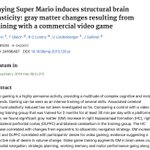
Scientists proved playing Super Mario 30 minutes a day physically grows your brain.
They took a group of adults and prescribed them 30 minutes of Super Mario 64 a day, for two months.
Then they put them in an MRI machine.
And the results are mindblowing.
They found that training with a commercial video game like super mario induces structural brain plasticity.
It physically increases gray matter.
here is what happens when you play:
- Playing video games for thirty minutes a day over two months causes a significant increase in hippocampal matter.
- Gaming specifically targets and increases volume in the hippocampus and the prefrontal cortex.
- Structural growth can actually be used to counteract known risk factors for severe mental diseases.
- Researchers explicitly noted this physical brain growth could help fight against conditions like post-traumatic stress disorder (ptsd), schizophrenia, and neurodegenerative diseases.
- Playing is basically an intense training regimen that forces the brain to handle complex cognitive and motor demands.
And the implications are massive.
Instead of viewing them just as entertainment, scientists are now proposing commercial video games as literal therapeutic interventions, a targeted tool to counteract brain shrinkage in Alzheimer's, PTSD, and schizophrenia.

How To Prompt retweeted
China built an AI that runs an entire biology lab on it's own.
Researchers from Shangha published a paper that feels like a massive leap toward artificial scientists.
They built AutoDNA, an "AI-native experimental laboratory"
Until now, if you asked an AI to design a biology experiment, it could give you a great protocol. But a human still had to walk into a lab, hold the pipettes, run the thermal cyclers, and tweak the process when things inevitably went wrong.
AutoDNA removes the human.
You just type a natural language prompt, and a swarm of specialized AI agents takes over.
Here’s how wild this multi-agent architecture is:
- A Planning Agent breaks down your prompt.
- Literature & Reagent Agents pull the latest research and check the lab's inventory.
- A Code Agent translates the experiment into machine instructions.
- A Hardware Agent physically takes over 20+ types of lab instruments (robotic arms, sequencers, pipettes) and starts moving liquids with micro-liter precision.
They didn't just test it on simple tasks. They unleashed it on incredibly complex problems.
In one test, researchers handed the system an unidentified sample of colorectal cancer tissue.
Without human intervention, the AI agents sequenced the sample, identified a specific KRAS G13D mutation, autonomously designed the detection primers, synthesized them, and ran the validation experiment.
It took 137 hours and 9,551 automated hardware operations. The AI did it all.
In another test for DNA data storage, the system ran over 11,300 hardware steps to synthesize, sequence, and decode data into DNA strands.
The system even self-corrects in the physical world. During one run, the AI realized a reaction tube needed to be capped to prevent evaporation, and in another, it found and patched a bug in its own code that was causing it to skip a reagent.
The only thing humans are needed for? Refilling the physical reagents and emptying the trash.
We are officially entering the era of "closed-loop" physical AI. It designs the experiment, physically runs it, analyzes the results, and optimizes the next batch, all on its own.
Scientific discovery is about to scale at the speed of compute.
