Own your intelligence. Makers of LangSmith, @LangChain_OSS, and @LangChain_JS.
Joined November 2022
- Tweets12.1K
- Following207
- Followers273K
- Likes6.7K




LangChain retweeted

gemini decisions API launched today!
this API will feel very familiar if you've used jev or other decision models. gemini decisions is much faster and cheaper than an LLM, and outputs are structured + reliable :)
we have day 0 support in langchain: docs.langchain.com/oss/pytho…


Today we’re launching the Gemini Decisions API, powered by our new Gemini Decision 1 model in @GoogleAIStudio.
Instead of generating text token by token, it’s built for closed-set choices scoring up to 1,000 questions across text, images, audio, video + PDFs in a single pass. A few details:
- 3 decision types: yes/no, multiple choice (up to 255 options) + rubric scoring
- $0.10 / 1M input tokens with $0 billed for output tokens (~5x cheaper than Flash-Lite)
- leads on several benchmark evals with lowest calibration error
Google teams are already building with it, below is a look at Stitch Rapid designing a full product flow in seconds (1x speed)
LangChain retweeted

we're running our annual "State of Agent Engineering" survey!
we're all just trying to figure out how to build agents together - these are a few of the questions/topics that are top of mind of us
excited to see what the community thinks!
form.typeform.com/to/U2EAO1L…

LangChain retweeted

We're running a MDA workshop in SF next Tuesday! Bring a laptop and leave with a deployed agent langch.in/mda-workshop

LangChain retweeted
here's my "proactive agent engineering" talk slides!
thesis: there's a shift coming from "you give an agent tasks" to "an agent gives you tasks"
this requires a step change in memory and ux
docs.google.com/presentation…

giving a talk at @aiDotEngineer in a few hours on my current favorite subject: proactive agents!
blog/slides coming soon 🤓

LangChain retweeted

I'm lucky to be surrounded by great engineers at LangChain
now you can too!
Come hang with us this Thurs + help us figure out if Make no mistakes actually works!
luma.com/x2d94ihu

LangChain retweeted

git ready with us. FastMCP is going to GitHub HQ.
Wed, Dec 2, 6-9 pm PT, San Francisco.
@jlowin, @zzstoatzz, @sydneyrunkle, and @pamelafox on skills over MCP, auth, async tasks, Postgres, and MCP apps. then food & drinks!
commit to it, link in comments.

LangChain retweeted

a couple reasons to use the deepagents harness & SDK
1. open source, extensible way to build a fully tailored agent for your use case
2. the meme game 🔥

More @LangChain Deep Agents workshop memes
(Retrieval & Context Engineering edition)
Retrieval: goldcast.ondemand.goldcast.i…
Context Engineering: events.langchain.com/on-dema…


LangChain retweeted

More @LangChain Deep Agents workshop memes
(Retrieval & Context Engineering edition)
Retrieval: goldcast.ondemand.goldcast.i…
Context Engineering: events.langchain.com/on-dema…

LangChain retweeted
this week at langchain:
- async subagents in deep agents - your agent keeps talking to you while subagents work in the background
- how we tuned browser use in MDA (7 toolsets tested, stagehand won)
- LangSmith BYOC on AWS, Azure + GCP
- Interrupt is back, March 24-25 in SF

LangChain retweeted

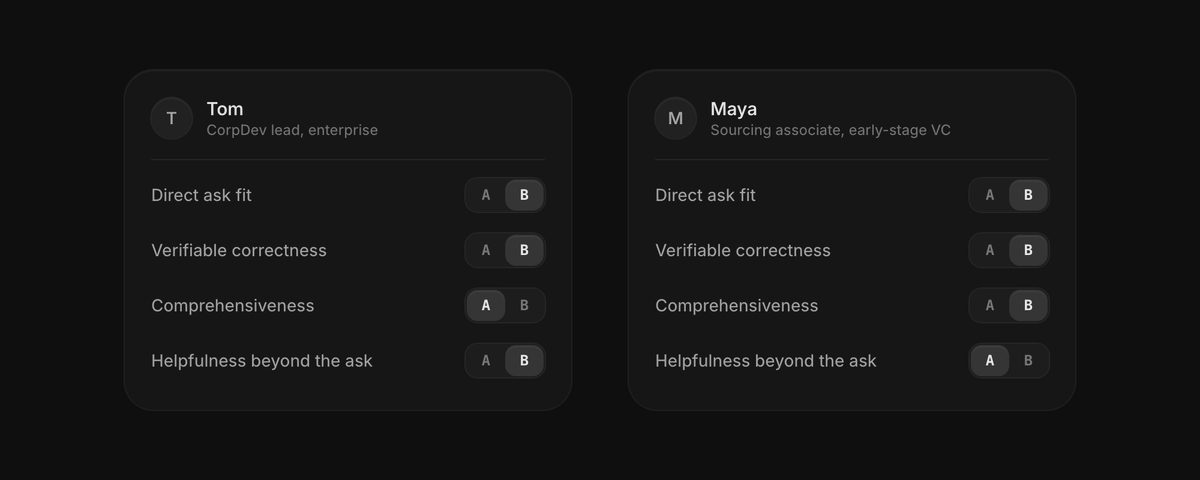
Some great mental models on writing high-quality evals by @austinberke and the harmonic team. A pleasure to work with them and some especially useful breakdowns of:
- the tradeoffs between eval dimensions rather than optimizing for one score
- evaluating verifiable correctness rather than prescribing a single "right" answer
It also nails the importance of actually getting in and looking at the data to reward responses that build 'trust' - a quality that is often overlooked if the verification is purely left to a language model.



LangChain retweeted
Async subagents might be the biggest improvement to chat UX this year. We ship them out of the box in MDA. @sydneyrunkle wrote a great piece on how they work


LangChain retweeted

Ask your agent in Slack to compare three vendors. Three subagents research in parallel while it keeps answering your follow-ups.
That’s async subagents in @LangChain's Managed Deep Agents. No setup needed: every served agent gets an async general-purpose subagent.
LangChain retweeted

Async subagents keep your agent responsive to you while background workers handle the long tasks.
Try them out in Deep Agents today!
LangChain retweeted
i messed up the code block formatting in my blog on "browser use for deep agents" the design agent we tested browser use in fixed it, then used browser use to validate the change.
great example of how browser use enhances testing, very full circle!
xitter.twitterapi.xyz/sydneyrunkle/status/21…


LangChain retweeted
full transparency, things that went wrong during the filming of this demo...
- almost booked a reservation that required a HUGE downpayment / cancellation fee bc my card was saved on resy, so the agent could just book+pay
- hit rate limits w/ resy bc i simulated log in so many times trying to get the demo right
browser use is a relatively new primitive for agents, so it makes sense that we're working through some growing pains
the hardest things rn seem to be guardrails + working at scale
LangChain retweeted
A year ago I wrote that LangGraph isn't going anywhere. Today it's the runtime under everything at LangChain, including MDA
@JoshARosen wrote a good piece on why deterministic layers will become standard agent infrastructure. We made the same bet early: xitter.twitterapi.xyz/JoshARosen/status/2117…

The fact that LangGraph has not changed much is a testament to its robustness and timelessness. I've loved working on this framework and I'm continuously blown away by the diversity of agentic applications I've seen built with it.
This is the decade of agents and LangGraph isn't going anywhere. Check out our new docs site which unifies langchain and langgraph OSS docs, there are some great tutorials to get you started. Knowing how to build with this framework is an insanely useful skill
LangChain retweeted

Who's joining us for World of Tavily NYC? On November 12, you'll hear lightning talks from leaders at Tavily, @nebiusai, @LangChain, Ocean, and @IBM about how production agents find, understand, and use information from the live web.
Come ready to ask questions, exchange ideas with other builders, and spend time with the speakers. We’ll also have plenty of bites, drinks, swag, and immersive sights to explore.
📅 Thursday, November 12
📍 New York City
Request to join: hubs.li/Q04DbVtF0

LangChain retweeted
this piece is worth the read, but quite dense. here's my (relatively) brief breakdown:
super agents are defined by 4 characteristics:
- continuous: one agent across threads and access points
- productive: responds quickly and completes work efficiently
- proactive: responds to events in its environment
- persistent: durable execution for high availability and crash recovery
these constraints apply to personal agents and agents doing commercial work alike, so the underlying architecture should look similar
the primitives behind them:
- two level architecture: a router layer keeps interaction continuous, and a worker layer runs tasks concurrently
- event driven design: the agent reacts to events in its environment and can schedule runs toward a long term goal
- multi channel interaction: context carries across channels, and async execution keeps the agent productive
- separate compute, state, and environments: the "separate the brain from the hands" idea, which supports persistence and security and lets the system scale
- watchdog: an independent control loop that keeps the whole thing running
they're upfront about what's still open:
- reliable scale
- representing tasks and work without the "session" primitive
- agent to agent communication and context standards
- security and privacy, as always
their core claim is that models need less and less human intervention on individual tasks, so the bottleneck to further productivity gains is shifting to human attention
which raises the question i'm most interested in: how do we design human-agent collaboration when human attention is the bottleneck?