

Making physics easier to understand, from the fundamentals to the latest discoveries.
Joined July 2024
- Tweets2.2K
- Following2.3K
- Followers37.5K
- Likes931




Pinned Tweet
Polaris won't be the North Star forever: Earth's axis wobbles like a spinning top, and in about 12,000 years it will point near Vega.
The Sun and the Moon pull on the bulge around Earth's equator, and the spinning Earth answers by swinging its axis round a circle in the sky, one turn about every 25,800 years.
When the Great Pyramid was built, around 2560 BC, the North Star was Thuban in Draco, 1.3 degrees from the pole. Vega was a pole star once before too, about 14,000 years ago. Around AD 27,200 the circle closes and Polaris is the North Star again.
A cup of tea is losing heat three ways at once, and each way follows a different rule.
Joseph Fourier wrote the law of conduction in 1822, while Newton had described cooling in moving air as far back as 1701. Radiation was the last to be understood. Josef Stefan found its fourth power rule from measurements in 1879, and his student Ludwig Boltzmann derived it from theory a few years later.
A vacuum flask is built to block all three. Its double wall holds a vacuum, so nothing can conduct or carry heat across, and silvered glass reflects the radiation back. James Dewar invented it in 1892 to keep liquid gases cold.

Both release the energy locked inside nuclei, but they run in opposite directions along the same curve.
Otto Hahn and Fritz Strassmann split uranium in Berlin in 1938, and Lise Meitner and her nephew Otto Frisch explained what had happened and named it fission. A year later Hans Bethe worked out that the Sun runs on fusion. Fusion has been the harder one to tame. In December 2022 a laser facility in California got out more fusion energy than its lasers delivered to the fuel, the first time that happened, although the whole building still used far more.
Iron sits at the top of the curve, which is why neither process can squeeze energy out of it.

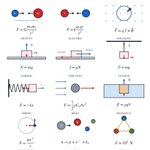
Physics lists four fundamental forces, yet a school textbook finds a dozen.
Most of the ones you feel are a single force in disguise. A table pushing back, friction, a rope pulling and a spring resisting are all atoms pushing on atoms through electromagnetism. Newton wrote down gravity in 1687, and Charles Coulomb measured the electric force with a twisting wire in 1785. The weak and strong forces were only found in the twentieth century, because they act across distances smaller than an atom.
That is why the last two have no everyday feeling. Without the strong force no nucleus would hold together, and without the weak force the Sun would not shine.


Why does the list of thermodynamic laws start at zero?
The first three were already famous when physicists realised they all assume that temperature means something. Ralph Fowler gave that missing foundation its name in the 1930s, and since it had to come first it became the zeroth. The second law grew out of Clausius and Kelvin arguing in the 1850s about how much work a steam engine could ever pull from heat. The third came from Walther Nernst around 1906.
Cold turns out to have a floor. Laboratories have reached billionths of a degree above it and never onto it.


A solid disc can cast a shadow with a bright spot at its very centre.
In 1818 the French Academy of Sciences ran a prize contest on diffraction. Augustin Fresnel entered a wave theory of light, and committee member Simeon Poisson, a supporter of the particle view, pointed out that it implied this absurd spot. Francois Arago tested it and found the spot, and Fresnel won. Joseph Delisle and Giacomo Maraldi had seen it a century earlier, but nobody had taken notice.
The effect now matters for space telescopes. Proposed starshades use carefully shaped petals so the bright spot and other diffraction ripples do not swamp a faint planet.

A flea can jump hundreds of times its own height, and no elephant ever will.
Galileo explained why in 1638 in his Discourses on Two New Sciences, arguing that a giant would need bones out of all proportion to a normal body. In 1926 the biologist J. B. S. Haldane put it vividly in his essay On Being the Right Size, noting that a mouse survives a fall down a mine shaft that would kill a person and break a horse.
It shapes engineering too. Skyscrapers, aircraft and ships cannot be scaled up from a small model by simply enlarging every part, because the loads grow faster than the strength.


Move the Moon 30 times closer and Earth tears it into rings.
We put the Moon on a circular orbit 12,800 km from Earth's centre, 30 times closer than today. It now laps Earth every 4 hours at 5.6 km/s, and Earth's tides on it are 27,000 times stronger. That is inside the Roche limit, where Earth's tides beat the Moon's own gravity: about 9,500 km for a rigid Moon, 18,500 km for a fluid one, and about 16,600 km for loose rubble like this.
In our run the Moon stretches toward Earth within the first hour and tears apart within an hour and a half. Its inner stream dives into Earth: 49% of the Moon lands within 60 hours, at about 9 km/s, with about 3 million times the energy of the impact that ended the dinosaurs. The other half wraps round Earth into a ring: 90% of it lies 10,600 to 78,000 km from Earth's centre, and it holds about 2,400 times the mass of Saturn's rings. No new moon forms in our 60 hours; published simulations of disks like this find the part outside the Roche limit gathering into a new, smaller moon within about a month.
Simulated as a rubble pile of about 20,000 pieces held together only by their own gravity (REBOUND, with collisions).
The shortest chapter in the history of physics textbooks.
From Why String Theory? by Joseph Conlon, CRC Press

A tiny doorkeeper who sorts fast molecules from slow ones seems able to break the second law of thermodynamics.
James Clerk Maxwell imagined the creature in a letter of 1867. Leo Szilard linked it to information in 1929, and Rolf Landauer showed in 1961 that erasing a bit of memory has an unavoidable energy cost. In 1982 Charles Bennett argued that the demon must eventually wipe its memory, and that this erasure pays back the entropy it seemed to save.
In 2010 a Japanese team built a working version with a microscopic bead and turned information into energy. The second law survived, with information counted as a physical quantity.


In a room full of air, no two molecules move at the same speed, and a few are far faster than average.
James Clerk Maxwell derived the distribution in 1860, and it is often called the first statistical law of physics. Ludwig Boltzmann extended it a few years later. In 1920 Otto Stern checked it directly by sending silver atoms through a spinning apparatus that sorted them by speed.
The fast tail has real consequences. It lets hot drinks cool by evaporation, it makes chemical reactions speed up with temperature, and it is why Earth has lost most of its helium, since the lightest molecules in the tail reach escape speed.

Every possible state of a single qubit sits at one point on the surface of a sphere.
Felix Bloch introduced it in 1946 to describe nuclear magnetic resonance, the same physics behind MRI, long before anyone built a quantum computer. The picture is a close cousin of the Poincaré sphere used for polarized light.
A classical bit can only be 0 or 1. A qubit can sit anywhere on the sphere, yet a measurement still returns only 0 or 1, with odds set by how close the point is to each pole. Quantum gates are rotations, and designing a quantum program amounts to steering a point across this surface.

A magnetic field can bend a charged particle's path but can never make it go faster.
The force law is named after Hendrik Lorentz, who gave it its modern form in 1895. Ernest Lawrence turned the circular path into the cyclotron in the 1930s, building the first of the machines that accelerate particles in spirals. The mirror effect in the last panel is why Earth's field traps particles in the Van Allen belts, discovered in 1958 by the Explorer 1 satellite.
Trapped particles bounce between the poles in the same way, and a few spill into the atmosphere to make the aurora.

A pendulum has only three kinds of motion, and one picture holds all of them.
Galileo is said to have noticed in a cathedral in Pisa that a swinging lamp keeps the same beat as its swing shrinks. The story is probably a legend, and the rule is true only for small swings. Large swings take longer, and the picture shows exactly why.
Henri Poincaré built on this way of drawing motion in the 1880s, and engineers now use it for circuits, populations and orbits. A pendulum balanced exactly upright sits at the gold crossing point, where the slightest nudge decides which way it falls.
