
Global statistics, macro trends & smart insights 🌍📊 | Learn something new daily | DM for Collab For Booking - https://xitter.twitterapi.xyz/t.co/cheyaAmIGl
India
Joined November 2012
- Tweets5K
- Following200
- Followers83.9K
- Likes12.1K






Cost of Salt Around the World
The markup on basic kitchen salt across borders makes zero economic sense.
A single kilo costs $0.20 in Russia and $0.31 in India, but rockets past $3 in the US and Uruguay.
Ghana hitting the top spot at $3.23 per kg is especially wild for an essential mineral that literally sits on the ground. You are not paying for the raw sodium chloride at that point. It is almost entirely local packaging, domestic freight friction, and supermarket retail shelf margins running up the bill on the cheapest commodity on Earth.


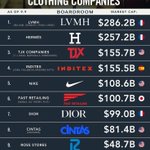
The World's Most Valuable Clothing Companies
Selling discount overstock is worth more than most historic luxury houses.
Everyone expects LVMH and Hermès at the very top of global apparel valuations.
The wild part is TJX Companies sitting at $155.7B, essentially tied with Inditex and valued way higher than Nike, Fast Retailing, or Dior. A boring off-price retailer buying surplus racks for T.J. Maxx and Marshalls has quietly built an enterprise worth more than four times Adidas. The market loves high fashion prestige, but liquidation logistics for everyday shoppers prints far more steady cash.


Elon Musk has 14 publicly known children with four women.
1. With Justine Wilson (6 children)
* Nevada Alexander (died at 10 weeks old)
* Griffin
* Vivian Jenna Wilson
* Kai
* Saxon
* Damian
2. With Grimes (3 children)
* X Æ A-Xii (X)
* Exa Dark Sideræl (Y)
* Techno Mechanicus (Tau)
3. With Shivon Zilis (4 children)
* Strider
* Azure
* Arcadia
* Seldon Lycurgus
4. With Ashley St. Clair (1 child)
* Romulus
Adani Group plans to invest over $120 billion in the next five years, putting more than $20 billion annually into its core businesses and new growth areas. Around 70% of the investment will go into energy, 20% into transport and logistics, and the remaining 10% into areas like cement, copper and aluminium.
The massive investment push is expected to double the group's asset base to ₹18 lakh crore and generate core earnings of up to ₹3 lakh crore within five years. Overall, Adani is betting big on infrastructure, energy and industrial growth to strengthen its position and expand its business.


Einstein gets almost all the credit, but the mathematical heavy lifting was already done.
Lorentz basically solved the transformation equations and the contraction factor before 1905.
He figured out the exact gamma factor that explains time dilation and length contraction purely to make Maxwell's equations hold up in different frames. Einstein's actual genius was taking Lorentz's mathematical fix and realizing it was not just a neat trick for electromagnetism, but the literal fabric of space and time itself. It is wild how close Lorentz came to the entire theory on his own.

The World's most powerful compute clusters
Private AI cluster scaling is starting to pull away from big tech defaults.
Looking at xAI's Colossus Phase 2 sitting at 200k H100 equivalents right in the center.
That is double the individual 100k footprints listed for Meta or the Microsoft and OpenAI buildout. What stands out just as much are the blue dots versus the red ones on the map. The US is basically hosting nearly all of the confirmed massive mega-clusters, while other regions are running small sovereign setups or fragmented systems. The sheer concentration of high-density AI compute in one country is getting pretty ridiculous.


We refine an entire barrel of oil mostly just to burn it on roads.
Between petrol at 42% and diesel at 27%, road transport eats up nearly 70% of every single 159-liter barrel.
The part people tend to forget is that thin bottom stack. Petrochemical feedstocks, asphalt, waxes, and lubricants only make up around 14% combined. But that tiny sliver supplies the base materials for our paved highways, plastics, electronics, and synthetic clothing. Even if every vehicle went electric tomorrow, our entire physical manufacturing base still relies on what comes out of that bottom fraction.


