

The fastest AI dev news engine on X — model releases, tools, and what they actually mean
What is trending in AI?
Joined April 2016
- Tweets14.3K
- Following1.2K
- Followers12K
- Likes7.6K




Pinned Tweet
▲ Marktechpost just launched GPU Leaderboard ( in beta mode), a free cloud GPU price comparison for inference, along with a Chrome extension.
The key idea is pricing a whole run, not a single hourly rate. Pick a GPU, count, duration and utilization, and it prices that exact run at every provider.
The spread is large: an 8×H100, 72-hour run costs $967.68 at the cheapest provider and $3,545.28 at the priciest, 73% less.
The chrome extension shows a model's VRAM needs at FP16, INT8 and INT4 on Hugging Face pages, and the cheapest GPU that fits. Free, multiple providers, 201 live instances, 37 accelerators......
Full analysis: marktechpost.com/2026/11/11/…
Portal: gpuleaderboard.com/
Chrome Extension: aicampaign.live/gpu-1
@Marktechpost @CoreWeave @nebiusai @latitudesh @LambdaAPI @runpod and many more...
▲ Google just released the Gemini Decisions API, powered by Gemini Decision 1, a model that answers typed questions instead of writing text.
The key idea is scoring, not generating. You send 1 shared input (text, images, audio, video or PDFs, up to 256K tokens) plus up to 1,000 yes/no, choice or rubric questions. The model scores every option in 1 forward pass and returns calibrated probabilities with a confidence value. Output tokens are always 0.
On Google's benchmark table, it leads 7 of 9 accuracy tests, including 92.2% on JevBench vs 90.9% for GPT-6 Luna on OpenAI's Decisions API. Its calibration error is 0.0250, about half of TypeSafe Jev 1.14 (0.0494). It is a trade-off though: Jev 1.14 wins When2Call (82.0% vs 79.9%) and costs less on the shared suite ($0.68 vs $0.88).
Pricing is $0.10 per 1M input tokens, $0 output, with a free tier in AI Studio. Google reports 150-250 ms end-to-end latency. No context caching or Batch API yet......
Full analysis: marktechpost.com/2026/11/11/…
Blog: blog.google/innovation-and-a…
Docs: aistudio.google.com/docs/dec…
Model: aistudio.google.com/docs/mod…
@GoogleAIStudio @OfficialLoganK @Google

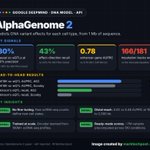
▲ Google DeepMind just released AlphaGenome 2, a DNA model that predicts variant effects in specific cell types instead of tissue averages.
The key idea is conditioning. The model reads 1 Mb of DNA plus 1 target condition, a tissue, cell type or cell state. A 256-d embedding modulates the encoder, transformer and decoder. You can also build that condition from raw scRNA-seq counts, with no fine-tuning.
On TenK10K single-cell eQTLs, it recovers 30% of causal variants at 90% precision. AlphaGenome 1 fine-tuned on single-cell data recovers 16%. Enhancer-gene AUPRC is 0.78 vs 0.73. It is a trade-off though: outside accessible chromatin, sign prediction AUROC tops out at 0.63.
Available now via the AlphaGenome API, free for non-commercial research. .
Full analysis: marktechpost.com/2026/11/11/…
Paper: storage.googleapis.com/deepm…
Docs: alphagenomedocs.com
Blog: deepmind.google/blog/alphage…
@GoogleDeepMind @pushmeet @sundarpichai

▲ Fish Audio just released Live 3, a full-duplex voice model that keeps listening while it speaks, so voice agents stop talking over callers.
The key idea is moving turn-taking into the speech model itself. Instead of silence thresholds and hand-written rules, Live 3 was trained on real human conversations. It learns when to acknowledge, wait, respond or stop, so "yeah" lets it keep going while "wait, actually" makes it yield.
Fish Audio says Live 3 can decide to react in as little as 186 ms for short cues like "mm-hmm" or "okay, 415". For context, Eleven Realtime v1 Max reports 0.57 s average time to first audio, a different measurement. It is a trade-off though: Live 3 is English only at launch, and Fish Audio has published 0 benchmark scores so far.
It runs on the Fish Agent Platform, the Fish Audio API and on-prem for enterprises. Agents are $0.035/min until Dec 31, 2026 ($0.07 list), covering STT, TTS and basic LLMs......
Full analysis: marktechpost.com/2026/11/10/…
Technical details: fish.audio/blog/introducing-…
Try it: fish.audio/live3
Docs: docs.fish.audio/agents/overv…
@FishAudio @rissa_cao @LengyueMatrix

▲ Marktechpost AI retweeted
▲ Anthropic just released Claude Fable 5.2 and Claude Mythos 5.2, an upgrade that beats Opus 5.5 on most of its own benchmarks at a lower price.
The key idea is 1 model with 2 safeguard levels. Fable 5.2 runs classifiers that block high-risk cyber and research-biology requests, then hands those to Opus 4.8 or Opus 5. Mythos 5.2 is the same model without those blocks, for vetted orgs only.
On FrontierCode 2.0, Fable 5.2 scores 49.1% at Xhigh effort, vs 45.5% for Opus 5.5 and 42.8% for GPT-6 Astra. At High effort it matches Opus 5.5's best score for roughly half the cost per task. It is a trade-off though: Gemini 4 Carbon still leads AutomationBench (53.9% vs 51.4%), and every score is self-reported.
Pricing is $8 / $40 per million tokens, with a 1M-token context window and 128K output. Fast mode runs up to 2.5x faster at $16 / $80. API ID: claude-fable-5-2......
Full analysis: marktechpost.com/2026/11/10/…
Launch post: anthropic.com/claude-fable-a…
Docs: platform.claude.com/docs/en/…
System card: anthropic.com/document/claud…
@AnthropicAI @claudeai

▲ Marktechpost AI retweeted
▲ Zyphra just open-sourced ZONOS3-Mini, a text-to-speech model that clones voices and runs in real time on a phone or laptop.
The key idea is sparsity. It is a Mixture of Experts with 800M total parameters, but only about 100M are active per token. A new 15 Hz codec (ZAC-1) cuts the number of frames the model has to generate.
On Zyphra's ZTTS2-Eval it scores 66.2 on the Capability Index, ahead of Fish Audio S2 Pro (61.7) and MOSS-TTS v1.5 (60.2). Clean-set WER is 7.79 vs 11.06 for Fish S2 Pro. Time to first audio is 80 ms on 1 H100. It is a trade-off though: all of this is Zyphra's own benchmark, and reference-clip cloning drops to 44.7 on the same index.
Weights are Apache 2.0. Runtimes cover WebGPU in the browser, MLX, ggml and SGLang-Omni, plus a hosted API on Zyphra Cloud......
Full analysis: marktechpost.com/2026/11/10/…
Model: huggingface.co/Zyphra/ZONOS3…
Repo: github.com/Zyphra/ZONOS3-Min…
Blog: zyphra.com/our-work/zonos3-m…
Playground: zyphra.com/zonos3mini/localp…
@ZyphraAI

▲ Marktechpost AI retweeted
▲ Meta FAIR just open-sourced e-means, a drop-in replacement for k-means that reaches the same loss in about one-tenth the epochs.
The key idea is simple. Lloyd's k-means recomputes every centroid from the full dataset each pass. e-means reads small mini-batches and keeps an exponential moving average of each cluster's sum and count. Two fitted scaling laws pick the batch size and step size from n, k and epochs, so there is nothing to tune beyond k.
The numbers: e-means beats Lloyd's 25-epoch loss in 1.4 to 2.6 epochs. That is a 10-45x GPU speedup vs Flash-KMeans and 8-15x on CPU vs Faiss. It also clustered 10 billion DINO embeddings into 16.7M clusters in 2.5 epochs. It is a trade-off though: runs are stochastic, and 16.7M centroids need 64 GiB of float32 accumulators, so they must be sharded. All results are self-reported.
Full analysis: marktechpost.com/2026/11/10/…
Paper: arxiv.org/abs/2611.09501
Repo: github.com/facebookresearch/…
Blog: e-means.github.io
@swann_bessa

▲ Meta FAIR just open-sourced e-means, a drop-in replacement for k-means that reaches the same loss in about one-tenth the epochs.
The key idea is simple. Lloyd's k-means recomputes every centroid from the full dataset each pass. e-means reads small mini-batches and keeps an exponential moving average of each cluster's sum and count. Two fitted scaling laws pick the batch size and step size from n, k and epochs, so there is nothing to tune beyond k.
The numbers: e-means beats Lloyd's 25-epoch loss in 1.4 to 2.6 epochs. That is a 10-45x GPU speedup vs Flash-KMeans and 8-15x on CPU vs Faiss. It also clustered 10 billion DINO embeddings into 16.7M clusters in 2.5 epochs. It is a trade-off though: runs are stochastic, and 16.7M centroids need 64 GiB of float32 accumulators, so they must be sharded. All results are self-reported.
Full analysis: marktechpost.com/2026/11/10/…
Paper: arxiv.org/abs/2611.09501
Repo: github.com/facebookresearch/…
Blog: e-means.github.io
@swann_bessa
▲ Zyphra just open-sourced ZONOS3-Mini, a text-to-speech model that clones voices and runs in real time on a phone or laptop.
The key idea is sparsity. It is a Mixture of Experts with 800M total parameters, but only about 100M are active per token. A new 15 Hz codec (ZAC-1) cuts the number of frames the model has to generate.
On Zyphra's ZTTS2-Eval it scores 66.2 on the Capability Index, ahead of Fish Audio S2 Pro (61.7) and MOSS-TTS v1.5 (60.2). Clean-set WER is 7.79 vs 11.06 for Fish S2 Pro. Time to first audio is 80 ms on 1 H100. It is a trade-off though: all of this is Zyphra's own benchmark, and reference-clip cloning drops to 44.7 on the same index.
Weights are Apache 2.0. Runtimes cover WebGPU in the browser, MLX, ggml and SGLang-Omni, plus a hosted API on Zyphra Cloud......
Full analysis: marktechpost.com/2026/11/10/…
Model: huggingface.co/Zyphra/ZONOS3…
Repo: github.com/Zyphra/ZONOS3-Min…
Blog: zyphra.com/our-work/zonos3-m…
Playground: zyphra.com/zonos3mini/localp…
@ZyphraAI
▲ Anthropic just released Claude Fable 5.2 and Claude Mythos 5.2, an upgrade that beats Opus 5.5 on most of its own benchmarks at a lower price.
The key idea is 1 model with 2 safeguard levels. Fable 5.2 runs classifiers that block high-risk cyber and research-biology requests, then hands those to Opus 4.8 or Opus 5. Mythos 5.2 is the same model without those blocks, for vetted orgs only.
On FrontierCode 2.0, Fable 5.2 scores 49.1% at Xhigh effort, vs 45.5% for Opus 5.5 and 42.8% for GPT-6 Astra. At High effort it matches Opus 5.5's best score for roughly half the cost per task. It is a trade-off though: Gemini 4 Carbon still leads AutomationBench (53.9% vs 51.4%), and every score is self-reported.
Pricing is $8 / $40 per million tokens, with a 1M-token context window and 128K output. Fast mode runs up to 2.5x faster at $16 / $80. API ID: claude-fable-5-2......
Full analysis: marktechpost.com/2026/11/10/…
Launch post: anthropic.com/claude-fable-a…
Docs: platform.claude.com/docs/en/…
System card: anthropic.com/document/claud…
@AnthropicAI @claudeai
▲ Marktechpost AI retweeted
▲ Meta just released Muse Ember, its smallest model, and it matches Claude Haiku 5.5 on the Artificial Analysis Intelligence Index at about a third of the cost per task.
The key idea is a split of labour inside agents. Muse Wonder plans the hard problem. Ember runs the volume: tool calls, tests, targeted code fixes, routing and extraction. It takes text, images, audio and video natively, with a 1M-token context and up to 512K output tokens.
Ember scores 36 on the AA Intelligence Index at max effort, level with Claude Haiku 5.5 and ahead of GPT-6 Luna at 28. Meta's chart puts Ember at $0.136 per task versus $0.411 for Haiku. On AutomationBench-AA it completes 37.8% of workflows, versus 20.2% for Luna and 13.9% for Haiku.
It is a trade-off though: Ember trails Haiku 5.5 on FrontierCode 2.0-AA, 27.2 vs 34.9, which judges whether real-repo changes are mergeable. Several results are also Meta internal runs.
Available today on Meta Model API and Muse Code as muse-ember-1.0. $0.10 per 1M input tokens, $0.50 per 1M output. Weights are closed and parameter count is not disclosed......
Full analysis: marktechpost.com/2026/11/09/…
Blog: research.meta.ai/blog/muse-e…
Eval report: research.meta.ai/static/muse…
API: developer.meta.com/ai/produc…
@AIatMeta

▲ Marktechpost AI retweeted
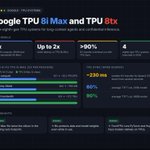
▲ Google just added TPU 8i Max and TPU 8tx to its eighth-gen TPU lineup, giving long-context agents and regulated AI their own TPU systems.
The key idea is building new systems around existing silicon, not new chips. TPU 8i Max packs 2 TPU 8i chips into 1 package. TPU 8tx pairs TPU 8t silicon with 5th Gen AMD EPYC hosts to keep data and weights protected while in use.
Google says 8i Max doubles TPU 8i compute, SRAM and HBM bandwidth. That implies about 17.2 TB/s per package, versus 22 TB/s on NVIDIA Rubin. 8tx claims up to 2x lower latency than TPU 8t. It is a trade-off though: Google published no absolute specs, prices or benchmarks for either system......
Full analysis: marktechpost.com/2026/11/09/…
Blog: blog.google/innovation-and-a…
Repo: github.com/google/tpu-sync
Docs: cloud.google.com/blog/produc…
@Google @googlecloud @AminVahdat

▲ Marktechpost AI retweeted
▲ Baidu just released ERNIE Evolve, an automated research system that edits AI training and inference code and keeps only verified gains.
The key idea is 2 nested loops. A Director picks research directions, and parallel lanes evolve trees of code versions. A hidden Evaluator outside the repo scores each candidate, and a Reviewer discards anything that games the eval.
On public benchmarks it hit 0.8763 BPB on NanoChat AutoResearch (best public: 0.8878) and 38.9 s on NanoGPT Speedrun Track 1 (record: 39.9 s). On ERNIE-5.5-Flash it pushed Kunlunxin P800 speed to 623.6% of baseline and deterministic GPU throughput up 33.7%. It is a trade-off though: SOL-ExecBench came in at 0.819, behind the 0.827 leader, and a 6.7 s Speedrun claim posted Oct 28 already moves that bar.
The system itself is not released. Baidu open-sourced the final code and run logs for the public benchmark results......
Full analysis: marktechpost.com/2026/11/09/…
Blog: ernie.baidu.com/research/pos…
Repo: github.com/ernie-research/ER…
@Baidu_Inc @Baidu_ERNIE

▲ Meta just released Muse Ember, its smallest model, and it matches Claude Haiku 5.5 on the Artificial Analysis Intelligence Index at about a third of the cost per task.
The key idea is a split of labour inside agents. Muse Wonder plans the hard problem. Ember runs the volume: tool calls, tests, targeted code fixes, routing and extraction. It takes text, images, audio and video natively, with a 1M-token context and up to 512K output tokens.
Ember scores 36 on the AA Intelligence Index at max effort, level with Claude Haiku 5.5 and ahead of GPT-6 Luna at 28. Meta's chart puts Ember at $0.136 per task versus $0.411 for Haiku. On AutomationBench-AA it completes 37.8% of workflows, versus 20.2% for Luna and 13.9% for Haiku.
It is a trade-off though: Ember trails Haiku 5.5 on FrontierCode 2.0-AA, 27.2 vs 34.9, which judges whether real-repo changes are mergeable. Several results are also Meta internal runs.
Available today on Meta Model API and Muse Code as muse-ember-1.0. $0.10 per 1M input tokens, $0.50 per 1M output. Weights are closed and parameter count is not disclosed......
Full analysis: marktechpost.com/2026/11/09/…
Blog: research.meta.ai/blog/muse-e…
Eval report: research.meta.ai/static/muse…
API: developer.meta.com/ai/produc…
@AIatMeta
▲ Google just added TPU 8i Max and TPU 8tx to its eighth-gen TPU lineup, giving long-context agents and regulated AI their own TPU systems.
The key idea is building new systems around existing silicon, not new chips. TPU 8i Max packs 2 TPU 8i chips into 1 package. TPU 8tx pairs TPU 8t silicon with 5th Gen AMD EPYC hosts to keep data and weights protected while in use.
Google says 8i Max doubles TPU 8i compute, SRAM and HBM bandwidth. That implies about 17.2 TB/s per package, versus 22 TB/s on NVIDIA Rubin. 8tx claims up to 2x lower latency than TPU 8t. It is a trade-off though: Google published no absolute specs, prices or benchmarks for either system......
Full analysis: marktechpost.com/2026/11/09/…
Blog: blog.google/innovation-and-a…
Repo: github.com/google/tpu-sync
Docs: cloud.google.com/blog/produc…
@Google @googlecloud @AminVahdat
▲ Baidu just released ERNIE Evolve, an automated research system that edits AI training and inference code and keeps only verified gains.
The key idea is 2 nested loops. A Director picks research directions, and parallel lanes evolve trees of code versions. A hidden Evaluator outside the repo scores each candidate, and a Reviewer discards anything that games the eval.
On public benchmarks it hit 0.8763 BPB on NanoChat AutoResearch (best public: 0.8878) and 38.9 s on NanoGPT Speedrun Track 1 (record: 39.9 s). On ERNIE-5.5-Flash it pushed Kunlunxin P800 speed to 623.6% of baseline and deterministic GPU throughput up 33.7%. It is a trade-off though: SOL-ExecBench came in at 0.819, behind the 0.827 leader, and a 6.7 s Speedrun claim posted Oct 28 already moves that bar.
The system itself is not released. Baidu open-sourced the final code and run logs for the public benchmark results......
Full analysis: marktechpost.com/2026/11/09/…
Blog: ernie.baidu.com/research/pos…
Repo: github.com/ernie-research/ER…
@Baidu_Inc @Baidu_ERNIE
▲ Marktechpost AI retweeted
▲ Reason Machines just open-sourced Aspen, a Git server built for repos that hundreds of AI agents push to at once.
The key idea is to stop ordering every push through one repository queue. Each branch is one Postgres row moved by a single compare-and-swap, so pushes to different branches never wait. Packs are stored as pushed in object storage and reused on fetch, so nothing is recompressed per client.
In the team's own test, Aspen sustained 567 pushes per second for 5 minutes on one 8-core server with S3 Standard. Median push was 208 ms and p99 was 314 ms. Cursor publishes 120/s for Origin on S3 Standard, on a different, replicated setup. It is a trade-off though: landing on main still runs at about 4 per second, and the 24-hour chaos run stopped at 11.59 clean hours.
Full analysis: marktechpost.com/2026/11/09/…
Repo: github.com/reason-machines/a…
Blog: reasonmachines.com/blog/aspe…
Demo: place.reasonmachines.com
@reasonmachines

▲ Reason Machines just open-sourced Aspen, a Git server built for repos that hundreds of AI agents push to at once.
The key idea is to stop ordering every push through one repository queue. Each branch is one Postgres row moved by a single compare-and-swap, so pushes to different branches never wait. Packs are stored as pushed in object storage and reused on fetch, so nothing is recompressed per client.
In the team's own test, Aspen sustained 567 pushes per second for 5 minutes on one 8-core server with S3 Standard. Median push was 208 ms and p99 was 314 ms. Cursor publishes 120/s for Origin on S3 Standard, on a different, replicated setup. It is a trade-off though: landing on main still runs at about 4 per second, and the 24-hour chaos run stopped at 11.59 clean hours.
Full analysis: marktechpost.com/2026/11/09/…
Repo: github.com/reason-machines/a…
Blog: reasonmachines.com/blog/aspe…
Demo: place.reasonmachines.com
@reasonmachines
▲ Marktechpost AI retweeted
▲ Nous Research just open-sourced Arete-27B, a Qwen3.8-27B fine-tune that strips Chinese state framing from its answers.
The key idea is that the bias layer is shallow. Nous ran plain supervised fine-tuning on 52.8M tokens, with Inkling as the teacher. No RL, no preference optimization, no architecture change.
On Nous's 803-prompt eval, propaganda answers fell from 22% to 0.9%. Fact mean rose from 2.32 to 2.98 of 5. Hermes Bench held at 65.60% vs 65.77% for the base. It is a trade-off though: 2.98 still trails Muse Glimmer 30B (3.02), and 216 of 803 answers still score 0. The eval is self-built and self-judged.
27B dense, Apache 2.0, BF16 weights on Hugging Face. Eval and training data are public too......
Full analysis: marktechpost.com/2026/11/07/…
Model: huggingface.co/NousResearch/…
Eval: huggingface.co/datasets/Nous…
Technical details: nousresearch.com/arete
@NousResearch
▲ Marktechpost AI retweeted
▲ Google just open-sourced the Elephant-Goldfish Model (EGM) plugin, which makes your coding agent write and defend a spec before it writes any code.
The key idea is splitting context. The "Elephant" is a long session that holds your project history and drafts the design doc. The "Goldfish" are fresh subagents that read only that doc and the files it references, so they do not inherit the conversation's blind spots.
The review runs 5 stages: zoom out, a comprehension test where a Goldfish paraphrases the design, a critic review, a second zoom out, and an implementation-readiness check. In Google's own test record, Codex 0.163.0 completed 15 fresh-context reviewers end to end and Antigravity CLI ran 16. It is a trade-off though: the Claude Cowork run stopped after stages 5 to 7 on usage limits, and issue #237 reports AGENTS.md leaking into some CLI reviewers.
It ships as an Apache 2.0 plugin with 7 skills and 9 reviewer personas. It works in Antigravity, Claude Code 2.1.271+, Codex and ChatGPT. The plugin is free, but every review burns your own model quota......
Full analysis: marktechpost.com/2026/11/08/…
Repo: github.com/google/elephant-g…
Docs: egm.dev
@GoogleCloudTech
