

CSO @ https://xitter-newx.xyz-mikolabs.workers.dev/t.co/HAQEopbvoT | Transforming capital strategy & health finance| McMaster Senior Scientist • Stanford Advisor • Philanthropist shaping global resilience
Joined November 2022
- Tweets5.4K
- Following4.9K
- Followers4.6K
- Likes18.1K



People still really want to be in the room. StubHub, on the NYSE, grew sales on its platform 7% to $2.6 billion last quarter while adjusted EBITDA jumped 84%, and it raised its full year outlook. Experiences keep winning the wallet. Halftime bathroom lines, you're next.
77
I hopped on @NanoCapPod with @Tjernlund. Our conversation on $PDC is live now. @Perpetuals_com @upsideonly_com
open.spotify.com/episode/5g6…
Tokenization is quietly turning into plumbing. Securitize, on the NYSE, just posted a record $5 billion in average tokenized assets, up 39%, with ARK, BlackRock and Neuberger bringing products onchain. Boring finance on new rails is my favorite kind of progress.
1
91
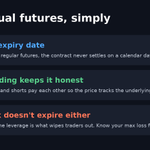
Perpetual futures in 3 lines.
A futures contract with no expiry date.
Longs and shorts pay each other funding that keeps the price tied to the asset.
No expiry doesn't mean no risk. Extreme leverage wipes traders out.
Born in crypto. Now in stocks, commodities and indices.

1
6
782
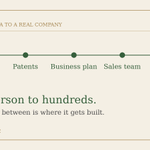
An idea isn't a company yet.
In between, you have to protect it, plan it, sell it and hire for it.
Most founders don't stall on the idea. They stall in between. That's the part I love helping with.
3
9
258
Google just ran an AI model on a TPU in orbit and got a haiku back over Norway.
Satellites in low Earth orbit can get up to 8x more solar power than on the ground. That's the pitch for compute in space.
Cute hello world. The real test is twin linked satellites in 2027.
1
5
223
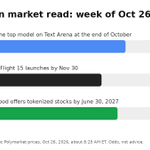
Monday prediction market read, from public Polymarket odds this morning.
Last week the market had Google at 86% to hold the top AI model spot at the end of October. It did.
AI. Google is 66% to stay on top through November, Anthropic 29%.
Space. Starship Flight 15 launching by Nov 30 sits at 76%, up from 74%.
Crypto. Robinhood offering tokenized stocks by mid 2027 is at 85%, up from 82%.
Real money behind every number. Same read next Monday.

1
3
160
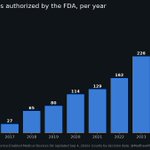
The FDA authorized 335 AI medical devices in 2025. In 2015 it was 6.
About three out of four AI devices on the FDA's list work in radiology, helping doctors read scans.
This is the AI story that gets the least hype and might help the most people.

Neuralink's R1 robot threads wires thinner than a human hair into the brain, with a neurosurgeon watching over it, so someone who lost their sight might see light again.
That's the AI story I care about most. Not the chatbot wars. Giving people back something they thought was gone for good.
2
84
Some of the best operators I've worked with thought they were stuck.
The bank said no and the plan felt dead.
More often than not, the business wasn't dead. Traditional banking was just the only door they'd tried.
3
105
The hardest part of fintech isn't the tech. It's patience.
The ideas that look obvious today usually spent years looking early.
Most people quit during the early part.
1
4
172
Before prediction markets, figuring out the odds of something meant reading ten opinions and guessing.
Now thousands of views get folded into one public number that updates the second new information shows up.
It's the news, priced in real time.
2
105
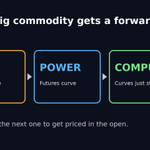
AI's most important commodity is still mostly priced in private deals: compute.
In July, Kalshi started publishing forward curves for Nvidia chips like the H200, built from prediction market prices.
Oil got a futures curve. Power got one. Compute is next.

1
1
88
Why does it take $500 to own one share of a great company?
It shouldn't. Fractional and tokenized shares let $5 buy a slice of the same company a big fund owns.
Ownership shouldn't come with a minimum.
1
76
Called It 🎯 #3
Falcon 9 is set to launch USSF-432 from California Monday night. The window opens 8:42 PM ET.
Does it fly in that first window?
Vote, then drop your call below to make the scoreboard. Just for fun.
0%Yes, first window
0%No, it slips
0 votes • Final results 2
76
Hoping every user hit this week is made whole. The industry only grows if people trust it with their money. That's why we chose the long road: regulated, transparent, built to last. No shortcuts.
1
49
Star Xu is right. Security is a team sport in this industry.
When one exchange gets hit, traders lose a little trust in all of us. Shared standards, shared threat intel and faster coordination shouldn't be a competitive edge. They should be the baseline.
Everyone has to step up.

🚨 LATEST: OKX CEO Star Xu says the Binance hack should serve as a wake-up call for the industry, and urges exchange CEOs to unite on stronger shared security standards.
“Security is everyone’s responsibility. No company can protect the future of crypto alone.”


1
1
53
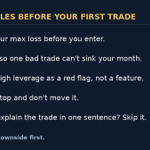
5 risk rules every new trader should learn before their first trade:
1. Pick your max loss before you enter.
2. Size it so one bad trade can't sink your month.
3. Treat high leverage as a red flag, not a feature. It's how traders get wiped out.
4. Set a stop and don't move it.
5. If you can't explain the trade in one sentence, skip it.
Protect the downside first.

2
2
101
More spectrum for satellite-to-phone means fewer spots on the map where your phone just says No Service. Dead zones are starting to look like a solved problem.

Big news, the FCC voted today to advance new satellite-to-phone rules that could benefit @SpaceX's Starlink Mobile, despite lobbying efforts by AT&T, Verizon, and T-Mobile to restrict parts of this proposal.
FCC: "This marks a major step to unleash American innovation and investment in next-generation connectivity."
The FCC voted to advance a proposal that would:
• Open up an additional 482 MHz of spectrum for satellite-to-phone services, expanding eligible frequency bands from 5 to 13.
• Eliminate restrictive spectrum-leasing requirements
• Remove rigid geographic coverage restrictions
• Allow more flexible agreements between satellite operators and wireless carriers
• Modernize technical rules to allow more efficient spectrum use
• Reconsider exclusive-use rights for certain satellite spectrum bands
If finalized, these changes could make it easier for SpaceX to expand Starlink Mobile, access additional spectrum, and reduce regulatory barriers.
Here's what happens next:
• Late 2026: Public comment period opens, allowing SpaceX, AT&T, Verizon, T-Mobile, and others to weigh in.
• Late 2026–Early 2027: Companies submit comments and responses arguing for or against specific rule changes.
• Early–Mid 2027: The FCC reviews the feedback, evaluates interference concerns, and considers revisions.
• Sometime in 2027: The FCC holds a final vote to officially adopt the new regulations.

1
102