
Thinker. Explorer.
Joined February 2020
- Tweets15.1K
- Following86
- Followers338
- Likes28.9K
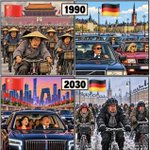


The best European university graduates in science and engineering struggle to earn even $3000 a month after taxes. Forget US, even top graduates in Bangalore and Beijing now have better career prospects than their counterparts in Berlin or Brussels. The youth see no future in EU.
Everyone talks about mass unskilled immigration to Europe, but the reality is much worse. Skilled Europeans, engineers, researchers, entrepreneurs, are leaving in large numbers. High marginal tax rates that treat additional earnings and business success primarily as a fiscal resource, layered with heavy regulation and a left cultural climate that views high productivity with suspicion, make them emigrate. Countries which reward hard work and entrepreneurship instead of punishing them with obscene taxes, become attractive destinations.
At the same time, many European welfare systems offer relatively unconditional lifelong benefits. This creates a huge pull for lower-skilled migration that does not require the same language, credentials, or immediate labor-market contribution. PISA data shows persistent and large achievement gaps between immigrant-background and native students in reading, mathematics, and science in numerous European countries. First-generation students frequently score even below basic proficiency and functional literacy thresholds.
High-value industries like advanced manufacturing, software, biotech, precision engineering require a skilled workforce. How can Europe stay competitive and prosperous if the best talent has had enough of the left nonsense and emigrates, replaced by largely illiterate inflows?

63
For the first time in human history, astonishing wealth is flowing towards STEM PhDs. That's a good thing, in my opinion.

Anthropic will make ~1,000 employees worth +$100m at $2 trillion market cap.
There's ~11,000 Americans with $100m in investable assets.
So something like 1 in 12 Americans with $100m (liquid) will be from Anthropic. If you add in Openai, maybe 1 in 7.
46
Another point, as people stop driving and start working productively in that time, how many billions of hours of EXTRA work are we going to get in a year ? What's the economic value of that ?

FSD could literally free up OVER $1.5 trillion/yr... WHY isn't anyone talking about this??
If Lawmakers were serious about serving the people, they would start focusing on how to speed up FSD adoption.
The Data:
Fatal & serious crashes cost the U.S. almost $2 trillion per year in total societal harm; including ~$400 billion in direct economic costs in the form of:
- medical bills
- property damage
- lost wages
- enormous quality-of-life cost of lost years
- permanent disability
Tesla’s latest FSD data shows vehicles with FSD engaged are ~9× SAFER than the average driver.
That means, if fully adopted, FSD could produce savings the size of any one of these:
- ~6% of GDP
- The entire Social Security program
- Medicare AND Medicaid
- Roughly 2× the defense budget
At this scale, FSD (and technologies like it) could be one of the first real steps toward an age of AI "abundance" people talk about.
50 years from now, our children and grandchildren will look back in horror at the fact that we ever drove at all.

1
36
There is a serious problem in working with mathematically dubious theories though. If you don't know why they work, then you will obviously have no clue when they don't work. Then you start using terms like dark energy. Really making sense of QFT may help with those things.

He has a point. To me the OpenAI announcement seems to be about mathematical physics.
To most people "mathematical physics" and "theoretical physics" sound interchangeable but they are different disciplines.
Theoretical physics is solidly part of physics. In this area, researchers develop either theories that explain observations already made, or they improve existing theories to make predictions for observations. (At least that's what they should be doing.)
Mathematical physics on the other hand is usually part of the department of mathematics, not physics. It is concerned, loosely speaking, with cleaning up the mess that physicists have made of their theories of nature. Or in some cases studying the properties of theories that have nothing to do with nature. (Like physics in lower or higher dimensions, fields that don't exist in nature, etc.)
People in these two disciplines work closely together of course. But mathematical physics is more maths than physics. I would not consider it part of the natural sciences as it is not itself concerned with describing nature.
I don't know exactly what the OpenAI discovery is about, but it sounds like it is more in the area of mathematical physics rather than theoretical physics. I am not saying this makes it irrelevant, but as Andreas points out, it is of limited interest for applications.
xitter-newx.xyz-mikolabs.workers.dev/karch_andreas/status/2…
1
64
Wow! Just wow!

Announcing three major scientific discoveries, one each in mathematics (harmonic analysis), computer science (complexity theory), and physics (quantum field theory).
AI starting to help us improve our understanding of the universe! openai.com/index/building-sc…

1
55
Europe is essentially USA minus the Republican party. Where all the postmodern leftist/green/globalist fantasies turned into reality. High taxes, degrowth, mass third world immigration. No hindrance from Trump and the pesky MAGA crowd. Well, enjoy the results.
Everyone is talking about Le Spread, the French-German ten-year bond yield differential, now at first euro crisis levels.
In reality, it’s much worse. During the first euro crisis, Germany still had a functioning economy and was seen as rock-solid. Today, many understand the German business model is broken, and Germany is just buying time by issuing more debt to mask its industry’s implosion through inflated, inefficient government spending and headcount. Germany is on the path to become another failed big-government state like France, with only a few years left to pretend with more debt that its economy is stable.
Le Spread doesn’t tell the whole story. With France already in crisis and Germany slowly becoming another France, Europe and the euro are cooked. If you own euro assets, hedge them before it’s too late.

60


I always thought that one major Western European nation has to collapse before the leftist/green/Islamic cabal running the Western civilization to the ground is finally defeated. France could be the one. Will be good for the civilization over the long run.
Many don’t yet grasp the seriousness of the French crisis. Markets have priced French debt as junk. The 10-year spread over German bunds has blown out to 174 bp, wider than Italy, Greece or Portugal, despite France’s AA-range S&P rating. The market concludes France’s fiscal arithmetic is broken and politically unfixable.
Public spending remains among the highest in the developed world (57% of GDP), an absurd tax burden already crushes growth potential, and the political system is paralyzed. Meaningful reforms have been impossible for years. When governments try, the unions and street response is rapid and often violent. Recent riots made the constraint explicit, any serious attempt to cut spending or raise the retirement age risks further unrest that damages business confidence, tourism and tax revenues. The short-term fiscal hit is already visible, the longer-term confidence channel is worse.
Higher borrowing costs compound the problem. Interest spending is set to exceed €90 billion next year, more than the defence or education budgets, and will keep rising as debt is refinanced at these spreads. That interest bill more than offsets any modest consolidation that might be legislated, widening the deficit and accelerating the debt-to-GDP ratio already near 120%. A ratings downgrade, which markets clearly anticipate, would raise funding costs for French banks, tightening credit, slowing growth and eroding tax revenues even further. That is the classic doom loop: higher yields → larger deficit → weaker growth and banks → even higher yields.
Rating agencies lag markets but will eventually follow the pricing. France lacks a governing majority capable of sustained fiscal adjustment without triggering further social paralysis and unrest. Until that changes, the market correctly treats French sovereign debt as much higher risk than its official rating implies. It is really difficult to imagine a scenario where France gets its act together and avoids a debt crisis taking down the entire eurozone with it. Please correct me if I’m wrong.

43
Imagine what the likes of NSA and US Cyber Command will be able to do with exclusive access to these models. Just imagine.

Over the past several months, we have substantially hardened the security of our research training environment. We’ve removed live internet access for all frontier models during training and built an offline world for them to use instead—a cached version of the web where they can still learn to browse, search, and use applications.
On September 20, after a model exploited a DNS misconfiguration to find a way outside of this offline world, we paused frontier training to strengthen containment further. We assembled teams of agents, powered by our most cyber-capable models, and tasked them with finding weaknesses in our research environments.
While they found no route to the internet they could easily exploit while concealing their activity from our monitors, they did find zero-day vulnerabilities, virtual machine escapes, and hardware side-channels for communication between agents. We used their discoveries to further strengthen our defenses and contribute fixes to open-source software.
After strengthening our containment architecture, we resumed our frontier RL training and inference on October 1. We’ve reserved substantial compute for continuous red-teaming, and made high-compute red-teaming part of the safety cases we use to decide whether frontier training and evaluation can proceed securely.
openai.com/index/securing-ou…

35
Can't compete with America in high tech. Can't compete with China on prices. Europe is getting caught in the no man's land in the middle. Future looks bleak.

Europe’s welfare state assumes there will be well-paid European workers to tax.
If Chinese factories squeeze the industrial wages and American AI squeezes the professional ones, every election becomes a fight over promises the tax base can no longer support.
4
61


There are 3 EU based companies that can be considered high tech (ASML, SAP, Siemens) among the world's top 100 most valuable companies. Just three. The rest are perfumes. Shocking just how much the EU has fallen.

Nvidia CEO Jensen Huang on Germany:
"Nothing pains me more, frankly, than to see one of the most technologically advanced countries to be left so far behind in technology.
And I think the reason for that is this: maybe it's the European way to overthink everything.
Germany has so much talent. Just get to work."


Sounds encouraging.

interpretability might be the most important scientific problem in the world right now, as I don't think we can solve alignment if we don't know what we're building. I think I have good news about it. I co-authored early work in mechanistic interpretability at OpenAI and came away pessimistic, because neural networks appeared to fold into arbitrary tangled knots. years later, I started openai's first large-scale automated interpretability project, finding about 2% of neurons legible with the primitive tools we had
with modern agentic tools and a much closer look, the picture looks totally different. the vast majority in models up to trillions of parameters are legible, and their circuits beautiful. many famous examples of tangled neurons turned out to be misunderstood. The roadblocks I expected mostly aren't there. I now think ambitious interpretability will be solved by the time we need it most, and possibly quite soon, as automated scientists keep improving. it may be a bitter lesson for interpretability: the simple thing, at absurd scale, works
already-clean.goodfire.com/

102
This is good actually. For the past 70 yrs or so physics was dominated by people with superb technical abilities. "Shut up and calculate" was the motto. We have reached the end of that route. Maybe it is time for philosopher physicists like Einstein and Bohr to shine again.

"Our initial evaluation suggested that GPT-6-Astra's score was in the late eighties followed closely by Opus 5.5. But, as we started to investigate the mistakes that the models might have made, the models, especially Astra, insisted that they were right and that it was the expert-supplied answers that were erroneous. When we went back to the experts it turned out, in multiple instances, that that the experts found some subtle errors buried deep inside their calculations. As they revised their answers, Astra's score started to inch up and it finally ended up with 98% (49/50)."


3
224
A brilliant analysis.

India built its IT industry on the belief that Western firms would pay for cheaper, English-speaking, qualified labor. What happens when AI labor displaces this model? David Oks (@davideoks) weighs in:

51