
Chief Economist of the Food and Agriculture Organization of the United Nations - FAO
Rome, Italy
Joined July 2012
- Tweets3.1K
- Following5.2K
- Followers16.6K
- Likes139



Trade can’t prevent droughts or floods. But it can help countries cope, or make things worse when governments restrict exports.
In a severe El Niño scenario, we estimate export restrictions could push another 21.4 million people into hunger.
doi.org/10.4060/cd8309en

What if there had been no wars? Our agrifood systems would be facing El Niño with more reliable inputs and trade, and greater financial capacity. Successive shocks have not only raised prices but eroded agrifood systems' capacity to absorb future ones. tinyurl.com/3vjpbxrj
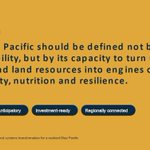
The Blue Pacific should be defined by its capacity, not its vulnerability. With rich fisheries and agricultural resources, Pacific Island nations can turn their natural assets into better diets, jobs, and resilience through smart policy and investment.
tinyurl.com/383f6b3w


Africa’s growing workforce and cities offer tremendous opportunities for agrifood transformation. Realizing this potential requires higher agricultural productivity, innovation, and stronger institutions that turn evidence into policies and investment.
tinyurl.com/4fszh6c6
How can farmers of all sizes use AI to be productive? I propose sticking to a simple principle of AI governance: the higher the potential for harm, the greater the need for caution.
maximotorero.com/2026/10/26/…

How can farmers of all sizes use AI to be productive? I propose sticking to a simple principle of AI governance: the higher the potential for harm, the greater the need for caution.
ft.com/content/41acd923-d0ca…

:The world doesn’t lack capital. It lacks effective ways to channel it into agrifood systems where investment can have the greatest impact.
@FAO's Hand-in-Hand Initiative is shifting how development and finance work together to transform agrifood systems.
youtu.be/j0OLBwMzdt4
Global grain supplies have buffered the impact of Black Sea trade disruptions. But with the war in Ukraine, the closure of the Strait of Hormuz, and El Niño compounding risks, the elastic band of agrifood system resilience is being stretched thin.
youtu.be/RMimTwgED7c
Agrifood systems offer tremendous opportunities for young people to build better livelihoods and careers. The Hand-in-Hand Investment Forum helps turn those opportunities into reality.
Registration closes Wed, 7 Oct, at midnight Rome time. See you there. fao.org/hand-in-hand/investm…
FAO Food Price Index rose 1.5% in September and 5.8% year on year. Cereal prices jumped 5.1% in one month. Global cereal supplies are sufficient for now, but shocks from Hormuz, the Black Sea, Red Sea and El Niño are starting to create compound risks. tinyurl.com/3nv36rkz

FAO Food Price Index rose 1.5% in September and 5.8% year on year. Cereal prices jumped 5.1% in one month. Global cereal supplies are sufficient for now, but shocks from Hormuz, the Black Sea, Red Sea and El Niño are starting to create compound risks. tinyurl.com/3nv36rkz
Agrifood systems need young people; and young people need agrifood systems -- for better incomes and opportunities to build careers.
Join us for the Hand-in-Hand Investment Forum: fao.org/hand-in-hand/investm…
Multilateralism should be judged not only by the agreements governments reach, but by what those agreements make possible. It must connect the actors, creating the conditions to turn collective ambition into action. @FAO's Hand-in-Hand Initiative is an example of this practice.
20 years ago, bringing telephones to isolated rural towns in Peru led to significant gains in household income. The technology has changed, but the challenge hasn't: How do we connect the people who stand to gain the most but are the most costly to reach?
doi.org/10.1111/j.1468-0335.…
As shipping is rerouted around Africa, there’s an opportunity that could outlast the current conflict in Middle East: invest in infrastructure to connect areas of high agricultural potential to markets. Ports, roads, rail, storage and logistics can boost Africa’s food security.

Global food security outlook is worsening, as pressures mount across agrifood systems: energy, fertilizer, freight, extreme weather, disrupted trade routes. The priority is to maintain market transparency, keep trade open, act early, and coordinate. tinyurl.com/2mj2j2tr
How do we regulate AI around human dignity and social justice, as Pope Leo XIV called for? In agriculture, we can start by asking, “How much more productive can AI make farmers and rural enterprises?” instead of “How many workers can it replace?”
vatican.va/content/leo-xiv/e…
Markets price not only today’s supply but expectations of what will be available tomorrow. Supply buffers are stronger than in 2022, and a food crisis is not inevitable. But the August price increases are a signal that multiple risks could converge into a broader supply shock.

My takeaway from the Africa Food Systems Forum in Kigali: Africa has the strategies, entrepreneurs, and potential. The world has capital looking for opportunities. The challenge is connecting them by turning Africa’s potential into investible opportunities. It’s time. #AFS2026

The devastating floods in Nepal are a reminder that resilience isn't about preventing every disaster. It's about learning from what has happened -- to prepare before, respond during, and recover after. The impact of disasters on agriculture: doi.org/10.4060/cd7185en
