NASA Science (@NASAScience_) header
NASA Science (@NASAScience_) profile picture

Powered by data, driven by discovery, made for everyone.

Joined September 2010
Photo by NASA Science (@NASAScience_)Photo by NASA Science (@NASAScience_)Photo by NASA Science (@NASAScience_)Photo by NASA Science (@NASAScience_)Photo by NASA Science (@NASAScience_)Photo by NASA Science (@NASAScience_)Photo by NASA Science (@NASAScience_)Photo by NASA Science (@NASAScience_)Photo by NASA Science (@NASAScience_)Photo by NASA Science (@NASAScience_)
How does fire behave in microgravity, and why does it matter for crew safety? 🔥 This @SpaceApps challenge asks teams to turn decades of NASA microgravity combustion research into an interactive dashboard for fire safety on future missions. Explore: go.nasa.gov/3Wj9b4F
3
10
59
5,593
Ready to use NASA data to explore the Moon, understand Earth, and study the universe? Join us this weekend, Nov. 14–15, for the NASA @SpaceApps Challenge! Everyone is invited to use open data to build ideas and tools that tackle real-world challenges.
5
33
2
113
10,882
Explore the 2026 challenges: go.nasa.gov/4sMf0U8
10
2,345
From curious stargazer to published scientist! 🔭 A high school research project led Darcy Wenn to NASA's Exoplanet Watch, where he helped study distant worlds and co-authored scientific research. See where NASA citizen science can take you: go.nasa.gov/3Ufd220 #STEMDay
4
31
126
10,525
Timing is everything when your rocket has only about five minutes in space. ⏱️ A new alert system predicts how long a solar flare will last, helping teams time sounding rocket experiments to catch flares in action. See how it helped make observations possible in 2024 and 2026: go.nasa.gov/4AfGfco
4
28
2
98
6,537
NASA is seeking industry input on future in-space servicing options for @NASAHubble, including a possible orbit boost to extend its science mission, future servicing capabilities, or end-of-mission planning. Responses to the RFI are due Nov. 30: go.nasa.gov/4eiJ3wK
11
67
3
344
28,932
Join us Nov. 4 to explore how commercial satellite data can support Earth science research: go.nasa.gov/48oujJj We'll take a closer look at Hydrosat's thermal imagery, satellite constellation, and data products available through NASA's Commercial Satellite Data Acquisition (CSDA) Program.
8
29
1
136
9,751
The NASA @SpaceApps Challenge statements are now live! Explore the science, objectives, and goals behind 14 challenges, with opportunities for beginners and experienced problem-solvers alike: go.nasa.gov/4iowRMa Challenge resources drop Friday, Nov. 13.
3
14
66
11,806
NASA just selected 19 new citizen science proposals! 🔭 What discoveries are on the horizon? From hunting for hidden super Jupiters to tracking habitat changes that affect penguins, seals, and whales, explore the upcoming opportunities for you to help advance NASA science: go.nasa.gov/4stmfQT
6
41
202
14,846
NASA has confirmed the UVEX (UltraViolet EXplorer) mission for launch by January 2031. 🚀 UVEX will map the universe in ultraviolet light, study the evolution of stars and galaxies, and help capture cosmic events tied to gravitational waves. Read more: go.nasa.gov/4sM2DYt
19
101
4
429
24,919
From sea ice and vegetation to atmospheric layers and inland surface water, ICESat-2 Quick Look products provide expedited access to a range of observations. Learn how to access them in Earthdata Cloud at our Oct. 28 webinar: go.nasa.gov/4zXXj6D
3
11
56
6,229
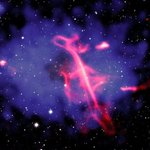
The universe has a musical side. 🎶 Meet the Treble Clef, an unusual radio structure stretching more than 2 million light-years across space. Its shape is striking, but the science behind it is even more fascinating. Studying structures like this can reveal how galaxy clusters interact and evolve. In this composite, radio emission appears in red, X-rays in blue, and infrared data in white: go.nasa.gov/3WCV89U
34
226
26
1,151
35,473
As today’s space-based laser instruments measure Earth's terrain, they leave gaps that can include millions of acres. Learn how NASA CASALS blends machine learning with an ultra-compact lidar to eliminate blind spots and create truly 3D images of Earth’s surface: go.nasa.gov/4zLpSnI
2
19
85
8,374
Have a research idea that could advance NASA science? 🔬 NASA plans to release ROSES-27 by January 2027, with over 50 research opportunities spanning astrophysics, Earth science, planetary science, heliophysics, space biology and more. Start planning: go.nasa.gov/489ZKqw
18
54
3
262
25,928
Day meets night at the lunar terminator. 🌗 The @NASAArtemis II crew highlighted this shadowy frontier during their close encounter in April. Now it’s your turn to explore! No spaceship needed.
7
34
2
190
19,591
A powerful launch. Big questions about life in space 🚀 Now on the @Space_Station, four NASA investigations will study brain cells, crop disease, astronaut health monitoring, and antibiotic-resistant bacteria. What we learn could help protect crews and support future exploration. go.nasa.gov/47cAcsF
6
13
3
83
6,062
One step closer to boots on the Moon! 🌙 To prepare for Moon Base, NASA needs to know what physical tasks crews can handle immediately after landing—and Artemis II provided some insight. Soon after splashdown, the crew suited up and tackled mission-critical tasks, demonstrating successful performance within hours of their return.
16
42
267
14,248
AVATAR-Org1 launched this morning and is on its way to @Space_Station! 🧠 Following AVATAR’s journey around the Moon on @NASAArtemis II, this new investigation will study lab-grown brain tissue to better understand how spaceflight affects human health. go.nasa.gov/4zpUxqk
8
27
1
175
13,578
Fitness goals don’t stop in space 💪 During their mission, @NASAArtemis II astronauts used a compact device, the flywheel, similar to a rowing machine, for daily exercise. Using the device helped the crew maintain muscle strength on their mission.
46
194
23
1,467
71,699
Because of its small footprint, the flywheel will be central to fitness regimens for future Artemis crews.
3
2
34
3,124
Ready to make an impact!? The @NASAArtemis II crew spotted lunar impact flashes, brief flickers from space rocks hitting the Moon. Their data matched reports from Earth-based volunteers. Grab your telescope and join the Impact Flash! project today: go.nasa.gov/4iSwxas
2
24
100
7,011
The data is out. So what happens next? Scientists, researchers, students, and curious minds around the world can dig in, ask new questions, and collaborate to deepen our understanding of the Moon. What we learn today can help inform future lunar missions as we explore the Moon and prepare to go farther.
A huge library of Artemis II data just dropped! Science is a relay race, and today marks the latest in a long series of handoffs. 814 GB of observations. 996 new images. 521 min of never-before-released crew audio. Dig in: go.nasa.gov/Artemis2LunarSci…
9
35
1
221
17,832
That’s the power of making NASA science openly available. 🌙
1
19
1,884