
News from Science (@NewsfromScience) header
News from Science (@NewsfromScience) profile picture

The latest stories in science, brought to you by the @ScienceMagazine news team.

Washington, D.C.
Joined October 2008
Photo by News from Science (@NewsfromScience)Photo by News from Science (@NewsfromScience)Photo by News from Science (@NewsfromScience)Photo by News from Science (@NewsfromScience)Photo by News from Science (@NewsfromScience)Photo by News from Science (@NewsfromScience)Photo by News from Science (@NewsfromScience)Photo by News from Science (@NewsfromScience)Photo by News from Science (@NewsfromScience)Photo by News from Science (@NewsfromScience)
Forests across North America have seen a drop in the number of songbirds heralding the arrival of spring. To figure out why, biologists scour forests to capture birds and tag them with leg bands. By going back to look for the tagged birds a year later, they can get a picture of how many survive from one year to the next. But the fieldwork takes untold hours, and capturing and banding can stress the birds. A new paper lays out a quicker, gentler approach. It uses sound recorders and #AI to identify individual birds based on their song alone and track them over time. Learn more: scim.ag/4zE48ui
1
1
5
1,919
Researchers have, for the first time, inserted receptors into the human brain that allow them to manipulate neuron activity with a drug. The groundbreaking gene therapy was designed to help three people with drug-resistant epilepsy by dampening activity in the seizure-generating zones of their hippocampus. The therapy did not produce major side effects, and appeared to reduce the incidence of seizures, the team conducting the clinical trial reported. Learn more: scim.ag/3Wypb2F
1
4
15
2,164
Californians appear to have said yes to a plan authorizing up to $8.4 billion in state bonds to fund immunology and immunotherapy research. But critics argue the proposal will end up funneling billions in taxpayer money to a single research institution—one founded by the same billionaire who funded the campaign to get Proposition 38 on the ballot. scim.ag/4eV78dg
1
3
10
4,346
In January 2027, microbiologist Jasmine Clark—who will be the first Black woman with a science Ph.D. to serve in Congress—hopes to gain a seat on the House science committee that Representative Zoe Lofgren is all but certain to chair after winning her 17th term. Fresh from their victories, Lofgren and Clark spoke this week to @ScienceInsider about their agendas. ⬇️ scim.ag/4k6lZFi
1
3
3,711
Scientists have long known that noise from human activities—from the roar of jet engines to the whir of ship propellers—can harm animals, stunting their growth and even scrambling their eggs. But it’s been unclear just how pervasive the problem is. A massive analysis reveals the impacts are far more widespread than even researchers thought. Data from 177 species that live on land and in the water reveal the vast majority are impacted by sound in some way, fundamentally altering their biology and behaviors, and causing many to die early. Learn more: scim.ag/4A8miUG
3
7
31
3,177
In January 2027, Democrats will gain control of both the U.S. Senate and House of Representatives. @ScienceInsider takes a look at what many researchers want from the 120th Congress at a time when it has many other issues to tackle, Trump still wields the veto pen, and federal judges could have the final say: scim.ag/4jb8G5m
1
3
2,073
Dinosaurs vanished about 66 million years ago, yet they still turn up on our clothes, our bedsheets, and even our dinner plates. But not all dinosaurs are equally famous. We all know Tyrannosaurus rex, but what about other smaller predators, or some of the larger herbivores that lived alongside the most famous dinosaur? A new study tries to answer that with numbers. By tracking people’s online footprints, researchers studying what’s known as conservation culturomics can find out what people care about in nature. Now, an international team has applied these methods to long-dead dinosaurs. Learn more: scim.ag/4kaRBts
3
8
58
4,264
Exclusive: Over the past 4 years, Pathogen Hunters has published dozens of eye-catching studies for which it claims to have collected more than 60,000 samples in 38 countries, including war-torn nations such as Yemen, Somalia, and Sudan. It has sampled wastewater from 11 countries to look for SARS-CoV-2; tested discarded condoms from brothels and public restrooms for the mpox virus; and found a tapeworm that sickens humans in feces from wild bears. Critics question how the group could have collected so many samples in such a short period, and they have found anomalies in the genomic data of at least five papers. Learn more: scim.ag/3WnoBF3
3
10
2,379
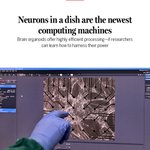
Your favorite chatbot may one day run not on silicon microchips, but on real human neurons. Both systems use electricity to compute, transforming inputs into outputs, but neurons—for reasons that are not fully understood—are orders of magnitude more efficient than semiconductor chips. They also require orders of magnitude less energy—not to mention fewer rare earth minerals, no vulnerable supply chains, and negligible water for cooling. Those advantages have some scientists thinking the data center of the future might sit in a lab dish, leveraging the natural computing abilities of organoids—miniature models of the brain grown from stem cells—or other brain cell configurations. Learn more: scim.ag/4kGQSjJ
13
38
6
155
10,116
Construction and mining firms are rolling out devices that track workers’ fatigue. Critics say the tech could be misused by authorities. Learn more: scim.ag/4eOXFnM @pulitzercenter
2
5
2,272
Call it the coolest scientific result ever: Physicists in China have attained a temperature of just 9.7 picokelvins—less than ten-trillionths of a degree above absolute zero—in a quantum mechanical soup of atoms. The result comes from an experiment aboard the China Space Station, which is also known as Tiangong. The automated module created what’s known as a Bose-Einstein condensate that lowered the coldest temperature ever achieved by a factor of four and could open new ways to use cold atoms in space to explore fundamental physics. Learn more: scim.ag/4ze7yTC
4
10
37
4,573
Today, Celtic languages are spoken as a mother tongue only on the far fringes of Europe—by about 1 million people in Ireland and Wales, and in small communities in Brittany and on the Isle of Man. But a new analysis, based on ancient DNA as well as linguistic clues and archaeology, shows the prehistoric homeland of the Celts lay in Europe’s very heart. Learn more: scim.ag/4iYZUr0
2
1
1
35
4,449
In March, a team of energy developers and academics finished drilling a borehole 3.6 kilometers deep in northeastern France, in the heart of the nation’s former coal country. But this hole, in the village of Pontpierre, was not drilled in pursuit of coal, oil, or natural gas. Rather, the team was chasing a resource that is more environmentally friendly, but also more elusive: clean burning hydrogen, produced naturally deep in the crust. At the H-NAT summit, the industry’s leading conference, the researchers reported intriguing results from the Pontpierre borehole. At depths of about 2500 meters, they found plenty of hydrogen, but not as a free gas. It was dissolved in water trapped in the rock. The result hints at a potentially vast underground resource—but one that will be difficult to exploit commercially. It’s the latest dose of sober reality in the hunt for natural hydrogen. Learn more: scim.ag/4z6ZVOK
1
4
9
2,905
Nine patients have developed tumors after receiving gene therapy for spinal muscular atrophy, seven more than previously disclosed, the company Novartis has confirmed. Learn more: scim.ag/48JiNIB
2
22
9
73
9,878
As concerns mount that artificial intelligence could make creating dangerous pathogens even easier, U.S. government–funded scientists who make and manipulate DNA sequences will face tougher regulations. scim.ag/4sQcEDP
2,155
Several scientific societies and two researchers are suing the U.S. National Science Foundation to stop it from further dismantling its social science funding. scim.ag/4BT03DN
9
1
32
5,503
A story that stinks: Gray whales, previously on the path to recovery, are now declining in record numbers as warming waters threaten their feeding grounds in the Arctic. Learn more: scim.ag/4kIcFaN
2
6
3,007
For clinical trials of tests and treatments, accuracy can be a matter of life or death; these studies directly inform medical practice, after all. A new tool may help make sure the studies are sound: #AI. In a test of whether 15 LLMs could identify methodological errors deliberately inserted into clinical research papers, one spotted nearly all the planted errors, and even the worst LLM performer found about half. Human reviewers found only one-quarter. Learn more: scim.ag/4BQVmdF
1
8
1
19
3,177