

Biotechnology for flourishing. Founding Editor @AsimovPress. Podcast, essays, occasional microgrants. Site: https://xitter.twitterapi.xyz/t.co/GabLJnLEnG Prev: Caltech, Imperial, NYU, MIT
Subscribe to Asimov Press
Joined November 2016
- Tweets4.8K
- Following191
- Followers52.7K
- Likes18.8K





Pinned Tweet
This is an ongoing thread for my series, "30 Essays to Make You Love Biology." ❤️🧬
I'll pin it on my profile.
In 1826, Philip Carpenter opened a shop at 24 Regent Street in London, called MICROCOSM, where he used solar microscopes (pictured below) to project 3-foot-wide images of microscopic life, including creatures in water. Entry cost a shilling.
One visitor, a German prince named Hermann von Pückler-Muskau, was absolutely horrified. In a letter from 1827, he wrote:
“What it shows is really enough to drive a man of lively imagination mad. Nothing can be more horrible [...] than the hideous, disgusting water animalculæ [...] which we daily swallow. They looked like damned souls darting about their filthy pools with the rapidity of lightning, while every motion and gesture seemed to bespeak deadly hate, horrid torture, warfare, and death.”
What I find so fascinating about this is that the British *public* was fully aware that there were microbes living in their drinking water several decades before those microbes were connected to particular diseases, such as cholera.
One reason for this, perhaps, is that leading scientists of the age were extremely opposed to the idea that microbes could cause disease!
Christian Gottfried Ehrenberg, a German naturalist in Berlin, coined the word “bacterium” in 1828 and was one of the world's leading experts on microscopic life. He knew that water was teeming with tiny organisms. And yet, during the cholera epidemics of 1831 and 1848, he explicitly rejected the idea that microscopic organisms could be causing the disease!
Meanwhile, the public was already so repulsed by the creatures in their water that artists were making satirical illustrations of them. In 1828, William Heath published a famous cartoon called *Monster Soup, Commonly Called Thames Water*, depicting London drinking water as a disgusting soup filled with microscopic monsters. (See image below.)
It wasn't until 1854 that John Snow traced a cholera outbreak in London to contaminated water from the Broad Street pump. And even then, Snow didn't identify the bacterium responsible.
I just find this history completely fascinating. In the 1820s, Londoners were literally paying a shilling to marvel at microbes projected onto walls, and artists were making jokes about the horrors lurking in drinking water, and yet nobody put two-and-two together for quite some time.


This is a simple method to make "bacterial chimeras" (or trimeras) by moving ~2 million bases of DNA between bacteria in a single step.
The method is called ACE, or Additive Conjugative-CAST Engineering. It's described in a new paper from Kaihang Wang's group at Caltech. They used this method to make, in one case, an organism with 4.6M bases of DNA from E. coli DH10B, 2M bases of DNA from Syn61 (a recoded strain of E. coli) and about 900kb from Shigella (meaning that this works across bacterial genera.)
When I joined Caltech in 2018 to start my PhD, I was actually the first graduate student in Kaihang’s lab! I remember unboxing the equipment, getting the new pipettes out of the box, and installing the DNA sequencing machine. My bench was like two rows down from David Baltimore's group. This is the first project talked about when I joined, meaning that they've been working on this for at least the last 8 years.
The way it works is that you have a donor strain and a recipient strain. You decide which DNA from the donor you want to transfer, and you flank that sequence with two bits of DNA, called CassetteSTART and CassetteEND. The donor is also engineered to express a helper plasmid, which encodes the machinery needed to move the DNA to the other strain via conjugation. Once the DNA moves into the recipient strain, a *second* helper plasmid splices it into a chosen location in the genome (via a CRISPR-associated transposase.)
They use this simple approach to move up to 2 million bases of DNA in a single step. When they tested this on a 1 million-base strand of DNA, they got 1,000 successful colonies per experiment. (Meaning this works REALLY well.) Across three target sites, 98.1–99.7% of mapped insertions were at the intended site, too. And when they did RNA sequencing on these chimeras, they found that all the genes from all the donors were expressed.
So why is this useful?
Well, we can already move large segments of DNA, but DNA is fragile and can shear. You can order oligos or genes and assemble big sequences, but that takes a lot of time and money. With this tool, you could instead just identify a biosynthetic pathway in a cell and transfer it into a strain that’s easier to grow or use for biomanufacturing. This is a cheaper, more scalable way to "port" capabilities between cells. (But only bacteria of relatively closely-related genera for now.)
This also works with synthetic DNA. Theoretically, then, you could "install" DNA into a cell and then use that strain as a sort of perpetual donor to transfer to other organisms, instead of rebuilding and re-transforming cells each time. I'm sure this will have other, as-yet-unseen uses as well.

If you like this, then you'll love @AsimovPress, a magazine about biology. You should subscribe! It's free!
2
452
Niko McCarty. retweeted
This is a simple method to make "bacterial chimeras" (or trimeras) by moving ~2 million bases of DNA between bacteria in a single step.
The method is called ACE, or Additive Conjugative-CAST Engineering. It's described in a new paper from Kaihang Wang's group at Caltech. They used this method to make, in one case, an organism with 4.6M bases of DNA from E. coli DH10B, 2M bases of DNA from Syn61 (a recoded strain of E. coli) and about 900kb from Shigella (meaning that this works across bacterial genera.)
When I joined Caltech in 2018 to start my PhD, I was actually the first graduate student in Kaihang’s lab! I remember unboxing the equipment, getting the new pipettes out of the box, and installing the DNA sequencing machine. My bench was like two rows down from David Baltimore's group. This is the first project talked about when I joined, meaning that they've been working on this for at least the last 8 years.
The way it works is that you have a donor strain and a recipient strain. You decide which DNA from the donor you want to transfer, and you flank that sequence with two bits of DNA, called CassetteSTART and CassetteEND. The donor is also engineered to express a helper plasmid, which encodes the machinery needed to move the DNA to the other strain via conjugation. Once the DNA moves into the recipient strain, a *second* helper plasmid splices it into a chosen location in the genome (via a CRISPR-associated transposase.)
They use this simple approach to move up to 2 million bases of DNA in a single step. When they tested this on a 1 million-base strand of DNA, they got 1,000 successful colonies per experiment. (Meaning this works REALLY well.) Across three target sites, 98.1–99.7% of mapped insertions were at the intended site, too. And when they did RNA sequencing on these chimeras, they found that all the genes from all the donors were expressed.
So why is this useful?
Well, we can already move large segments of DNA, but DNA is fragile and can shear. You can order oligos or genes and assemble big sequences, but that takes a lot of time and money. With this tool, you could instead just identify a biosynthetic pathway in a cell and transfer it into a strain that’s easier to grow or use for biomanufacturing. This is a cheaper, more scalable way to "port" capabilities between cells. (But only bacteria of relatively closely-related genera for now.)
This also works with synthetic DNA. Theoretically, then, you could "install" DNA into a cell and then use that strain as a sort of perpetual donor to transfer to other organisms, instead of rebuilding and re-transforming cells each time. I'm sure this will have other, as-yet-unseen uses as well.
Up to 50 people will receive $70k to give away, as microgrants, to create new scientific fields. Good opportunity!

BIG NEWS!
For the past few years, we've given scientists budgets so they can fund their peers with small, fast grants. Today, we're going bigger.
We're opening up a call to find and fund emerging "field builders"—people with the ambition and curiosity to kickstart a new field of science and technology. You'll get a budget of $70,000 to regrant (up to $10,000) out to projects and ideas and join a community of explorers.
Do you have an idea for a new field of science that *should* exist? Please apply!
Niko McCarty. retweeted

Introducing PERCEPT, a non-viral CRISPR delivery platform for in vivo genome editing! We reversibly attach peptides and polymers to CRISPR enzymes, driving editing in the brain, retina, muscle, or lungs of mice via local delivery. 🧵below, bioRxiv🔗bit.ly/PERCEPTpre

My podcasts are way too long and way too technical. Few people have time to sit through 90 minutes of hardcore immunology!
But if there's just one idea to take away from my interview with Jake Glanville at Centivax, a company developing universal flu vaccines and antivenoms, then I think it's this:
First, influenza (and many other viruses or pathogens) mutate so rapidly that we keep getting infected by slightly different versions of them. And so the challenge of making a universal flu vaccine is to elicit antibodies that recognize many different strains, including ones that don't yet exist.
The normal approach to this problem is just to mix together antigens from many different strains and inject them into humans all together. But your immune system then generates separate antibodies against each antigen, without necessarily producing antibodies that recognize ALL of them.
(Imagine a vaccine with 20 different versions of influenza's hemagglutinin protein. Your immune system might make antibodies against version A, others against B, and others against C. But what happens when influenza mutates again, producing version 21? Your body has no antibodies.)
What we really want are antibodies that recognize regions of the virus that rarely change! These so-called "conserved epitopes" are more likely to be shared across past, present, and future strains of ther pathogen.
So Jake, noticing this problem, invented a thing called conservation–concentration coupling. The gist is that, instead of injecting ALL of the antigens into a human at high doses, you deliberately lower the concentration of each one. There's only a tiny bit of each antigen in the vaccine, in other words; too little to elicit an immune response on its own. (If a B cell comes along and recognizes only antigen A, that B-cell won't become strongly activated!)
If, however, a B cell comes along that recognizes some converved region across MANY of the antigens, and it can bind to all of them, then it WILL become activated. Even though each individual antigen is present at a very low concentration, the B cell effectively encounters 20 times as much antigen, or 20x the normal dose. It is stimulated enough to proliferate, while the B cells recognizing only individual strains get "outcompeted."
In other words, you're using antigen concentration to bias the immune system toward making broadly reactive antibodies. This is the key idea behind Centivax, and they've gotten really compelling data that this actually works in mice and humans (~180 patients in their phase I, which is now finished.)
If you like this, then you'll love @AsimovPress, a magazine about biology. You should subscribe! It's free!
1
802
Niko McCarty. retweeted

A major update on combinatorial scaling of proteomics throughput using time-encoded multiplexing.
Mass spec proteomics has long multiplexed samples in the mass domain (with mass tags). timePlex multiplexes in the time domain, setting a direction with new possibilities.
1/

A biologist in Ohio is living with a rare form of cystic fibrosis. His particular mutation is not amenable to existing drugs for the disease.
And that’s why, for the last 10+ years, he has been trying to make a gene therapy to cure it. New essay today in @AsimovPress.
Most people living with cystic fibrosis still make copies of the cystic fibrosis transmembrane conductance regulator (CFTR) protein. These proteins are often defective, but modern drugs can help them fold or function properly.
And these drugs have been enormously successful. For decades, treatments like antibiotics and mechanical vibration vests have helped clear bacteria from the airways and raise life expectancy for people with cystic fibrosis from about 10 years to 40. Newer drugs that restore CFTR function have pushed life expectancy even higher; many patients today can live relatively normal lives.
But about 5–10% of people with cystic fibrosis have mutations that prevent them from making essentially any CFTR protein at all. These are often called nonsense or frameshift mutations. And because these patients don't make the protein, the existing CFTR-modulating drugs have nothing to act upon.
@jacobwitten1, the author of today's essay, is one of these patients. His laboratory at Case Western Reserve University is developing lipid nanoparticles that can deliver RNA into lung cells, with the ultimate goal of restoring CFTR function. These particles could carry RNA strands encoding the missing protein, or gene-editing tools that fix the mutation directly.
This is a deeply personal essay about the last 30 years of cystic fibrosis research, the extraordinary difficulty of delivering gene therapies into the lungs, and what it’s like to try to cure your own disease. We’re extremely honored that Jacob decided to write this! The piece is charming and irreverent and, I think, a reflection of his personality.
press.asimov.com/articles/cy…

If you like this, then you'll love @AsimovPress, a magazine about biology. You should subscribe! It's free!
2
753
Niko McCarty. retweeted

An explanation of my whole deal for the curious!
press.asimov.com/articles/cy…
Niko McCarty. retweeted

I'm Trying to Cure My Cystic Fibrosis
A personal essay by @JacobWitten1 about what it's like to live with cystic fibrosis and, at the same time, run a laboratory (and company) trying to cure it.
Read: asimov.press/p/cystic-fibros…

Most students learn that DNA → RNA → protein. This sounds straightforward, but transcription (or that DNA → RNA bit) is surprisingly unpredictable, even in genetically identical cells. And, unfortunately, many tools commonly used in biology miss the way that gene expression actually works.
For several decades, most biologists assumed that transcription followed a Poisson process. In other words, imagine that you are a gene within a cell moving through time. At each small step forward in time, you roll a die, and there's a fixed probability that this gene will get transcribed into mRNA. Most of the time, nothing happens; but sometimes you get a new mRNA. In a Poisson distribution, as time goes on, the probability that the cell has not made a transcript at all trends exponentially toward zero.
Scientists believed this because they did not have methods to refute it. All the techniques we had to study gene expression were indirect. They might put a gene encoding green fluorescent protein into a cell, for example, let the cell transcribe and translate that gene, and then use a microscope to measure how brightly the cell glowed. They'd count up the fluorescent signal and try to work backward to infer how many mRNAs were responsible. But obviously these were proxies, and there's no correlation (in many genes) between protein levels and mRNA levels.
So in 2005, Ido Golding and colleagues published what I think is one of the most beautiful and important papers in modern biology. They figured out how to watch and count mRNAs in individual living bacteria, and used this method to test whether transcription really followed a Poisson process.
First, they engineered E. coli to make a green fluorescent protein fused to something called the MS2 coat protein. MS2 binds to a particular RNA sequence, called an MS2 binding site. So the bacteria were producing large amounts of this green fluorescent protein, which was floating around inside the cells.
Second, they introduced another genetic construct, this time encoding a red fluorescent protein. But at the end of this gene, they added an enormous array of 96 MS2 binding sites.
So what happens is that, when the cell transcribes the gene encoding the red fluorescent protein, the resulting mRNA also contains this long string of MS2 binding sites, which the green protein (fused to MS2) quickly gloms onto. And now, instead of having green fluorescence diffused throughout the cell, you get these very bright, green spots or "puncta" where the GFP molecules have accumulated on an mRNA. And because each mRNA recruits dozens of GFP molecules, the researchers could calibrate the brightness of these spots and estimate how many individual transcripts were present in a single cell.
Importantly, they could also activate the red fluorescent gene using a small molecule called IPTG. (The gene was placed "downstream" from a so-called inducible promoter.) This meant they could add IPTG, start a stopwatch, take pictures over time, and then watch the bright green spots appear as the bacteria produced mRNAs.
And they found that gene expression is sort of Poisson, but with a huge caveat.
In a true Poisson process, the variance equals the mean. So if a gene produces an average of 10 mRNA molecules over some period of time, the variance in the number produced should also be 10. The transcripts appear at random times, sometimes close together, sometimes farther apart, but each event is independent.
Instead, Golding and his colleagues found that the variance in mRNA abundance was about FOUR TIMES larger than a Poisson process would predict. This happens because transcription is BURSTY.
A gene remains silent for a long time, then suddenly turns on and makes a bunch of mRNAs really quickly, and shuts off again. A cell might produce four transcripts over a few minutes and then make nothing for the next half hour.
(The full model is this: When a gene is ON, transcription follows a Poisson process. But the gene can switch OFF at any moment. And because each ON period lasts a different amount of time, the number of transcripts produced in each burst follows a geometric distribution. In their experiments, genes were inactive for about 37 minutes on average, then active for about six minutes, producing an average of 2.2 transcripts per burst.)
This study changed how we study biology. It's so important, because it influences the way we study RNAs in cells today.
Depending on when you kill cells and extract their molecules, for example, some might have no transcripts from a particular gene, while others might have lots of them. That variation doesn't necessarily mean the cells are fundamentally different; some of them might have just had a recent burst of transcription, while others haven't.
Or consider two genes that have exactly the same expression level. One might produce transcripts slowly and frequently, while the other produces them in large, infrequent bursts. If you just measure how many mRNAs are present, you can't tell how those transcripts were produced, or how the genes are regulated.
I made a little interactive to show how this works and hope it is helpful.
If you like this, then you'll love @AsimovPress, a magazine about biology. You should subscribe! It's free!
6
1,412
Niko McCarty. retweeted

We have another banger lineup of pieces in the December issue of Works in Progress magazine. Subscribe now to get your print copy as soon as it's out.
Including:
➔ @RuxandraTeslo and @NikoMcCarty on Chinese biotech
➔ @pietergaricano on Emmanuel Macron
➔ @salonium on smallpox eradication
➔ @JamieRumbelow on the internet's infrastructure
➔ @SCP_Hughes on the history of architectural taste
➔ @erinbraid on the curse of Italy
➔ @Aria_Babu on Hollywood remakes
➔ @chalmermagne on the end of Communism
➔ @CharlesCMann on forest fires
➔ @tylercowen on Armenian food
worksinprogress.co/print

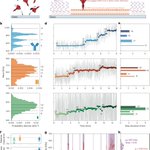
A simple yet elegant study, showing how phages infect and then destroy individual bacterial cells.
They put E. coli into a Mother Machine (a thin microfluidics chamber) with a microscope overhead. You can stain a phage with SYTOX Orange (see video #1) and watch as it binds to a cell and injects its genome. Or, you can image cells at 100 frames per second and watch as they rupture with phages (as in video #2).
If you repeat this for hundreds of cells across conditions, like type of phage or temperature or anything else, and then plot the data, you find some extreme heterogeneity in phage infection and lysis dynamics!

If you like this, then you'll love @AsimovPress, a magazine about biology. You should subscribe! It's free!
3
929
