

Oracle Developers is a community for developers by developers
Austin, TX
Joined April 2007
- Tweets20.5K
- Following669
- Followers117K
- Likes10.8K


APIs that run for hours? Your timeout would like a word.
See how Oracle MicroTx and TxEventQ help developers build reliable, event-driven workflows with asynchronous processing, durable messaging, and transaction coordination. social.ora.cl/6015BHZes3

Modernizing IAM isn't just about swapping out old systems. It's about making identity security ready for what's next. 🔒
See how we're evolving IAM with cloud-native architecture, automation, and stronger access controls to support enterprise scale. social.ora.cl/6013BHZeTL

Browser agents are impressive, but they can also be wrong. FreeSQL offers a better way.
@krisrice demonstrates how FreeSQL registers WebMCP tools, allowing the agent to leverage those tools instead of direct page manipulation.
The tools run in the page and use the session you already have. No credentials handed to the agent. No wallet. No connect string.
For years, we automated processes by drawing every possible path in advance.
Now, agents let us describe the work and put determinism only where it earns its place.
We discuss the patterns in use today, the architecture it converges on, and how Oracle Integration gets you there by reusing what you already run. social.ora.cl/6015BHZjj3

This exploration suggests a practical path for using agent fleets to assist scientific work.
OCI supplies the execution and persistent-workspace foundation, while our fleet software coordinates the work above it.
Take a look: social.ora.cl/6016BHZjBr

In this Oracle Developers Explains demo, Srinidhi Sathyamurthy walks through the Oracle AI Developer Hub repository, oracle-devrel/oracle-ai-developer-hub on GitHub, and gets it running on a local machine. 🤖 social.ora.cl/6018BHLpoG

The new capabilities for MCP integrations in OCI IAM simplify onboarding for approved AI clients, limit access to specific resources, and authorize work across applications—giving developers a consistent identity model while administrators retain control over access.
Learn more: social.ora.cl/6015BHZwa5

Oracle APEX 26.2 brings support for the Provider API in Generative AI Services and a Reasoning Effort setting for AI Agents and programmatic AI requests.
Choose the provider API used by a service and adjust how much reasoning a supported model uses for a task.
Get all the details: social.ora.cl/6016BHZBMk #orclAPEX

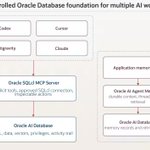
Check out this developer guide to controlled Oracle AI Database workflows with the Oracle SQLcl MCP server, Codex, Cursor, Antigravity, Claude, and Oracle AI Agent Memory. social.ora.cl/6011BHrDQx

AI agents don't need more memory. They need better context management.
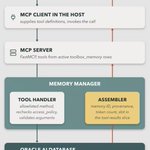
Learn how to build smarter multi-tenant agents with token budgets, context selection, and MCP tool calls without drowning your LLM in irrelevant data. social.ora.cl/6018BHJwVY

We recently announced Workload Identity support for self-managed Kubernetes clusters in OCI, enabling workloads to exchange their Kubernetes service account identity for a short-lived OCI token. They can then use that token to securely access OCI resources through Identity and Access Management policies.
Get all the details: social.ora.cl/6015BHMWZ7

We can't believe it's already been one week since #AIWorld. 🤯
It was amazing to see thousands of people join us in Las Vegas, all with one overarching goal—learning how to put AI to work for their organizations.
Relive the keynotes, product spotlights, and Oracle TV coverage, and access learning sessions with On Air: social.ora.cl/6019BHxz2h
Did you attend? Share your favorite moments, pictures, and sessions below!


We take a closer look at the image-aware memory path:
👉 How visual evidence enters memory
👉 How it is persisted in Oracle AI Database
👉 How descriptions and captions make images searchable
👉 Why normal retrieval stays lightweight by omitting raw bytes
👉 How applications can explicitly hydrate image bytes when the workflow requires them
Check it out: social.ora.cl/6016BHJklo

10
985
AI agents are getting smarter. Their access controls should be, too.
See how we use OCI IAM and MCP Security to secure AI workflows with least-privilege access, just-in-time permissions, human approvals, and keyless authentication. social.ora.cl/6018BHBPb0

Check out two new hands-on workshops in Oracle LiveLabs that guide you through OCI Internet of Things Platform, from setting up your tenancy and defining digital twin models and instances to viewing normalized device data. social.ora.cl/6011BH1IRD

See how the new Forms-to-APEX skill helps teams analyze Forms logic, reconcile database dependencies, preserve business behavior, and generate native APEX apps. #orclAPEX social.ora.cl/6017BH1YuR

In our latest Oracle Developers Explained episode, we store a performance chart with a short description in Oracle AI Agent Memory, find it later by searching in ordinary words from a fresh Python process, load the original image bytes back from Oracle AI Database 26ai, then prove they are the same bytes.
Watch: social.ora.cl/6013BHUZMR

A Halloween treat 🍬
At #AIWorld, we introduced AI Registry—now generally available in Oracle AI Data Platform!
See how it gives teams a central place to register approved Oracle and compatible third-party agents and tools, control who can access them, and make existing capabilities available for reuse across teams. social.ora.cl/6015BHjHHt

Improving AI/ML infrastructure price performance often requires keeping GPUs supplied with data while reducing I/O bottlenecks.
Deploying Alluxio as a compute-side caching layer with OCI GPU instances help organizations reduce data-access latency, improve accelerator utilization, and improve effective price performance for appropriately configured I/O-constrained workloads.
Learn more: social.ora.cl/6014BHBOtG

In Part 1 of this series, we opened up oraviz-mcp (a small MCP server I built for the Oracle AI Database) and looked at the three questions every tool on its menu has to answer:
❓ What am I allowed to run
❓ How much am I allowed to say back
❓ What about data that doesn’t fit
In part 2, we get hands-on. 💪 social.ora.cl/6018BHBOT8
