

Ethereum
Joined November 2017
- Tweets18.4K
- Following6.8K
- Followers161K
- Likes25.1K






WETH ARM LPs outperformed standard ETH staking yield by over 30% in the last 30 days.
The WETH ARM earns this through LST redemption arbitrage.
LPs deposit WETH, and the ARM keeps that capital working across stETH, eETH and their wrapped versions.
Explore the WETH ARM Vault → app.originprotocol.com/#/arm…

Thanks for having us on the show.
For anyone curious about the ARM, check out how it works: docs.originprotocol.com/auto…

5
105
October was an ATH for the WETH ARM.
52K+ $ETH processed in a single month.
That’s a 16x turnover on just ~3.2K ETH of TVL.
ARM LPs earned 3.05% trailing 30-day APY.
Explore the WETH ARM Vault → app.originprotocol.com/#/arm…

Origin recently shared how it approaches protocol security. Here’s what that looks like in practice.
At @summit_defi Mumbai this week, @clement_moller showed how Origin’s invariant tests catch bugs that can block a withdrawal, even when every balance check passes.


Origin's October Update is live 📰
Starting this month, you can expect a new section: From the Team.
It's where the team shares their thoughts on our products and their future, drawn from the work we do.
This month, @clement_moller highlights the WETH ARM and what it taught us about capital efficiency.
🔗 originprotocol.com/blog/octo…

Origin has restored its onchain OGN liquidity.
After identifying that the attacker held OGN, our team withdrew liquidity on Ethereum and Base to limit their ability to sell OGN onchain.
With liquidity thin, the attacker sold OGN at an average price approximately 79% below the reference market price. Prices across the affected pools have since largely stabilized.
We continue to monitor the situation. Thank you for your patience.
We are monitoring reports of a potential security incident at Binance involving wallets holding OGN.
As a precaution, Origin has temporarily withdrawn its onchain OGN liquidity.
We intend to restore liquidity once conditions allow and will share updates here.

Credit to the authors of EIP-7251: @mikeneuder @fradamt @dapplion @mkalinin2 @drakefjustin
How OETH's staking works:
originprotocol.com/blog/oeth…
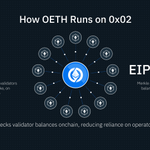
All of OETH's stake runs on 13 compounding validators on MAVAN infrastructure.
With rewards accruing inside each validator, OETH verifies validator balances against Ethereum consensus data with EIP-4788 Merkle proofs, reducing reliance on operator-reported accounting.

Second, flexibility. A 0x02 validator can withdraw part of its balance without a full exit, and accept deposits in any amount instead of 32 ETH batches.
A partial withdrawal still goes through the exit queue, but skips the validator sweep, which takes about a week to cycle.
Fewer, larger validators holding the same stake also lighten the load on Ethereum's consensus layer.

First, compounding. Rewards stay inside the validator and add to its effective balance in 1 ETH increments, so they earn too.
Over the 90 days to October 25th, the median 0x02 validator earned a 2.48% consensus-layer APR, against 2.14% for 0x01 (beacon chain data).

Before Pectra, every validator was capped at 32 ETH.
Rewards above that were swept out about every nine days and had to be redeployed into a new 32 ETH validator before they could earn again. EIP-7251 raised the cap to 2,048 ETH and added 0x02 credentials.

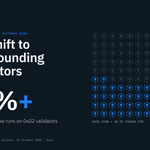
Over 40% of all staked ETH has now moved to compounding (0x02) validators.
They change how staking rewards are earned, kept and withdrawn. Here's how it works, and why ethereum:0x856c4efb76c1d1ae02e20ceb03a2a6a08b0b8dc3 runs entirely on them 🧵

Origin ARM is the onchain liquidity engine for redeemable assets.
To put it in perspective, its $11.1M in 24-hour volume, mostly LSTs, ranks 7th among Ethereum DEXs on @coingecko.
ARM LPs earn from the arbitrage behind it.
Explore ARM Vaults → app.originprotocol.com/#/arm…

Learn how Origin maps security work to deployed products and manages risk throughout the protocol lifecycle.
Read the full article:
🔗 originprotocol.com/blog/prot…

Audits are only one part of Origin’s security process.
Design review, testing, controlled deployment, governance, monitoring, incident response, and independent research address risks outside an audit’s scope.

Origin’s public audit matrix shows these relationships.
It separates direct reviews and shared implementations from inherited code, narrow follow-ups, and reviews of external dependencies:
docs.originprotocol.com/secu…

This matters at Origin because OUSD, OETH, and Super OETH share parts of their token and vault architecture.
A review of shared code may apply across products. Product-specific strategies and integrations require separate analysis.

The same assessment determines whether a contract change needs an external audit.
Each audit covers a defined scope, code revision, and set of assumptions. When code or configuration changes, Origin reassesses whether the report still applies.
