Penn Bioengineering (@pennbioeng) header
Penn Bioengineering (@pennbioeng) profile picture

The Department of Bioengineering at the University of Pennsylvania. Established 1973. #PennBioengineering

Philadelphia, PA
Joined May 2012
Photo by Penn Bioengineering (@pennbioeng)Photo by Penn Bioengineering (@pennbioeng)Photo by Penn Bioengineering (@pennbioeng)Photo by Penn Bioengineering (@pennbioeng)Photo by Penn Bioengineering (@pennbioeng)Photo by Penn Bioengineering (@pennbioeng)Photo by Penn Bioengineering (@pennbioeng)Photo by Penn Bioengineering (@pennbioeng)Photo by Penn Bioengineering (@pennbioeng)Photo by Penn Bioengineering (@pennbioeng)
Penn Bioengineering retweeted
Technology used in COVID-19 vaccines could help advance a new approach to Duchenne muscular dystrophy (DMD). In a study led by @PennMedicine researchers, a team including @Pennbioeng’s @MJMitchell_Lab combined mRNA delivery with CRISPR gene editing to boost production of utrophin, a protein that can compensate for the dystrophin missing in people with DMD. In mouse models, the approach improved muscle function and halted, or even reversed, signs of disease progression. Researchers are now exploring ways to deliver gene-editing tools to muscle cells more effectively. bit.ly/4zg8EyN
1
1
271
Can digital twins improve cancer drug development? At the 2026 AACR Industry Roundtable, BE Chair Radhakrishnan led a discussion on using computational models to inform treatment decisions, emphasizing reliable data and validation. aacr.org/blog/2026/11/05/nee… @PennEngineers @CBE_Penn
We thank our Sustaining Members who joined us in Philadelphia for the 2026 AACR-Industry Roundtable on Accelerating Drug Development: Innovation from Discovery to Approval. Collaboration is key to driving progress in cancer science and medicine. #CancerResearchSavesLives
136
Penn Bioengineering retweeted
A new placenta-on-a-chip model from Penn Engineers is helping researchers study how environmental toxins affect the placenta. Led by Dan Huh (@pennbioeng), the team found that even relatively low levels of cadmium can impair placental function without killing cells. Published in @natbme, the study also identified a protective protein and metabolic changes that could offer clues to exposure-related damage. bit.ly/3UnRf8l
1
8
548
Great connections and an incredible community at #BMES2026! Thank you to everyone who joined the Department of Bioengineering's reception in Orlando. We loved bringing the biomedical engineering community together! @PennEngineers #Bioengineering
1
7
471
RT @PennEngineers: From Penn Engineering to the Jeopardy! stage. Kayla Patel (GEng’25), who earned her B.S.E. and M.S.E. in @PennBioeng at…
1
11
What can AI reveal in CT scans? BE Ph.D. candidate Cameron Beeche is lead author of a study on Percival, an AI model designed to detect hidden health risks. With senior author Walter Witschey & co-author Charles Kahn. @PennMedicine | @PennEngineers pennmedicine.org/news/ai-mod…
2
236
What if your medical device could text you back? Brian Litt, MD, and Bioengineering Ph.D. students Zack Goldblum, Haoer Shi and Zhongchuan Xu are advancing AI-powered patient-device communication. Learn More: pennmedicine.org/news/ai-pla… @PennEngineers
1
192
A year of growth and achievement in BE. From faculty honors to student success and new interdisciplinary initiatives, we’re celebrating the accomplishments moving our community forward. Read more: bit.ly/3T6Qj7K @PennEngineers
2
437
Meet our 2026 Bioengineering Summer Fellows! Hailey Van ('29) on targeting post-MI arrhythmia and Adarsh Ramamurthy ('29) on modeling pediatric tumor responses. Learn More: be.engineering.upenn.edu/sum… @PennEngineers #UndergraduateResearch
1
415
Last week, Bioengineering welcomed @JHUBME’s Michael I. Miller as our Schwan Distinguished Lecturer. Miller shared advances in multiscale neuroimaging models connecting MRI, digital pathology and spatial transcriptomics to the study of neurodegenerative disease. @PennEngineers
1
1
325
We’re hiring. The Department of Bioengineering is seeking faculty at the Assistant, Associate and Full Professor levels across bioengineering as part of a multi-year hiring initiative. Applications due Nov. 23, 2026. Learn more + apply: be.engineering.upenn.edu/abo… @PennEngineers
18
1
28
3,138
From Penn to Texas A&M: Raghav Garg is launching a lab focused on implantable and wearable neural interfaces for neurological diseases. See how his 4.5 years at Penn helped shape his path to faculty leadership: beblog.seas.upenn.edu/launch… @PennEngineers #AcademicCareers
2
357
From Penn to Wake Forest: Hannah Zlotnick (Ph.D. BE 2022) is launching a lab focused on clinically relevant solutions for orthopaedic disease. See how her Ph.D. training helped shape her path to faculty leadership: beblog.seas.upenn.edu/next-g… @PennEngineers #Bioengineering
3
365
Penn Bioengineering retweeted
Featured in @IEEEAPMag's Legends of Electromagnetics series, Penn Engineering's Nader Engheta shares his journey from his childhood fascination with a battery-operated radio to his pioneering research in electromagnetics and beyond. Watch the full interview today. bit.ly/4zoBBsL @MSEatPenn @ESEatPenn @pennbioeng @physatpenn
5
6
454
Vivodyne has launched a human biological datacenter designed to study living human tissues at scale. Behind the work: Andrei Georgescu (BE’21), CEO and co-founder, and Dan Huh, J. Peter Skirkanich Professor in Bioengineering and CSO. bit.ly/4gAUyB5 @PennEngineers
6
740
Penn Bioengineering retweeted
Penn researchers have built the first spatial map of the developing human kidney, analyzing more than 700,000 cells to show how soluble signals from neighboring cells guide development. The study was conducted by the Penn-CHOP Kidney Innovation Center, a collaboration between @PennMedicine and @ChildrensPhila, in partnership with Penn Engineering and the @IRM_UPenn. "The kidney is a physical structure, and physical context is not incidental to how it forms—it is instructive," says Alex J. Hughes, Associate Professor in @PennBioeng, who co-led the study. bit.ly/4hrJYgO
1
14
22
1,956
Our Launching the Next Generation of Bioengineering Faculty series continues with Margaret Billingsley. Read how her experience in the Mitchell Lab helped prepare her to launch her own lab at @UVA Engineering. beblog.seas.upenn.edu/next-g… @PennEngineers #Bioengineering
5
304
Deadline tomorrow: Applications for the 2026 Rising Stars in Engineering in Health workshop close July 31. For postdocs, research scientists and Ph.D. students preparing to pursue faculty positions. Apply here: be.engineering.upenn.edu/hom…
202
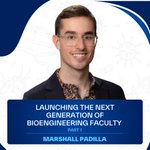
From Bioengineering at Penn to Stanford. Marshall Padilla is launching his independent career as Assistant Professor of Materials Science & Engineering and Stanford ChEM-H faculty. Read more about his journey: beblog.seas.upenn.edu/next-g… @PennEngineers
1
5
561