

Ziren: General-Purpose zkVM & Proving Infrastructure
ZK
Joined June 2023
- Tweets3.9K
- Following585
- Followers42.4K
- Likes9.8K




ZKM retweeted

The Metis Hybrid Rollup is now running on devnet.
Having led the decentralized sequencer work at Metis, I’m glad to see DSeq adding post-quantum signatures while Ziren proves the chain.
The same sequencer upgrade is under way on @GOATNetwork.


ZKM retweeted
Metis announced the Hybrid Rollup in 2023, so why is it only happening now?
Two main reasons.
Metis runs its own version of the OP Stack, so proving it meant building a zkVM for the MIPS program Metis already uses for fraud proofs - not grabbing an off-the-shelf prover and rewriting Metis in another language. Ziren was the harder path for our developers, and making it production-grade - through external security reviews, and now fast enough to prove Ethereum blocks in real time - took time.
Also, while it was being built, post-quantum went from a background concern to having a concrete deadline. NIST retires today’s curves by 2035, so the Ziren proof path is being made hash-based from end to end - no wrapper, switched in module by module.
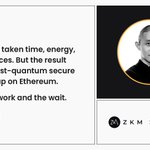
This has all taken time, energy, and resources. But the result will be a post-quantum secure hybrid rollup on Ethereum. Worth the work and the wait.

ZKM retweeted

Ziren is the backbone of the GOAT Network stack. Its speed and cost carry straight into the bridge that will move BTC between Bitcoin and GOAT, so a faster Ziren means cheaper, faster exits.
And the new core stays hash-based - the heaviest cryptography in the proof system is already quantum-resistant, while the remaining elliptic-curve pieces are replaced on the published post-quantum plan.
The full plan, with sources and measurements, is on Applied PQC - the open-source post-quantum research initiative our engineers run.
appliedpqc.io/blog-bitcoin-l…

ZKM retweeted
Our team has taken the hard path on every decision for many years.
Build a zkVM from scratch on MIPS. A working decentralized sequencer set. A truly trust-minimized Bitcoin bridge. Post-quantum security in progress across the stack. And now real-time proving on Ethereum.
Ziren is already the heart of GOAT Network, and work is now underway to bring it to Metis.
ZKM retweeted

Excited to release Ziren v2.0!
Main updates:
1. Proof system upgraded to WHIR, > 100-bit proven security, compressed proof < 300KiB, and >4x speedup over Ziren v1.x
2. Chip constraint determinism formally verified by Lean 4
3. On @eth_proofs, RTP on Reth is launched, Geth keeper proving is ready to go
4. More use cases delivered internally!
ZKM retweeted
This is an inspiring work. We have been auditing Ziren Linux ABI by Lean4 for a while, the basic syscall has been done, but not covering all.

x86 formal verification is coming!
The (first?) published machine-checked proof of a security property for the end-to-end execution of a Linux process running an x86 binary statically linked against glibc.
And we believe it scales!
A joint research project with @zellic_io 🧵👇

ZKM retweeted
Make zkVM and Bitcoin Rollup technology for daily life!

ZKM retweeted
BREAKING: GOAT Network and KOSDAQ-listed @Squaretech_HQ have signed an MOU to advance AI agent-powered stablecoin payments in South Korea 🇰🇷
The first focus is a stablecoin payment program for foreign tourists that Square Tech is developing with Lordsystem. It aims to let visitors verify their identity with a mobile passport and pay participating merchants in US dollar stablecoins, and the partners will explore bringing GOAT's AI agent payment technology into it.
Under the agreement, Square Tech will lead business development, merchant partnerships and regulatory engagement in Korea. GOAT Network will provide its AI agent payment technology and Bitcoin-secured network infrastructure, and DAC Labs, the core infrastructure developer behind GOAT Network, will support technical integration, security reviews and network operations.
Full announcement below.
goat.network/news/goat-netwo…

ZKM retweeted
Good thread.
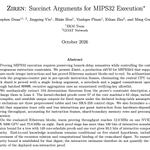
One data point on depth, from our Ziren paper (eprint.iacr.org/2026/2330):
Our recursion is not open-ended (unlimited depth). A block proof is one leaf per shard, a compose tree of arity ≤ 3, and a single root: depth 2 + ⌈log₃ N⌉, about 7 levels for our largest test block. The recursion keys are not inputs either. Every leaf and compose key must sit in a fixed allowlist committed under one root, and the verifier fixes the schedule rather than reading it from the proof. That's a bounded, closed set of verifier circuits, a different risk profile from unlimited-depth recursion with the aggregated vk passed in as input.
We also state the recursion assumption as an open hypothesis rather than a belief. Our composition theorem works in the ROM, where Fiat–Shamir costs log(Q) bits for Q oracle queries: a 150-proof tree has 93.51 interactive bits, 53.5 at Q = 2^40. It holds under hypotheses including that "each node's extractor succeeds on the transcripts its parent's extractor produces".

A few reflections on the lattice vs. hash-only debate that our recent Aerie post sparked:
1. Cryptographic ossification for blockchains was never safe. Until the day we know with certainty that P ≠ NP, that finding short vectors in lattices is intractable, that Keccak effectively behaves like a random oracle in deployed SNARKs, and that every single bug has been eliminated from our codebases, blockchains cannot ossify. That is simply not how safe systems are built. Issues will arise, and the system will have to respond.
It’s a double standard to reject lattices because blockchains are hard to upgrade if lattices break, while counting on upgrades if AI breaks your hash function or finds a critical zkVM bug.
The best counterargument is that hash-only designs are more agile: if your hash function breaks, just swap out the hash. But we must aspire to a higher level of agility than this. Indeed, as I cover next, if SNARK recursion itself turns out to degrade security, the proposed hash-only blockchain designs would need to be rethought from the ground up.
2. The real security debate is not lattices vs. hashes — it is lattices vs. building everything on SNARK recursion. That’s because “hash-only” is not really hash-only: it rests on hashes plus the soundness of deep SNARK recursion. Ethereum’s roadmap relies on exactly that: hash-based aggregation needs recursion to keep up with a slot’s worth of signatures, and EIP-8288 would send other signature schemes and users’ own proofs through the same recursive pipeline. In contrast, Aerie proves a slot’s worth of signatures on one laptop without any recursion.
All deployed post-quantum SNARKs rely on the Random Oracle Methodology (via Fiat–Shamir) to establish their security. This is an idealization we know fails in the real world: we have explicit counterexamples where “SNARKs” coming out of this methodology are totally insecure when instantiated with any concrete hash function.
We generally ignore these counterexamples in part because they only arise when proving contrived, self-referential statements about the very hash function used by the SNARK verifier.
But proving statements about the verifier’s own hash function is the exact thing you do in SNARK recursion. That’s why the security of recursive SNARKs can’t be established even in the random oracle model.
On top of that, the standard security proofs for recursion (in other models) suffer an “extractor runtime” blowup that is exponential in the recursion depth, suggesting that security may degrade as more recursion is applied. Yet Ethereum’s own EIP-8288 enables unlimited-depth recursion, even as it lists soundness of recursive SNARKs as a trust assumption. Proofs in more idealized models avoid the blowup, but they mainly tell us that an attack on SNARK recursion would have to exploit the concrete hash function, which is exactly what the Fiat–Shamir attacks above do.
To be clear, we don’t know of any outright attacks on SNARK recursion, and I very much hope it is secure. But some of us who have studied the question have a lingering sense that an attack may be possible in some settings. And if AI is going to supercharge cryptanalysis, there is no reason to expect it to spare Fiat–Shamir for SNARKs, let alone SNARK recursion, both of which have had far less scrutiny than lattices.
So, I do not concede that a “recursion everywhere” hash-only approach is clearly more conservative than one built on standard lattice assumptions.
3. “Just wrap everything in a hash-based SNARK” (like EIP-8288) faces challenges.
Aggregating signatures and proofs off-chain into a single block-level proof is a powerful design independent of the hash-only vs. lattice debate, and I am not telling people to avoid it. But claiming, as Vitalik Buterin did this week, that users can run whatever cryptography they want locally and wrap it in a client-side leanVM proof glosses over major hurdles.
For example, leanVM today is a minimal VM designed almost entirely to prove hash-based signatures and recursion, not general-purpose computation. And binary-field SNARKs like leanVM remain slow at proving the integer multiplications that lattice cryptography does en masse.
I am optimistic that many of these zkVM challenges can be met (including via my own work, binary-field Twist and Shout, which are now implemented in Magnetar). But regardless, if lattices can make aggregation simpler and faster, then they should be leveraged. We need to be agile no matter what.
4. For chains whose reason for existence is privacy, I truly struggle to understand the pushback. Public-key encryption (and fast single-server PIR) cannot be built from hashes alone, at least not in any black-box way. If lattices break, it is going to be very, very hard for these chains to provide acceptable levels of privacy and functionality. For a project whose entire reason for existence is privacy, a loss of confidentiality is an existential failure. Next to that, a second signature upgrade (after the first one, from elliptic curves alone to, hopefully, a hybrid lattice scheme) is easy.
Summary: We don’t know for sure what is secure and what isn’t. We are all weighing unquantifiable risks against each other, and we do not need to agree on a total order on them. But hash-only solutions face many open engineering challenges, and they are not more “conservative” in the way some have argued. Some of those challenges are entirely prosaic and have nothing to do with bugs or cryptography, like hardware support for custom schemes whose hash function is still undecided. I hope we can overcome those challenges within the appropriate timelines, but they must be acknowledged and portrayed realistically.
Overall, cryptographic agility and defense in depth (e.g., hybrid signatures) are the answer, which is why we are building both lattice-Jolt and hash-Jolt. In practice, the positions are less polarized than social media discourse suggests: for example, StarkWare is working to make Falcon verification cheap (falcon.provably.fast/), which is great to see.
Here is the (apparently) controversial take I am sticking to: Conditioned on agility, whenever lattices make systems simpler or more functional, we should embrace them rather than default to “hash-only” designs. Lattices are what the rest of the world will depend on, with decades of study and hardening behind them, and at the system level, less functional often means less secure. Where hash-only designs are just as simple and functional, by all means use them.

ZKM retweeted

Something Vitalik hasn't mentioned yet: Ziren is the first zkVM to prove Geth without modifying the Go compiler.
@ProjectZKM's R&D team has worked closely with the @ethereumfndn on it for around a year.
The speed battle Vitalik calls won was fought almost entirely on Rust clients. Ethereum's most widely used execution client is written in Go, and proving it is a different problem - Ziren patches the Go runtime's garbage collector and scheduler to do it.
If the top priority is now security - for Ziren it always was - then prover-side client diversity belongs on that list. The Foundation has spent years on client diversity for Ethereum itself; proofs that all run through one client reproduce the monoculture problem one layer up.

Big congratulations to the @zksync airbender team for this milestone.
At this point, I consider the battle for speed to be definitively won, and the top priority for zkEVMs should shift fully to security.
To me that means formally verifying
(i) equivalence of the arithmetization to the ethereum spec
(ii) a hard maximum bound on (prover cost) / (amount of gas in block)
(iii) security of the proof system itself
firefly.social/post/x/211001…

ZKM retweeted
Congratulations to @zksync!
Also would love to mention Ziren V2 @ProjectZKM here!
1. Ziren are proving Reth and Geth, to make sure the client diversity works for Ethereum protocol. Ziren is the first zkVM proving Geth.
2. Ziren also finished the constraint determinism by Lean4 for its 57 VM chips with 104 theorem proofs.
3. Ziren proof system has >100 interactive proven soundness, within unique-decoding radius.
ZKM retweeted
Share some numbers about multi-client proving for Ethereum with Ziren V2.0 @ProjectZKM, which can prove 75.8MHz with 8X5090, and 12MHz with 1X5090.
And the instruction efficiency of Geth/Reth is around 7x, which seems larger than 5 months ago, because we did more guest side optimizations on Reth:
> Witness and trie: arena nodes, compact digest references, borrowed input slices, faster RLP decoding, and fewer allocations and clones.
> Memory and hashing: word-wise comparisons, a cheaper hash-map hasher, and Keccak input buffers built directly, using the stack for short inputs.
> 256-bit arithmetic: multiplication and modular multiplication use zkVM precompiles; division uses hints checked inside the guest.
> Cryptography: syscall-backed BN254 and BLS operations, cached KZG preparation, and accelerated modular exponentiation.
> EVM interpreter: MIPS32 fast paths for gas accounting, stack swaps, and memory loads/stores.
PS. the number in the picture will be updated in our next release of our paper.
@go_ethereum @ethereumfndn


Happy to share our latest work on Ziren @ProjectZKM @GOATNetwork. Feedback welcome!
A summary:
1. A new proof system based on Jaggled reduction and WHIR(including recursion proof over binary field and Blake3). Acknowledgements to SP1 team and Plonky3 contributors.
2. 4x proving efficiency, 10x emulation efficiency improvement over previous v1.2. Speedup is happening every day with AI assistant.
3. >100-bit proven security
4. A fully Lean 4 assisted constraint determinism proof, covering 104 chips.
5. A complete end-to-end zkVM design reference.
ZKM retweeted
ZKM's new paper, published on the IACR Cryptology ePrint Archive, is a testament to the world-class work @sd_eigen and our R&D team have done on Ziren.
Importantly, we know exactly where we stand on quantum resistance and exactly what the options are. Our highest security priority is a post-quantum secure BitVM3 bridge between @GOATNetwork and Bitcoin.
Ziren: Succinct Arguments for MIPS32 Execution has been published on the IACR Cryptology ePrint Archive.
→ eprint.iacr.org/2026/2330
It is a complete design reference, covering the proof system, the formal verification of the machine itself, and the production record.
Ziren is a CPU-less chip architecture: every executed instruction is one row of its opcode's chip. Each shard is proved with one lookup argument and one zerocheck, then a jagged sumcheck reduces tens of thousands of columns of differing heights to a single evaluation, opened with one batched WHIR proof. A recursion tree composes the shard proofs under an enumerated allowlist of verifying keys.
All 104 extracted determinism theorems are proved in Lean 4, generated from the same constraint description the prover evaluates, and the security analysis states its bounds with every assumption listed.
The same machine runs in production. It proves 77 user-mode MIPS32r2 instructions, has proved Ethereum mainnet blocks end to end, and reaches up to 7.3 MHz on a single RTX 5090, scaling to 24 MHz across four.
Securing Ziren has been and continues to be an extensive effort. Our deepest thanks go out to @ethereumfndn, @ConsensysAudits, and @VeridiseInc for working with us so closely on it.
Code: github.com/ProjectZKM/Ziren
Docs: docs.zkm.io
ZKM retweeted

The solution of post-quantum safe BitVM is coming soon!
Of the two families in the comparison, the lattice side is where we're headed: ML-DSA is the scheme GOAT Network's validator consensus keys are migrating to.
With the @AppliedPQC playground, anyone can run it in browser and see what that means.
The post-quantum work continues.
ZKM retweeted
ZK does not remove trust while what ZK is good at is narrower, and more useful. It can prove one fact, age, wealth etc., not on a sanctions list, without handing over the passport, address, or income behind that fact.
It changes what you have to trust. Today’s KYC/AML model treats a full identity file as proof of compliance. Every institution collects the same personal data, stores it, and hopes a bigger database will catch more crime. That is the “data haystack”: more records, more breach risk, not necessarily more signal.
But the trust root remains. A proof only shows that some inputs satisfy a rule. It does not prove those inputs were honest. Someone still has to issue the credential, screen the wallet, or sign the risk score. If that issuer is compromised, the math will still verify a bad claim.
So the real world stays responsible for issuance and accountability. ZK keeps disclosure small, the chain stores a checkable proof instead of a personal file.
ZK can shrink the haystack. It cannot certify the needle.
#zkvm


ZKM retweeted
Formal verification becomes one of the fundamental feature of proof system. Ziren 1.x @ProjectZKM was formally verified by Veridise, and the upcoming 2.0 is already formal verified by Lean4.

Thanks to Tachyon's @MariusMargulus, the new zk-SNARK prover in Zakura (and also in @vizorwallet) is the first Zcash prover with a machine-checked Lean proof of statistical honest-verifier zero-knowledge.
Read more:
zakura.com/engineering/ironw…

ZKM retweeted
@ProjectZKM tackled the claim doing the most damage in this conversation: "STARKs are hash-based, so they must be post-quantum".
True of a commitment scheme, false of a proof system. ZKM audited Ziren under that rule, found one thing, and shows how it closes.
This piece has been resonating with ZK researchers for a reason.
zkm.io/blog/hash-based-is-no…

ZKM retweeted
Make GOAT Network PQ safe step by step.
A network built to secure the next economy with Bitcoin has to outlive the quantum computer. The signatures securing most blockchains today will not.
GOAT Network is moving its validator consensus keys from secp256k1 to ML-DSA-65, the NIST post-quantum signature standard: one validator at a time, while the chain keeps producing blocks.
Full engineering writeup below: what broke, what it costs, and the playbook for any chain looking to do the same.
hackmd.io/@goatresearch/B1f3…

ZKM retweeted
Today, builders who spent a summer shipping agent products put their work in front of a live audience.
Joining to judge: @GOATNetwork CEO @kevinliu, @ProjectZKM CTO @sd_eigen, and @MetisL2's @ElenaCryptoChic and Andrei S.
Live here at 9am EST.
ZKM retweeted

A look at the security report from our audit of Ziren, a zkVM, assessed through our Vulnerability Mining workflow and ZK fuzzing, in close collaboration with @ProjectZKM ↓
The past week at GOAT:
Last week was largely about @ProjectZKM. From the release of the Ziren security report with @ConsensysAudits to new work on Poseidon2 and long-term cryptographic assumptions, much of the week focused on the proving and security layer that sits beneath GOAT Network.
Also this week:
◦ @0x1164 hosted Part 2 of From Demo to Demand, with the full resource pack now available
◦ Our team showed support for BIP-448
◦ We gave a clear view of "What We Want Built on GOAT"
And more. Dive in below 🧵