

2026 Ambassador of Polish History Award | Father, writer & seeker of truth. Exploring memory, faith & the moral weight of history. Memento Mori. Veritas Manet.
USA
Joined May 2021
- Tweets13.7K
- Following533
- Followers33.7K
- Likes26.9K






Pinned Tweet
Long post: 😊
As someone not of Polish descent, I approach Polish history with an objective and committed perspective.
My passion for uncovering and sharing these often-overlooked stories comes from a deep respect for the resilience and sacrifices of the Polish people.
In my journey to shed light on these narratives, I’ve faced criticism, name-calling, censorship, and the spread of falsehoods.
Some deliberately distort history for personal gain or to diminish the significance of Polish experiences or simply out of malice.
I refuse to remain silent in the face of such lies.
The truth matters, both to history and to the dignity of those who lived it.
As a real Christian, I believe that truth, honor, and integrity are essential virtues.
To follow Christ is to value honesty and stand for justice, even when it’s difficult or unpopular.
This belief guides my work in exploring Polish history and every other aspect of life.
Whether analyzing past events, current issues, or personal struggles, I am committed to revealing the truth. In a world rife with misinformation, this pursuit is a reflection of the gospel’s call to love, humility, and justice.
Yet, I’m not afraid to confront evil and call out manipulators for what they truly are.
I believe in speaking honestly and directly, as truth requires boldness and integrity.
This commitment reminds me that all people, regardless of nationality, are made in the image of God and deserve dignity and compassion.
Just as I seek to honor Poland’s history and legacy, I strive to live a life dedicated to truth in all areas.
From addressing injustices in my own country to confronting global issues, I am committed to shedding light on what truly matters.
Falsehoods must be challenged for the betterment of humanity, wherever they arise.
To those who intentionally manipulate facts or distort history, I say this: the truth cannot be silenced.
You may mislead for a time, but truth always prevails.
Your actions dishonor the memory of those who suffered and are currently suffering.
Accountability is not optional, it is essential for justice and healing.
Poland’s history is not only a tale of oppression and struggle but a testament to the strength of the human spirit, the fight for freedom, and the belief in justice.
These ideals fuel my broader mission to promote truth, compassion, and integrity.
The challenges and betrayals I witness in my own country inspire me to uphold the values of honesty, compassion, and justice.
Today is a special day for me as I welcome another member of my family, my namesake, Theodor (“Gift from God”).
I am eager to teach him the knowledge I have, share with him the truth, and, God willing, see him become a better man than I.
I also want to take a moment to thank everyone who has supported my work.
Your encouragement and willingness to share my research inspire me to continue, even in difficult times.
It is because of you that I remain committed to sharing the truths that must be heard.
You remind me that standing by the truth, regardless of the challenges, is always worth it.
To everyone who believes in the power of truth: thank you.
Together, we honor the past and work toward a future grounded in honesty, dignity, and faith.
Let us continue seeking the truth, confronting falsehoods, and ensuring that the legacies of courage and hope endure.
Fiat Lux et Veritas

For 123 years, Poland existed without a sovereign state. Three empires had divided its territory, suppressed its aspirations, and attempted, in different ways, to destroy its national identity.
Generations of Poles were born, lived, and died without ever seeing their homeland free and yet Poland endured.
It survived in the prayers of mothers, the classrooms of courageous teachers, the writings of poets, the sacrifices of insurgents, and the quiet determination of ordinary families who refused to surrender their identity.
Some fought with weapons. Others fought with books, language, faith, and memory. Many paid with their freedom or their lives.
When Poland regained independence in November 1918, it was not simply the restoration of a state. It was the fulfillment of a promise carried across generations by people who knew they might never live to see it realized.
And perhaps that is the greatest lesson of Polish history: that our lives can have meaning beyond what we ourselves will ever witness. Freedom is not merely inherited, it is entrusted to us by those who came before.
Let’s remember not only the heroes whose names fill our history books, but also the countless forgotten Poles whose sacrifices made November 11 possible.
A nation may be erased from a map, but it cannot be erased from the hearts of those determined to remember.
Niech żyje Polska! 🇵🇱
Happy Polish Independence Day.

General August Emil Fieldorf “Nil” was a hero who survived German occupation, commanded the Home Army’s legendary Kedyw sabotage operations, and endured Soviet forced labor camps, only to be arrested, tortured, and murdered by Poland’s lackeys, the communist rulers.
His interrogators subjected him to brutal physical and psychological abuse, attempting to force him into false confessions. He refused to betray his comrades or surrender his honor.
Condemned in a Stalinist show trial, Fieldorf was hanged on February 24, 1953, at Warsaw’s Mokotów Prison. His body was secretly buried, and his remains have never been identified.
The cruelty was deliberate: a Polish patriot who had fought German tyranny was destroyed by another totalitarian regime claiming to have liberated his country.
The Germans failed to break him. The Soviets imprisoned him. Poland’s communist executioners murdered him.
His crime was loyalty to a free and independent Poland.
Honor to General Fieldorf and shame upon his murderers.

#OTD in 1950, Gen. August Emil Fieldorf "Nil," former commander of Kedyw, the Polish Home Army's sabotage and combat operations branch during WW2, was arrested by the communist secret police in Łódź. Having survived Soviet labor camps, he was later sentenced to death in a sham trial and executed in 1953.

🇵🇱 Poland - A Nation That Refused to Disappear
November 10, 1918. There are moments in history when the impossible begins to become possible.
After 123 years of partitions, generations of struggle, and countless sacrifices, Poland stood on the threshold of rebirth.
On this day, Józef Piłsudski returned to Warsaw, just as a new chapter of Polish history was beginning.
Poland’s story reminds us that freedom is never guaranteed, identity is more than geography, and the spirit of a nation can survive even when its borders disappear.
Some nations are defined by their victories. Others are defined by their refusal to surrender.

As November 11th approaches, we honor Poland’s Independence Day, a testament to resilience, sacrifice, remarkable loyalty, and the enduring spirit of freedom.
For 123 years (1795–1918), Poland vanished from the map of Europe, divided among three empires. Yet its identity survived through generations who preserved their language, culture, traditions, lifestyle, and the unwavering hope for independence.
In 1918, Poland rose again, proving that a nation may lose its borders, but never its soul. Polish history reminds us that freedom is never guaranteed - it must be earned through courage, defended through sacrifice, and preserved through remembrance.
Today, we honor those who kept Poland alive when it existed only in the hearts of its people.
Jeszcze Polska nie zginęła.
“Poland Is Not Yet Lost.”
Niech żyje Polska! 🇵🇱


Under Hans Frank, occupied Poland became a killing ground. Poles were dragged from their homes, tortured in prisons, shot in forests, and publicly hanged as warnings to others. Teachers, priests, professors, and ordinary civilians were systematically targeted. Entire families were destroyed.
Frank chillingly contrasted German repression in the Czech lands with Poland, boasting that if he announced every seven Poles executed, there would not be enough paper in Poland’s forests to print the notices.
In occupied Poland, the gallows were not merely instruments of execution. They were instruments of government. Frank was convicted at Nuremberg and hanged in 1946.
There is something particularly obscene about a German mass murderer ruling from the castle of Polish kings while his regime systematically destroyed the people, culture, and civilization it represented.
He occupied the castle of kings - he governed through murder and in the end, he met the very gallows he had inflicted upon countless innocent Poles.
The German occupation governor Hans Frank took up residence at Wawel Castle in Kraków #OTD in 1939.
By Adolf Hitler’s decision, Kraków became the capital of the German General Government, which comprised Polish territories that had not been directly annexed to the Third Reich.
Hans Frank was responsible for crimes committed by the Germans in occupied Poland between 1939 and 1945.

ALT Governor Hans Frank accompanied by General Walther von Brauchitsch (third from right) and General Johannes Blaskowitz (far left, holding a cigarette) in the arcaded courtyard of Wawel Castle in Kraków. (National Digital Archives)
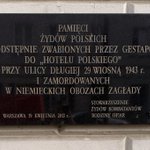
While walking through Warsaw, last week (with the help of my friend @PrefdeZoo, I encountered this memorial at 29 Długa Street, commemorating Polish Jews deceived and subsequently murdered by Germany.
Yet the plaque omits a deeply disturbing and documented aspect of this tragedy: Jewish Gestapo collaborators played an active role in facilitating the Hotel Polski affair, exploiting fellow Jews who were desperately trying to survive.
Leon Skosowski and Adam Żurawin were among those implicated in the operation. They helped arrange the sale of foreign identity documents, extracting enormous sums from desperate people whose hopes of survival were ultimately shattered.
This was not merely passive cooperation. It involved active collaboration with the machinery of persecution, financial exploitation, and the betrayal of people facing extermination. It’s was cruel murderous intentions.
The Gestapo bears primary responsibility for the operation and the murders, but indeed those who knowingly collaborated, profited, and helped expose victims to their persecutors must also be held accountable in the historical record.
Why should their involvement disappear from public remembrance? Why should documented collaborators escape scrutiny simply because they belonged to the same persecuted community as their victims?
Collaboration does not become less reprehensible because of the collaborator’s identity. Betrayal does not become less monstrous because the victims and their betrayers shared an ancestry.
The victims deserve remembrance, and every documented participant in their persecution deserves historical scrutiny.
History must never become an exercise in selective accountability and the truth must include the collaborators as well as the principal perpetrators.

For far too long, historical accountability has been applied selectively, with certain individuals and institutions shielded from the scrutiny demanded of others. The consequences of such moral double standards are profound: when people believe their actions are beyond criticism or consequence, injustice becomes easier to excuse and evil easier to perpetuate.
The world is increasingly questioning these double standards, and rightly so. No identity, ancestry, religion, or historical suffering grants anyone immunity from moral responsibility. Evil does not become less evil because of who commits it, nor does a victim’s suffering become less significant because of who inflicted it.
There cannot be one standard of justice for some and another for everyone else. If truth and morality mean anything, they must apply universally, without exception, favoritism, or fear.
On this day, 159 years ago, Maria Skłodowska-Curie was born in Warsaw, at a time when Poland had been erased from the map of Europe by foreign powers. Despite growing up under Russian rule and facing the limitations imposed on women seeking higher education, she rose to become one of the most remarkable scientists in human history.
Her groundbreaking research transformed our understanding of radioactivity and opened new possibilities in medicine and science. In 1898, together with her husband Pierre Curie, she discovered two chemical elements, polonium and radium. She deliberately named polonium in honor of her beloved Poland, ensuring that the name of her homeland would be recognized by the scientific world even while Poland remained deprived of its independence.
In 1903, she became the first woman to receive a Nobel Prize, sharing the Nobel Prize in Physics with Pierre Curie and Henri Becquerel. In 1911, she received the Nobel Prize in Chemistry, becoming the first person in history to win two Nobel Prizes and remaining the only person to have received Nobel Prizes in two different scientific disciplines. Her pioneering discoveries helped lay the foundations for modern radiation-based cancer treatments and advanced scientific understanding of the atom.
Her dedication to humanity extended far beyond the laboratory. During the First World War, she helped develop and operate mobile X-ray units that allowed doctors to examine wounded soldiers near the front lines, improving medical care and saving lives - she understood that scientific knowledge carried a responsibility to serve others, and she devoted much of her life to putting that belief into practice.
Although she spent much of her professional life in France, Maria Skłodowska-Curie never forgot her Polish heritage. Her achievements were not only triumphs of scientific discovery but also powerful examples of perseverance, courage, and intellectual independence in a world that placed enormous obstacles before women.
She reminds us that Poland’s contribution to world history extends far beyond its struggles for freedom and independence. It lives in the minds, discoveries, and accomplishments of Polish people whose work has shaped humanity. Maria Skłodowska-Curie demonstrated that even when a nation is denied its sovereignty, its spirit, identity, and contributions to civilization cannot be erased.
We remember not only a brilliant scientist and a two-time Nobel Prize laureate, but also a remarkable Polish woman who carried the name of her homeland into the history of science and left a legacy that continues to benefit generations around the world.

On this day, 87 years ago, one of the darkest chapters in the history of Polish education unfolded in Kraków. On November 6, 1939, just two months after Germany invaded Poland, the occupation authorities carried out an operation known as Sonderaktion Krakau (Special Operation Kraków).
Professors and academics from the prestigious Jagiellonian University and other Kraków institutions were summoned to what they believed would be an academic lecture at the university’s Collegium Novum.
Instead, they walked into a carefully prepared trap.
SS officer Bruno Müller announced that the university was acting against German interests. The assembled academics were arrested. In total, 183 people were detained, including some of Poland’s most distinguished scholars, scientists, and intellectuals.
Many were subsequently transported to Sachsenhausen concentration camp, where they endured brutal conditions, hunger, humiliation, and forced confinement. Some died as a result of their imprisonment.
The operation was not simply an attack on a university. It formed part of Germany’s broader campaign to destroy Poland’s educated leadership, suppress its cultural institutions, and weaken the nation’s capacity to resist occupation. Yet the attempt to extinguish Polish intellectual life ultimately failed.
Despite the closure of universities and the persecution of teachers, clandestine education continued throughout occupied Poland. Professors and students risked imprisonment and death to preserve knowledge and learning.
November 6, 1939, reminds us that the destruction of a nation does not begin only with the destruction of its cities. It can also begin with the silencing of its teachers, historians, scientists, and thinkers.


It was a tremendous honor to stand alongside my fellow recipients of the 2026 Ambassador of Polish History Award in Warsaw. Though we come from different countries, we share a commitment to preserving historical truth, honoring those who came before us, and ensuring Poland’s their remarkable and unbreakable history is never forgotten.
My heartfelt congratulations to my fellow laureates. I am truly humbled to be among them.

📣 W Warszawie po raz kolejny przyznaliśmy nagrody „Ambasador Polskiej Historii”. W uroczystości uczestniczyli zastępcy prezesa Instytutu Pamięci Narodowej: dr hab. Karol Polejowski, dr Mateusz Szpytma i dr hab. Krzysztof Szwagrzyk.
ℹ️ Nagroda „Ambasador Polskiej Historii” to honorowe wyróżnienie, ustanowione przez Instytut Pamięci Narodowej. Otrzymują je osoby oraz instytucje spoza Polski, które w sposób szczególny zasłużone są dla upamiętniania polskiej historii i poprzez swoją działalność wspierają Instytut w realizacji jego ustawowej misji w obszarach edukacyjnym i naukowym.
November 5, 1939 - When the Germans Tried to Silence Poland, the Underground Press Began to Speak.
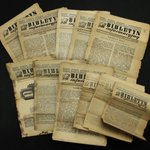
87 years ago today, only weeks after Poland’s courageous defense against overwhelming odds, the first issue of Biuletyn Informacyjny appeared. While German occupation authorities sought to control information, suppress Polish identity, and destroy the nation’s institutions, ordinary Poles were already organizing an exceptional underground press.
The publication would become one of the most important voices of the Polish resistance, bringing news, information, and encouragement to a population living under terror. Every issue represented an act of defiance. Behind the printed words were people risking imprisonment, torture, and death to ensure that the Polish nation would not be silenced.
The Germans could occupy Poland’s cities, close its institutions, and imprison its citizens, but they could not extinguish the determination of those who believed that truth itself was worth defending. Sometimes resistance begins not with a rifle, but with a printed page.

I’m deeply honored by this recognition from the Institute of National Remembrance. What began as a personal fascination in my youth regarding Polish history many years ago has become one of the most meaningful pursuits of my life.
My sincere thanks to the IPN and to everyone who has supported, encouraged, and followed my work over the years. Your interest and encouragement have meant more than you know.
Poland’s history deserves to be told truthfully, while also being remembered, understood, and shared with the world. I’m grateful to have played even a small part in that effort.
🏆 Edward Reid
❗️Amerykański popularyzator historii Polski, twórca portalu PolishTruth.com. W anglojęzycznych publikacjach i mediach społecznościowych przedstawia m. in. doświadczenia Polaków podczas II wojny światowej, dzieje Polskiego Państwa Podziemnego i zbrodnie reżimów totalitarnych. Dociera do Polonii oraz zagranicznych odbiorców, którzy dzięki jego pracy poznają polską perspektywę historyczną.
#AmbasadorPolskiejHistorii

On November 2, 1925, Poland solemnly inaugurated the Tomb of the Unknown Soldier (Grób Nieznanego Żołnierza) in Warsaw, creating one of the nation’s most sacred monuments to courage, sacrifice, and freedom.
At the heart of the ceremony was the coffin of an unidentified Polish soldier, whose remains had been brought from the Cemetery of the Defenders of Lwów (Lviv). He represented the countless Polish soldiers who had given their lives fighting for their freedom and homeland, many of whom would never be identified or return to their families.
The tomb was established beneath the magnificent colonnade of the Saxon Palace in Warsaw. During World War II, German forces destroyed the Saxon Palace in December 1944. Miraculously, a portion of the colonnade containing the tomb survived.
Today, that surviving structure remains one of Warsaw’s most powerful symbols of Polish resilience. An eternal flame burns at the tomb, and a military honor guard stands watch, preserving the memory of generations who fought and died for Poland’s independence - soldier’s name is unknown, but his sacrifice belongs to the entire nation.

One of the things that moves me most deeply about Poland is the way its people honor their dead on All Saints’ Day.
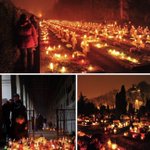
Across this beautiful country, cemeteries glow with thousands of candles. Families gather at the graves of parents, grandparents, children, and ancestors they may never have known personally. Flowers are placed, prayers are offered, and generations are remembered with a tenderness and reverence that I find profoundly moving.
Having witnessed this tradition myself, I can tell you that photographs hardly capture the experience. There is something extraordinary about walking through a Polish cemetery illuminated by countless candles, seeing entire families gathered in remembrance, and realizing that this is not simply a religious observance but something deeply woven into the nation’s character.
For me, it touches something profoundly personal: the realization that those who came before us are never truly absent from our lives. We carry their sacrifices, their struggles, their love, and their hopes within us. We are, in so many ways, the continuation of their stories.
As an American, I cannot help but reflect on how much of this sacred connection we have lost.
American society has become increasingly consumed by work, ambition, material pursuits, and the relentless distractions of modern life. We celebrate individual achievement, personal advancement, and the pursuit of happiness, yet too often neglect the generations whose sacrifices made our own lives possible. We bury our loved ones, mourn them, and are then expected to move on. Graves are visited less frequently, family histories are forgotten, and the names of those who came before us gradually disappear from memory.
Of course, many Americans continue to honor their ancestors with great devotion. But I believe something important has been lost in our broader culture. We have become remarkably good at looking forward and increasingly careless about looking back.
Poland offers a powerful reminder that remembrance is not simply nostalgia. It is an act of love, gratitude, and fidelity.
There is something extraordinarily meaningful about a nation that pauses its daily life to honor those who are no longer here. A people who understand that death does not erase our obligations to those we have loved, and that the past is not something to be discarded simply because it no longer serves our immediate interests.
I wish more Americans could experience this remarkable Polish tradition. Not merely to admire the beauty of candlelit cemeteries, but to reconsider what we owe our parents, grandparents, ancestors, and all those whose lives and sacrifices made our own existence possible.
A civilization is measured not only by what it builds for future generations, but also by how faithfully it remembers the generations that built it. Poland understands something that our modern, hurried, increasingly individualistic society is in danger of forgetting - it is truly an honor to witness this.
We do not honor the dead because they can remember us. We honor them because we refuse to forget them.


On November 2, Poland observes All Souls’ Day, known as Dzień Zaduszny or Zaduszki. Following All Saints’ Day on November 1, this solemn occasion is dedicated to remembering and praying for those who have passed away.
Across Poland, families gather at cemeteries to light candles, place flowers on graves, and honor the memory of their loved ones. Thousands of flickering candles illuminate the cemeteries, creating a beautiful and moving tribute to generations past.
It is also a time to remember Poland’s fallen soldiers, national heroes, and all those who sacrificed their lives for their homeland. Their courage and sacrifice remain an important part of Poland’s history and national identity.
All Souls’ Day is more than a religious observance. It is a cherished Polish tradition that connects generations, preserves memories, and reminds us never to forget those who came before us.
Pamiętamy o tych, którzy odeszli. Nigdy nie zapomnimy.
We remember those who have passed away. We will never forget.

Eighty-six years ago, as Germany tightened its control over the Warsaw Ghetto in occupied Poland, hundreds of thousands of Jewish men, women, and children faced increasingly desperate conditions.
Yet beyond the ghetto walls, countless courageous Polish citizens were helping to keep people alive.
As one historical account describes, the isolation of the Warsaw Ghetto created an extraordinary dependence on assistance from outside, which allowed the ghetto population to survive for two years in complete isolation. Food rations were desperately inadequate, with the passage describing daily caloric allowances falling from approximately 500 to just 300 calories.
In response, Polish civilians helped provide food, work, money, and essential supplies to their Jewish neighbors. People from different social backgrounds and walks of life established connections across the ghetto walls, creating networks of assistance despite the danger.
These efforts, alongside the resourcefulness of Jewish residents and underground networks, helped sustain life in the ghetto.
This assistance was no small act of kindness. Under German occupation, helping Jews could carry the death penalty, not only for the individual but for the entire family. Every delivery of food, every hidden family, every forged document, and every act of compassion could place the rescuer’s life in danger.
In December 1942, the Polish underground helped establish Żegota, the Council to Aid Jews, which organized financial assistance, shelter, false documents, and rescue efforts. Polish and Jewish members worked together to save lives. Among those remembered is Irena Sendler, whose courageous work with fellow rescuers helped save Jewish children.
Today, Poland holds the distinction of having the largest number of people recognized by Yad Vashem as Righteous Among the Nations - these stories remind us that even during one of history’s darkest chapters, compassion, courage, and solidarity could cross walls built to divide people.
The walls of the Warsaw Ghetto were built to isolate. The people who risked their lives to help showed that humanity could reach beyond them.
The Polish men and women who risked their lives to help their Jewish neighbors deserve the utmost honor and recognition, for they were under no obligation to place themselves and their families in such extraordinary danger, yet they chose compassion, courage, and humanity over their own safety.

86 years ago, a Polish soldier was risking his life inside Auschwitz, not because he had been captured in battle, but because he had volunteered to enter the camp - his name was Captain Witold Pilecki.
On September 19, 1940, Pilecki deliberately allowed himself to be arrested during a German roundup in Warsaw. His mission was extraordinary: infiltrate Auschwitz, gather intelligence about German crimes, and organize resistance from within.
By October 30, 1940, Pilecki had spent more than a month inside the concentration camp, where he was registered as prisoner number 4859 under a fake identity as Tomasz Serafiński.
Despite the constant threat of death, he helped build a clandestine resistance network known as the Union of Military Organizations (ZOW) and through secret communications, Pilecki’s network gathered and transmitted information about the atrocities taking place inside Auschwitz.
After nearly three years of imprisonment, he escaped in April 1943 and continued fighting for Poland, but his story did not end with the defeat of Germany.
In 1948, Poland’s communist authorities executed Pilecki after a politically motivated trial and his burial place was concealed, and his memory was suppressed for decades.
Today, Witold Pilecki is remembered as one of Poland’s most extraordinary resistance heroes - he voluntarily entered one of the most terrifying and deadly places in human history to fight against evil from within.

On this day in 1944, soldiers of the Polish 1st Armoured Division, commanded by General Stanisław Maczek, liberated the Dutch city of Breda from German occupation. What made their victory remarkable was not merely that they defeated the Germans, but how they accomplished it.
Determined to spare civilian lives, Maczek’s men avoided a devastating frontal assault, helping preserve much of the historic city.
The Dutch greeted their Polish liberators with extraordinary gratitude, yet behind the celebrations lay a bitter irony.
These soldiers had fought years across Europe for the freedom of other nations and when the war ended, Poland fell under Soviet domination, and many could not safely return to the homeland they had sacrificed so much to defend.
Maczek’s own fate was particularly heartbreaking. Despite commanding thousands of soldiers and helping liberate Western Europe, the celebrated general was denied a British military pension. Living in exile in Scotland, he was forced to take menial jobs to support his family, including working as a bartender at an Edinburgh hotel.
A man who had commanded an armoured division against Germany was now serving drinks to make ends meet. Maczek passed away in 1994 at the age of 102 and was buried in Breda, among the soldiers who had fought under his command.
To this day, the Dutch city honors its Polish liberators. The Polish gave freedom to strangers while being denied freedom in their own homeland and the general who helped liberate Europe was left to struggle for his own livelihood.


In the autumn of 1939, the Germans unleashed a campaign of terror and mass murder across Polish Pomerania. As part of the Intelligenzaktion, teachers, priests, intellectuals, and community leaders were systematically executed in an effort to destroy Polish national identity.
The victims also included ordinary farmers, workers, and craftsmen and particularly chilling was the participation of local ethnic Germans who sometimes denounced or murdered Polish neighbors they had known for years, motivated by hatred, revenge, or greed.
On October 28, 1939, approximately 130 Polish prisoners were executed in the Barbarka Forest near Toruń. It was one of many massacres that turned Pomerania’s forests into mass graves.
There are estimates that approximately 30,000 people were murdered in Gdańsk Pomerania in 1939. Thousands of psychiatric patients and people with disabilities were also killed under Nazi racial policy.
At Piaśnica, Szpęgawsk, and elsewhere, entire communities were devastated. Perhaps the most terrifying lesson of these massacres is how quickly familiar neighbors can become executioners when hatred is given permission to rule.
The victims were meant to disappear into history, yet it is our refusal to let that happen that keeps their memory alive.


On this day in 1939, German authorities arrested Stefan Starzyński, the heroic mayor of Warsaw and a symbol of Polish courage and resistance.
During the German invasion of Poland, he refused to abandon Warsaw and remained with its people, organizing civilian defense and inspiring hope as bombs devastated the city.
In his historic radio address, he declared:
„Chciałem, by Warszawa była wielka. Wierzyłem, że wielka będzie.”
“I wanted Warsaw to be great. I believed that it would be great.”
Starzyński was later murdered by the Germans, but his faith in Warsaw’s future endured. The city he loved rose again from the ruins.

In October 1939, German occupation authorities moved to suppress unauthorized publishing in Poland. The Germans sought to destroy not only Polish independence but its culture, education, and national identity.
Still, in hidden cellars and secret workshops, Polish resistance members risked their lives printing newspapers, books, and reports exposing German atrocities.
Among the most important was Biuletyn Informacyjny (Information Bulletin), which began with just 90 copies in November 1939. By 1944, the circulation had reached approximately 43,000. Every printed page carried the possibility of a death sentence. Couriers caught with forbidden newspapers faced Gestapo interrogation, torture, deportation, or execution. One discovery could condemn an entire network, including friends and family.
Yet thousands continued, determined to preserve the truth. The Germans could occupy Poland, but they could not silence its people or extinguish their determination to remain Polish - a nation can be conquered militarily without surrendering its soul.
Pictured: Jerzy Rutkowski (1914–1989), head of the Secret Military Publishing Works (Tajne Wojskowe Zakłady Wydawnicze), the clandestine printing operation of the Polish Home Army.

#OnThisDay 87 years ago the German occupation in #Poland🇵🇱 outlawed all unauthorized publishing during #WW2. Despite this, Poles continued printing uncensored material, ranging from news of Allied victories to banned fiction. If caught, underground publishers were often executed.
