

I make simulations of countries, maps, space and what-ifs, built from real data and real physics, showing things no camera could ever film.
Joined April 2009
- Tweets703
- Following718
- Followers417K
- Likes4.6K




Run The Sim retweeted
This is what will eventually happen to the Sun and our Earth.
In about a billion years a 10% brighter Sun boils the oceans away, and about 5 billion years from now it swells into a red giant over 200 times wider, swallowing Mercury, Venus and probably Earth. It never explodes; it leaves a white dwarf the size of Earth.
Music: Holst, The Planets (1921 score).
Run The Sim retweeted
This is how sunrise looks on other worlds.
On Mercury the Sun rises, stops, sinks back down, then rises a second time.
This is how sunrise looks on other worlds.
On Mercury the Sun rises, stops, sinks back down, then rises a second time.
This is the map of the world after the sea rises 100 metres (330 feet): 14 countries are gone, and 1.3 billion people have lost their city.
Whole countries like the Maldives, the Netherlands, Denmark and Bangladesh would disappear, and so would many cities, including Shanghai 🇨🇳 , Mumbai 🇮🇳, Lagos 🇳🇬, London 🇬🇧, New York 🇺🇸, Buenos Aires 🇦🇷 and Sydney 🇦🇺.
The water would even reach the foot of the Pyramids of Giza and fill the dry heart of Australia.
A what-if, not a forecast: all the ice on Earth holds about 65 metres (213 feet) of sea level, and the 14 countries are the ones that lose at least 95% of their land. What it shows is how close to the sea most of us have built our homes.
Run The Sim retweeted
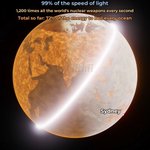
If you drop a teaspoon of neutron star into the ocean at Point Nemo, the most remote spot on Earth, this is what would happen: it explodes on contact, falling debris sets the sky on fire over every country within two hours, and the oceans boil away in about four months, leaving only salt on the sea floor.
If you drop a teaspoon of neutron star into the ocean at Point Nemo, the most remote spot on Earth, this is what would happen: it explodes on contact, falling debris sets the sky on fire over every country within two hours, and the oceans boil away in about four months, leaving only salt on the sea floor.

It goes up into the sky. All that steam stays wrapped around the planet, because Earth's gravity holds it in, and it makes an atmosphere about 270 times heavier than the air we breathe now, roughly three times the pressure on the surface of Venus. Over a few thousand years it slowly cools and rains back down, refilling the oceans.
3
83
7,274
Deep inside Uranus, scientists think it rains diamonds.
About 10,000 km down, under clouds that smell like rotten eggs, a hot sea of water, ammonia and methane is squeezed a million times harder than our air, enough to turn carbon into diamonds that sink toward the core.
3
12
4,383
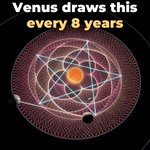
If you draw a line from Earth to Venus every 3 days for 8 years, you get this flower.
Venus goes around the Sun 13 times while Earth goes around 8, then both are back almost where they started. Venus passes between us and the Sun five times in those 8 years, and joining those five spots makes a star.
Venus last passed us in late October. It's the bright "star" in the east before sunrise right now.
Did you know that in all the trillions of snowflakes that have ever fallen, no two are exactly alike?
Jupiter is Earth's bodyguard.
It’s 318 times heavier than Earth and every comet heading our way has to pass it. Of half a million comets aimed at Earth's orbit over a million years, it threw 268,951 out of the Solar System for good and pushed one 96 million km off course.
In 1994 it took 21 pieces of one comet, leaving scars bigger than Earth.
a black hole the size of a coin appeared on Earth, it would weigh more than the whole planet. The ground around it would start falling in, getting so hot on the way down that a tiny share of that energy coming back out would rip the planet apart.
Half an hour later Earth would be a cloud of glowing rock flying off at about 72,000 km/h (45,000 mph), and the black hole would still be the size of a coin, with the Moon now circling it.
Run The Sim retweeted
The centre of the Earth is hotter than the surface of the Sun.
It's a ball of solid iron at about 6,000 °C (10,800 °F), crushed by more than three and a half million times the pressure we feel, and the deepest hole anyone has ever drilled, 12 km (7.6 miles), barely scratches the skin of the planet above it.

This doesn't add up, the bottom of the Oceans atleast are deep into the earth, almost closer to the earth core than anything else.
If the earth core is as hot as the sun, then the bottom of the oceans would be warm always if not boiling, and there will be no Ice on oceans.
3
1
208
