

Slow, real science for sleep or a quiet mind. From ancient Earth to distant galaxies. A little wonder here every night ✨ Full journeys on YouTube ↓
Halfway to Dreamland
Joined October 2026
- Tweets115
- Following34
- Followers7
- Likes61


Pinned Tweet
Welcome to Sandman Science 🌙
Slow, real science for when you want to fall asleep, or just unwind.
Tonight: they called it the Oh-My-God particle. In 1991, it struck the sky over Utah with the energy of a thrown baseball. Where it came from is still a mystery. ✨
2
1
64
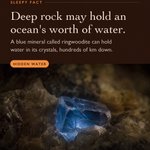
Deep rock may hold an ocean's worth of water.
A blue mineral called ringwoodite can hold water in its crystals, hundreds of km down.

4
Whatever happened today, the stars still showed up on time. 🌙
Some of the light above you tonight left its star before anyone alive was born.
Something slower to drift off to: youtube.com/watch?v=QjBzqseS…
Sweet dreams, curious minds ✨
2
Some of Earth's water isn't in the oceans at all. It's locked inside blue crystals, hundreds of kilometres beneath your feet. 💎

1
Pieces of another planet may lie deep inside the Earth.
Two huge masses deep in the mantle may be remains of Theia, whose impact made the Moon.

1
2
The study: Yuan et al. 2023, Nature. Simulations suggest the two continent-sized blobs at the base of the mantle may be buried remains of Theia's mantle.
doi.org/10.1038/s41586-023-0…

1
1
From our sleep documentary A Journey to the Centre of the Earth. Put it on, close your eyes, and drift: youtube.com/watch?v=bjXzJZrn…
The clocks went back an hour last night. Your body clock didn't.
It takes a few days to catch up, and some simple habits help. Our new video follows one ordinary day and looks at what the research says works. 🧵
2
8 sleepy facts about the centre of the Earth.
Earth's inner core is as hot as the Sun's surface.
Here are the first three. Would you take the 38 minute fall? ✨


1
3
2. Scientific American on the Kola Superdeep Borehole: 12,262 metres deep and only about 23 centimetres across, too narrow for a person to fit.
scientificamerican.com/artic…

1
2
All eight facts come from our new sleep documentary, A Journey to the Centre of the Earth. Put it on, close your eyes, and drift: youtube.com/watch?v=bjXzJZrn…
1. The ESRF explains the study, Anzellini et al. 2013 in Science: melting iron at 3.3 million atmospheres puts the inner core boundary near 6,000 degrees C, give or take 500.
esrf.fr/news/general/Earth-C…
2
4
3. Read the paper: Klotz 2015, American Journal of Physics. Using Earth's real layered density from seismic data, the fall takes 38 minutes rather than the textbook 42.
arxiv.org/abs/1308.1342

One of our most-watched shorts right now 🌙
Tonight's grain of sand: there's a small world in our solar system that takes more than 11,000 years to circle the Sun.
The last time Sedna was where it is now, people were only just learning to farm.
Sweet dreams, curious minds ✨
2
9
The full slow journey is on YouTube.
Put it on, close your eyes, and drift: youtube.com/watch?v=5zm-Y3RK…
3
It's also one of the reddest worlds in the solar system, and it's slowly nearing its closest point to the Sun, around 2076. Then it turns around for another 11,000-year trip. Talk about a long commute. 🪐
9
8 sleepy facts about Jupiter.
Jupiter has no surface, just a sky that becomes a sea.
Here are the first three. Would you dare fall in? 🪐


3
11
All eight facts come from our new sleep documentary, Falling Into Jupiter. Put it on, close your eyes, and drift: youtube.com/watch?v=JU23UpL6…
1
1. NASA explains it here. Jupiter has no true surface; deep down the pressure turns hydrogen gas into liquid, making the largest ocean in the solar system.
science.nasa.gov/jupiter/fac…

2
7
3. The study: Brygoo et al. 2021, Nature. Laser-shocked hydrogen and helium separated at Jupiter-like pressures, which fits the helium shortfall Galileo found up top.
doi.org/10.1038/s41586-021-0…

1
2. More on this from NASA's Hubble team. The spot is still wider than Earth, its edge winds top 400 miles an hour, and it has been studied since the 1800s.
science.nasa.gov/missions/hu…

1