Shining Science (@ShiningScience) header
Shining Science (@ShiningScience) profile picture

Sky above, science within — your guide to the universe.

In the Realm of Bright Ideas
Joined June 2022
Photo by Shining Science (@ShiningScience)Photo by Shining Science (@ShiningScience)Photo by Shining Science (@ShiningScience)Photo by Shining Science (@ShiningScience)Photo by Shining Science (@ShiningScience)Photo by Shining Science (@ShiningScience)Photo by Shining Science (@ShiningScience)Photo by Shining Science (@ShiningScience)Photo by Shining Science (@ShiningScience)Photo by Shining Science (@ShiningScience)
Eating meat is associated with being more manly. But new research shows men who eat animal protein have lower testosterone levels. Men who got more of their protein from plants had higher testosterone than those who leaned on animal foods. Researchers at the University of Eastern Finland used the long-running Kuopio Ischaemic Heart Disease Risk Factor Study, which recorded what 2,546 men aged 42 to 60 ate and measured the hormones in their blood, in a new analysis. When the team split the men into four groups by protein intake, those eating the most animal protein had total testosterone about 1.2 nmol/l lower than those eating the least, even after accounting for age, weight and lifestyle. The men eating the most plant protein had levels about 1.1 nmol/l higher. Dairy protein in particular was linked to lower testosterone, while protein from vegetables and other non-grain plants tracked with higher levels. The study appeared in the International Journal of Food Sciences and Nutrition. That runs against the popular gym belief that piling on meat and dairy keeps testosterone up. Testosterone helps maintain muscle, bone, energy and sex drive, and it slowly declines as men age, so what's on the plate is one of the few levers people feel they can pull. That said, this was a one-time snapshot that shows a link, not proof that animal protein lowers testosterone. Studies that actually swap men's protein sources would be the way to find out whether a plate of lentils really moves the needle. source: Wynne-Ellis, M. M., et al. (2026). Associations of dietary proteins with serum total testosterone and sex hormone-binding globulin concentrations in middle-aged men. International Journal of Food Sciences and Nutrition.
7
2
9
2,111
The biggest danger of AI data centers might not be water or power. It's what’s holding them up. A new BBC Science Focus investigation looks past the usual worries about water and electricity to the money, highlighting far more worrisome concerns. Citing economists Jonathan and Jessica Wachter, it reports that major tech companies plan to spend more than $750 billion on new U.S. infrastructure and equipment by the end of 2026, with yearly spending possibly passing $1 trillion by 2027, and they're increasingly borrowing to do it. The Wachters calculate that for investors to get the returns they expect, data centers would need to become 2.7 times as productive, and if that doesn't happen, they warn, the firms "risk bankruptcy." Economic historian Liaquat Ahamed has compared the boom to America's post-Civil War railroad frenzy, when borrowed money doubled the rail network in seven years and the crash of 1873 helped set off the Long Depression. Railroad building peaked at about 2.5% of the U.S. economy, and AI infrastructure spending is expected to reach about 2.8%. Meanwhile, other experts point out that cheaper, smaller AI models already perform nearly as well as the expensive ones these giant campuses are built to run. That said, this is an analysis of where the money is going, not a prediction that a crash is coming, and the 2.7-times figure comes from one economic model. Still, it's a question worth asking now, while communities are deciding whether to host these projects. source: Noone, G. (2026, November 9). 'It's truly staggering': There's a bigger problem with data centres than water or power, warn experts. BBC Science Focus.
2
6
8
1,811
🚨Scientists just got heart muscle to regrow after a heart attack. Adult heart muscle cells almost never divide, so the damage from a heart attack is usually permanent, and a human heart can lose up to a billion of those cells in a single attack. A team from the University of Cambridge, Australia's QIMR Berghofer and AstraZeneca injected a short-lived mRNA into the heart after a heart attack. It briefly switched on two proteins, Myc and cyclin T1, that push heart muscle cells to start dividing again, then faded away. Treated hearts pumped about 10% more blood per beat than untreated ones, and the benefit was still there 12 weeks later. The study was published in Nature Cardiovascular Research. Today's heart failure drugs ease the strain on a damaged heart, but none of them replace lost muscle. "We're not just treating the symptoms of heart failure, this approach could help the heart to repair itself," said Cambridge researcher Catherine Wilson, and the British Heart Foundation called getting the human heart to repair itself "the holy grail for cardiologists." That said, all of these results come from mice, and the method used to deliver the mRNA can't be used in patients yet. Also, Myc is a well-known cancer gene, so long-term safety is the big open question, even though the treated mice showed no tumors during the study. The British Heart Foundation is now funding the next step, testing the treatment in larger animals on the road to human trials. source: Boikova, A., Quaife-Ryan, G. A., Batho, C. A. P., et al. (2026). A transient modified mRNA encoding Myc and cyclin T1 improves cardiac function after myocardial injury. Nature Cardiovascular Research.
2
19
1
103
3,270
Those taking bone-strengthening pills are 24% less likely to develop dementia, a study of more than 120,000 older adults found. Researchers at the University of Hong Kong combed through health records for more than 120,000 people aged 60 and over who had osteoporosis or a fragile-bone fracture. They compared people who took a common class of bone drugs called bisphosphonates, such as alendronate and zoledronate, with people who took other osteoporosis drugs or none at all. users were 16% less likely to develop Alzheimer's and related dementias than untreated patients, and 24% less likely than people on other bone drugs. The results held up across several checks, and the study was published in Alzheimer's & Dementia. Bisphosphonates are cheap, decades old and already taken by millions of people with weak bones, so if the link holds up, they could offer a double benefit for a group already at high risk of dementia. The team estimates that treating about 48 people for five years would mean one fewer dementia case. Still, this is an observational study, so it shows a link rather than proof that the drugs protect the brain, and things the records didn't capture, like education, could play a part. Also, it was published in 2025 and drew on patients from Hong Kong only. But it's a strong lead, and the researchers are calling for clinical trials to test it directly. source: Sing, C.-W., Chan, K.-H., Chiu, P. K.-C., Lau, W. C.-Y., Zhang, X., Tan, K. C.-B., & Cheung, C.-L. (2025). Bisphosphonates and the risk of dementia in patients with osteoporosis or fragility fracture: A population-based study in Hong Kong. Alzheimer's & Dementia, 21(7), e70503.
1
11
53
3,493
Chemotherapy leaves 'zombie' cancer cells that let tumors come back — scientists just found the switch that destroys them. Chemotherapy works by damaging the DNA of cancer cells, which should flip on sensors called death receptors that tell the cell to self-destruct. Seamus Martin and Gokhan Gunay at Trinity College Dublin found that some cells survive because proteins called IAPs, short for inhibitor of apoptosis proteins, smother those death signals. The survivors don't die and don't divide either. They slip into a state called senescence, growing to almost ten times the size of a normal cell within a few days, and pumping out inflammatory signals that draw in immune cells and help the tumor recover, which is why they're nicknamed zombie cells. Because these zombies depend so heavily on IAPs to stay alive, the team treated them with drugs called IAP antagonists, which knocked out that protection, restarted the self-destruct program and selectively eliminated the senescent cells. The study was published in Science Advances. Cancer that returns after treatment is one of the hardest problems in oncology, and leftover senescent cells are a big suspect. Martin's idea is to "lower the defenses of tumors by neutralizing IAPs after the delivery of chemotherapeutic drugs," so that fewer cells escape into this zombie state in the first place and more of them die. To be clear, the experiments were done on human cells in the lab, not in animals or patients, so it's not yet known how well a follow-up drug would work in a real tumor or how safe it would be. But it gives researchers a concrete one-two strategy to test: hit the tumor with chemo, then take away the shield its survivors hide behind. source: Gunay, G., et al., & Martin, S. J. (2026). Death receptors regulate entry to therapy-induced senescence and orchestrate addiction to IAPs. Science Advances.
3
32
5
124
4,476
Instead of suppressing symptoms, this therapy resets the immune system — and it works. Stiff person syndrome locks muscles in painful spasms and has no approved treatment. A one-time cell therapy just helped most patients get their mobility back and stop taking immune drugs. The trial, published in JAMA Neurology, treated 26 adults whose stiff person syndrome hadn't responded to standard immune treatments. Kyverna, the company behind the work, says it expects to finish its application for FDA approval by the end of 2026, which could make this the first approved CAR-T therapy for an autoimmune disease. Doctors engineered each patient's own T cells, a type of immune cell, into CAR-T cells that hunt down B cells, which make the antibodies that attack the nervous system in this disease. After a single infusion, 21 of the 26 patients (81%) walked a 25-foot course at least 20% faster 16 weeks later, and the typical patient cut their time by about 46%. Of the 12 people who needed a cane or walker beforehand, eight no longer did, and every patient was off their regular immune-suppressing treatments for the disease at last check. Stiff person syndrome is a rare autoimmune disorder that causes rigid muscles and spasms so painful that a sudden noise can trigger a fall. Céline Dion revealed her diagnosis in 2022, and there is still no approved U.S. treatment. CAR-T has transformed some blood cancers, and this is one of the clearest signs yet that resetting the immune system could work for autoimmune nerve diseases too. source: Piquet, A. L., Zekeridou, A., Gergis, U., et al. (2026). Mivocabtagene autoleucel CD19 chimeric antigen receptor T-cell therapy in stiff person syndrome: A nonrandomized clinical trial. JAMA Neurology.
1
28
2
95
3,913
The FDA is adding a vision-loss warning to every GLP-1 drug on the U.S. market. On November 9, the FDA told the makers of all 12 approved GLP-1 drugs, including Mounjaro, Trulicity, Victoza and the new pill Foundayo, to add a potential risk of NAION to the warnings section of their labels. NAION, short for non-arteritic anterior ischemic optic neuropathy, happens when blood flow to the optic nerve drops, and it usually causes sudden vision loss in one eye that can be permanent. The agency pooled 126 clinical trials with more than 134,000 patients and found about 6.4 cases for every 100,000 patients treated for a year on GLP-1s, compared with 3.8 on other treatments. These are now some of the most widely used medicines in America, so even a rare side effect matters. The FDA says anyone taking them who notices sudden vision loss in one eye, blind spots, tunnel vision, faded colors or blurry central vision should get care right away, and anyone who develops NAION should talk with their doctor about whether to keep taking the drug. Smoking, diabetes, high blood pressure, sleep apnea, anemia and kidney disease all raise the risk on their own. To be clear, the FDA says it has not established that the drugs cause NAION, and Novo Nordisk says the data don't show cause and effect. And the risk stays very low, a few extra cases per 100,000 patients a year in the trial data. What the new label does is give millions of patients and doctors a clear warning sign to watch for, and a faster route to an eye specialist when it counts. source: U.S. Food and Drug Administration. (2026, November 9). FDA requires safety labeling changes for glucagon-like peptide-1 receptor agonists (GLP-1 RAs) due to potential increased risk of rare but serious eye condition [Drug safety communication].
6
32
1
77
5,154
Experts just discovered that an FDA-approved pill jams the recycling system cancer cells depend on — and they die. The drug is eliglustat, sold as Cerdelga, which is approved in the U.S. for adults with Gaucher disease type 1, a rare inherited disorder. It blocks an enzyme called glucosylceramide synthase, and a team led by Can Senkal at VCU Massey Comprehensive Cancer Center tested what that does to cancer cells. When they treated several cancer cell lines with eliglustat, or switched the enzyme off genetically, the cells died. Looking closer, they found that the cells' lysosomes, the little sacs that break down worn-out parts so they can be reused, swelled up and stopped working, leaving undigested proteins, fats and old cell parts piling up inside. Fast-growing cancer cells lean heavily on that recycling, so losing it was fatal, and when the team used another compound to restart lysosome production, the cells survived. The study was published in Cell Death Discovery. For years, scientists assumed blocking this enzyme hurt cancer by letting a toxic fat called ceramide build up. This work shows the real damage comes from breaking the cell's recycling system, which changes how the drug might best be used. And because eliglustat has already been through safety testing and approval, it could reach cancer trials far faster than a brand-new compound. That said, all of this was done on cancer cells in dishes, not in animals or people, and the doses that kill cells in a lab may not be ones patients can safely take. The next step is testing whether the same lysosome breakdown happens in living tumors, which would decide if an old pill earns a new job. source: Straus, A. J., Kempelingaiah, S. K., Nguyen, S., Premanandh, S., et al., & Senkal, C. E. (2026). Targeting glucosylceramide generation induces cancer cell death through lysosomal dysfunction independent of ceramide accumulation. Cell Death Discovery.
8
55
4
241
8,642
Those who get the high-dose flu shot are less likely to be diagnosed with Alzheimer's, new research shows. Researchers at UTHealth Houston went through US insurance claims from 2014 to 2019 and compared about 120,800 people aged 65 and older who got the high-dose flu vaccine with about 44,000 who got the standard one. The high-dose shot packs roughly four times as much antigen, the part of a vaccine that trains the immune system, but it's sometimes in short supply, so many seniors end up with the regular dose instead. That gave the team a natural comparison. For about two years after vaccination, the high-dose group had a lower risk of being diagnosed with Alzheimer's, and the gap held longer for women than for men. The findings were published in the journal Neurology. This builds on the same team's 2022 finding that older adults who got a flu shot were about 40% less likely to develop Alzheimer's than those who skipped it. One idea is that preventing flu spares the brain from bouts of inflammation, though nobody knows the mechanism yet. If the link holds up, it adds a brain-health reason to a shot that's already a preferred choice for people 65 and up. That said, this is a records study that shows a link, not proof that the stronger shot prevents Alzheimer's. That said, the difference was roughly one fewer diagnosis for every 185 people given the high dose. The next big question is whether it's fewer flu infections, or the stronger immune response itself, that makes the difference. source: Bukhbinder, A. S., He, E., Harris, K., Jiang, X., Kim, Y., Schulz, P. E., et al. (2026). Risk of Alzheimer dementia after high-dose vs standard-dose influenza vaccination. Neurology, 106(8).
5
19
85
4,503
Millions live with painful arthritic knees. A new shot just erased that pain in two large clinical trials. Two phase 3 trials, together involving more than 1,000 adults with knee osteoarthritis and overweight or obesity, tested the once-weekly injection against a placebo. And the shot worked. Retatrutide acts on three hormone receptors at once, one more than drugs like Zepbound. In the TRIUMPH-4 trial, people on the highest dose lost about a quarter of their body weight on average over 68 weeks, and Northwestern's Thomas Schnitzer, the study's corresponding author, said a few lost a hundred pounds or more. Across both trials, about two-thirds of people on the drug said their knee pain dropped by at least 50%, compared with 38% of those on the placebo. For some, pain was erased. The results were published in the New England Journal of Medicine and presented at the American College of Rheumatology meeting. Osteoarthritis wears away the cushioning cartilage in joints, and for many people the options come down to painkillers, physical therapy, losing weight and, eventually, a knee replacement. As Schnitzer put it, losing weight means you're loading your knees less, so there's less pain. The drug also lowered blood pressure, blood fats and body-wide inflammation. Still, both trials were funded by Eli Lilly, which makes the drug and employs some of the co-authors, and retatrutide isn't approved yet. On top of that, in TRIUMPH-4 between 12% and 18% of people on the drug quit because of side effects such as nausea, compared with 4% on placebo. Schnitzer calls it a first step, but if regulators sign off, people with arthritis could get one treatment that tackles their weight and their knee pain at once. source: Schnitzer, T., Conaghan, P., et al. (2026). Retatrutide once weekly in adults with knee osteoarthritis pain and obesity. New England Journal of Medicine.
3
13
70
4,327
🚨 The share of US babies not receiving the vitamin K shot more than doubled in eight years, from 3.1% to 6.8%. And children have started to die. Researchers at Children's Hospital of Philadelphia looked at more than 5.2 million US birth records from 2017 to 2025 and found that the share of newborns who didn't get a vitamin K shot at birth more than doubled, from 3.1% to 6.8%. The jump was especially sharp lately, rising from 5.6% to 6.8% in just the last year. When the team followed the babies through their first six months, those who skipped the shot had a 47% higher risk of any bleeding, more than double the risk of a brain bleed, and more than double the risk of dying before leaving the hospital. Vitamin K is a natural nutrient, not a vaccine, and the body needs it to form blood clots. Newborns are born with very little of it, and breast milk or formula doesn't supply enough in the first months, so a single shot has been standard in the US since the early 1960s. Without it, some babies develop vitamin K deficiency bleeding, which often strikes with no warning signs. According to the CDC, about half of babies with the late form bleed into the brain, which can cause permanent damage. Doctors say many parents refuse because of a black box warning that actually applies to high intravenous doses in adults, not the tiny injection babies get. To be clear, the study is built on medical records, so it shows a strong link between skipping the shot and bleeding rather than proving every case was caused by it. Still, pediatricians say the pattern is exactly what they feared, and they hope these numbers help more families talk it through with their doctor before saying no. source: Scott, K., Handley, S. C., Lo, J. Y., Culhane, J. F., Greenspan, J., Knake, L. A., Loyal, J., McKenney, K. M., Miller, E., Nelin, T. D., Son, M., Burris, H. H., & Dysart, K. (2026). Nonreceipt of newborn vitamin K and risk of bleeding. JAMA.
4
16
1
47
3,606
New research is revealing everyday habits are tied to a far higher risk of dementia. Here’s what you need to change, according to the latest science. In a study of about 8,000 people aged 50 to 70, those who regularly slept less than seven hours had a 30% higher risk of dementia. Long-term loneliness can raise risk by around 60%, according to the Alzheimer's Society, while regular exercise is linked to a roughly 28% lower risk. Even air pollution matters: each small rise in fine particle pollution was tied to a 4% higher risk. And in one UK study of 8,623 people, changes in vision predicted dementia up to 12 years before diagnosis. With 153 million people expected to live with dementia worldwide by 2050, prevention is getting serious attention. And sleep, movement, friendship, and cleaner air are worth protecting. source: Howarth, T. (2026). How to cut your dementia risk. BBC Science Focus.
7
11
3
60
4,195
Spending time immersed in nature can have measurable effects on our immune system. A controlled study found that just three days in a forest led to an average 80% increase in natural killer (NK) cell activity, which are immune cells that help the body fight off cancer and infections. According to NutritionFacts. org, this immune boost was observed in nearly all participants and lasted for up to a month after the trip, showing both immediate and sustained benefits. Participants also showed lower stress hormone (cortisol) levels compared to those who spent time in urban settings, indicating both psychological and physiological effects. This highlights how something as simple as spending time in the forest can have powerful impacts on our health.
5
45
5
186
5,800
Scientists just found a bacterium that wakes up repair genes after periods of fasting. Researchers at the University of Texas MD Anderson Cancer Center found that a 24-hour fast boosts a friendly gut bacterium called Akkermansia muciniphila in the small intestine. That bacterium makes a compound called propionate, which, together with the body's own fasting changes, loosens up the packaging around DNA in gut cells. This lets them switch on regeneration genes ahead of time, so when radiation later damaged the gut lining, these primed cells multiplied and rebuilt it faster. When the team wiped out the bacterium, fasting stopped helping, and putting it back restored the protection. Radiation for cancers in the abdomen often damages the delicate lining of the small intestine, causing painful side effects and sometimes limiting how strong a dose doctors can safely give. Because fasting isn't always practical for people going through cancer treatment, the team hopes the bacterium or its propionate could one day deliver the same protection without skipping meals. That said, this was a preclinical study in lab animals, so nobody yet knows whether the same thing happens in people or whether it would safely improve outcomes for patients on radiation. Still, it points to a surprisingly simple lever, the gut's own microbes, for protecting healthy tissue during cancer treatment, and the researchers now want to see whether it works in other fast-dividing tissues like bone marrow. source: Barrodia, P., Saw, A. K., Jeter-Jones, S. L., Chang, C.-C., Shao, J., Arslan, E., Singh, A. K., Satpati, S., Jenq, R. R., Rai, K., & Piwnica-Worms, H. (2026). Fasting primes small intestinal regeneration after damage via a microbiome-metabolite-chromatin axis. Proceedings of the National Academy of Sciences, 123(26).
6
106
5
401
13,498
The odds of meeting "the one" are just 1 in 562, a mathematician calculated. The number comes from British mathematician and TV presenter Rachel Riley, best known from the quiz show Countdown, who crunched the figures for the dating site eHarmony in 2017 With input from researchers at the University of Bath, the team weighed 18 factors that shape who we're actually interested in, such as preferred age, attractiveness, relationship status and how far from home we're willing to look. Once all of those filters were applied, only about 84,000 adults in the whole of the UK fit the average person's wish list, which works out to roughly a 1 in 562 chance of finding love. The odds weren't the same for everyone. Londoners did better at 1 in 394, simply because they're surrounded by more people, and the chances actually improved with age, from 1 in 1,024 for 18-to-24-year-olds to 1 in 304 for people aged 65 to 74. The calculation also suggested that small changes, like going to the gym, socializing with colleagues and their friends, looking a bit further from home, or trying online dating, all nudge the numbers in your favor. . source: Walker-Arnott, E. The odds of finding love in London today are... Time Out London.
10
13
4
78
3,793
Companies are selling your emails, Slack messages, and files to train AI — and they’re getting millions. Wired's Steven Levy started getting cold emails claiming that AI labs pay companies $350,000 to $1.8 million as a one-time fee for their old work records: documents, emails, Slack messages, support tickets and call transcripts. Digging in, he found a fast-growing industry of data brokers, led by firms like Mercor, Micro1 and Handshake, that buy these archives, strip out names and other personal details, and supply them to AI developers. Some startups now even help failing companies shut down and sell their data on the way out. When bankrupt Spirit Airlines put its digital records up for sale, the bids for 80,000 email accounts and 500 million internal messages topped $10 million. Why the rush? AI labs have largely used up public internet data, and real workplace records show models how actual businesses run, messiness and all. Micro1's CEO predicts companies will one day earn more from selling their workflow data than from ads. But privacy experts warn that anonymizing casual messages is hard, since employees mention things like doctor's appointments and family problems, and workers rarely get a say in a sale that could help train AI to do their jobs. That said, the industry's biggest figures come from the brokers themselves and haven't been independently verified, and Anthropic told Wired it doesn't buy workflow data from live companies, while OpenAI didn't respond. The Spirit sale is also on hold after the flight attendants' union objected that it included their private information, a case that could help set the rules for everyone else. source: Levy, S. (2026, November 6). AI companies really, really want to buy your work files and emails. Wired.
4
17
2
27
2,859
One dose of psilocybin sent 40% of people with depression into remission within three weeks, a UK trial found. Only 3% of the control had similar results. Researchers in London, led by psychiatrist James Rucker at the NIHR Maudsley Biomedical Research Centre, recruited 60 adults whose depression had not lifted with standard treatments. Half were randomly given a single dose of psilocybin, the active compound in magic mushrooms, and half got a placebo, with both groups receiving the same psychological support before and after. Three weeks later, 40% of the psilocybin group were in remission, meaning their symptoms had dropped to minimal levels, compared with just 3% on placebo. By six weeks, half of the psilocybin group had responded to treatment, and the benefit over placebo was still there. Treatment-resistant depression is one of the hardest problems in psychiatry, and many patients cycle through drug after drug without relief. This was the first publicly funded randomized trial of psilocybin for depression in the UK, and it was run inside the public health system rather than a specialist private clinic, which matters if the therapy is ever going to reach ordinary patients. Side effects were mostly mild and short-lived. That said, it was a small trial, and almost everyone could tell whether they had received psilocybin, which may have inflated the gap between the groups. Also, the drug was given under close medical supervision after careful screening, which is very different from taking mushrooms on your own. The team is now calling for larger publicly funded trials in community settings, and says treatments like this could one day be offered on the NHS. source: Rucker, J. J., Mantingh, T., Kerr-Gaffney, J., et al. (2026). Psilocybin-assisted therapy for treatment-resistant major depressive disorder in a public healthcare setting: A randomized controlled trial. Nature Medicine.
12
46
4
208
6,972
🚨 Your oat milk may be missing something cow's milk quietly gave you: iodine, which your thyroid and a baby's developing brain depend on. Researchers from the University of Surrey and Queen's University Belfast took real diet records from more than 3,500 people in the UK, aged 18 months to 100 years, and modeled what would happen if their milk, cheese and yogurt were replaced with plant-based alternatives from store shelves. They tracked four nutrients that dairy supplies: iodine, calcium, vitamin B12 and riboflavin. All four dropped, but iodine fell hardest. Even swapping out just a fifth to a third of dairy raised the share of teenage girls not getting enough iodine from 54% to 65%, and a full switch pushed it to 80%. Iodine matters because the thyroid uses it to make hormones that control metabolism, and during pregnancy it's essential for a baby's brain development. Many plant-based milks and cheeses contain very little iodine unless it's added, and the UK, unlike the US, doesn't add it to table salt. The researchers found that requiring plant-based alternatives to be fortified stopped most of the drop, and adding iodine to bread as well brought teenage girls' shortfall down to 37%. To be clear, this was a computer model built on diet surveys, not a test of people's actual iodine levels, so falling below the recommended intake isn't the same as having a deficiency. Still, as more people cut back on dairy for the planet or their health, the study points to a simple fix: check the label for added iodine and calcium, and push for fortification so the switch doesn't come at a hidden cost. source: Nicol, K., Nugent, A., Woodside, J., & Bath, S. C. (2026). The impact of replacing dairy products with plant-based dairy alternatives on iodine and other micronutrients: A modelling study and evaluation of policy options to support population intake. The Lancet Planetary Health.
4
14
1
48
3,277
A pill taken for just 6 to 12 months kept high blood pressure in check for two years after patients stopped taking it. In a new report in the New England Journal of Medicine, a team led by Professor Morris Brown at Queen Mary University of London followed 14 patients at eight U.S. centers who took a daily pill called baxdrostat for 6 to 12 months and then stopped. Up to two years later, their main marker of excess aldosterone was still 99% lower than before treatment, their blood pressure was about 25 points lower on average, and almost a quarter had normal blood pressure without any other medication. The problem is called primary aldosteronism. Small, harmless lumps on the adrenal glands pump out too much of a hormone called aldosterone, which makes the kidneys hold on to salt and pushes blood pressure up. Until now, the only real cure was surgery to remove an entire adrenal gland. The drug blocks the enzyme that makes aldosterone, and the team thinks that switching it off for months may make the overactive cells wither away, echoing a 2005 mouse study in which deleting that gene made those cells vanish. And since fewer than 1 in 100 people with the condition are ever tested, many don't know their high blood pressure has a fixable cause. That said, this was a small group of 14 people, and even the researchers say it's too early to call anyone cured, though Brown says longer follow-up may justify that claim. Their larger ELIXIR trial will use adrenal scans to check whether the overactive cells really disappear, and if they do, a once-a-day pill could one day spare many patients from surgery. source: Brown, M. J., et al. (2026). Hyperaldosteronism remission after extended aldosterone synthase inhibition. New England Journal of Medicine.
13
1
48
3,470
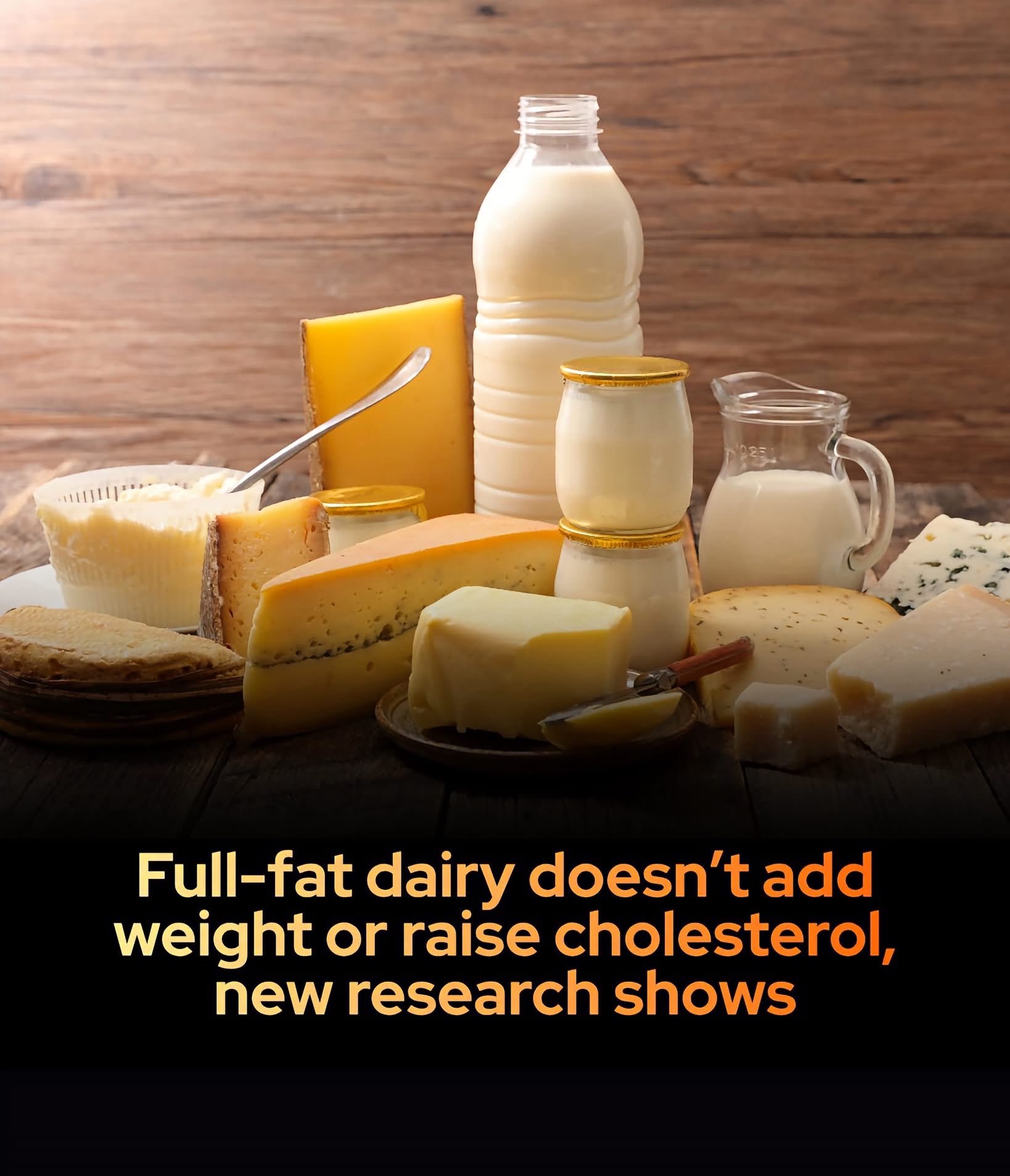
If you've been avoiding full-fat cheese and whole milk for your heart, a new trial says you may have been worrying for nothing. Researchers at the University of Toronto split 74 adults with overweight or obesity into three groups for 12 weeks. One group followed a calorie-cut diet with very little dairy, while the other two ate three servings of full-fat dairy every day, such as whole milk, cheese and yogurt. At the end, the dairy eaters hadn't gained more weight or body fat than the low-dairy group, and their cholesterol, blood fats and blood sugar weren't any worse. In fact, the extra dairy came with more calcium, protein and vitamin D in their diets, and blood pressure dropped in some groups. That cuts against decades of advice to choose skim and low-fat versions to protect your heart and waistline. Lead researcher Harvey Anderson thinks the answer lies in the way dairy is built: its two main proteins, casein and whey, are bound up with the fat, so whole dairy may act differently in the body than its fat content alone would suggest. His own advice is simple: eat a variety of foods, and not too much of anything. That said, this was a small trial that lasted only three months, so it can't tell us what full-fat dairy does to heart disease or diabetes risk over many years. Also, the work was funded partly through a Canadian dairy research program, which is worth knowing when weighing the results. Still, it adds to a growing pile of research suggesting that full-fat dairy doesn't deserve its old reputation, and longer studies could finally settle the question. source: Anderson, G. H., Zhou, C. Z. C., Vien, S., Soo, M., Salamat, S., Akbarifakhrabadi, M., Chomka, L., Kathirvel, P., Siddiqi, F., Fabek, H., & Luhovyy, B. (2026). The effect of three daily servings of full-fat dairy for 12 weeks on body weight, body composition, energy metabolism, blood lipids, and dietary intake of adults with overweight and obesity. The Journal of Nutrition, 156(4), 101373.
7
35
2
116
4,463