

Mission Operations Center for NASA's Webb Space Telescope (#NASAWebb). Science operations for the Hubble Space Telescope and Nancy Grace Roman Space Telescope.
- Tweets5.6K
- Following860
- Followers342K
- Likes1.4K








ALT A clumpy dome of blue and gray clouds topped with streaky, translucent red wisps. A large, prominent star with Webb’s signature eight-point diffraction spike pattern is at the top. These features lie against the black background of space, which shows many distant galaxies.


ALT A sign hanging on a brick wall with the STScI logo and the words: Space Telescope Science Institute.

ALT The view of the Webb Mission Operations Center from a hallway shows four large computer screens with the time at 19:04.

ALT A faded square image of a man working on an image of an object in space on a computer screen.

ALT A tightly cropped image of a model of the James Webb Space Telescope’s primary mirror near a window.
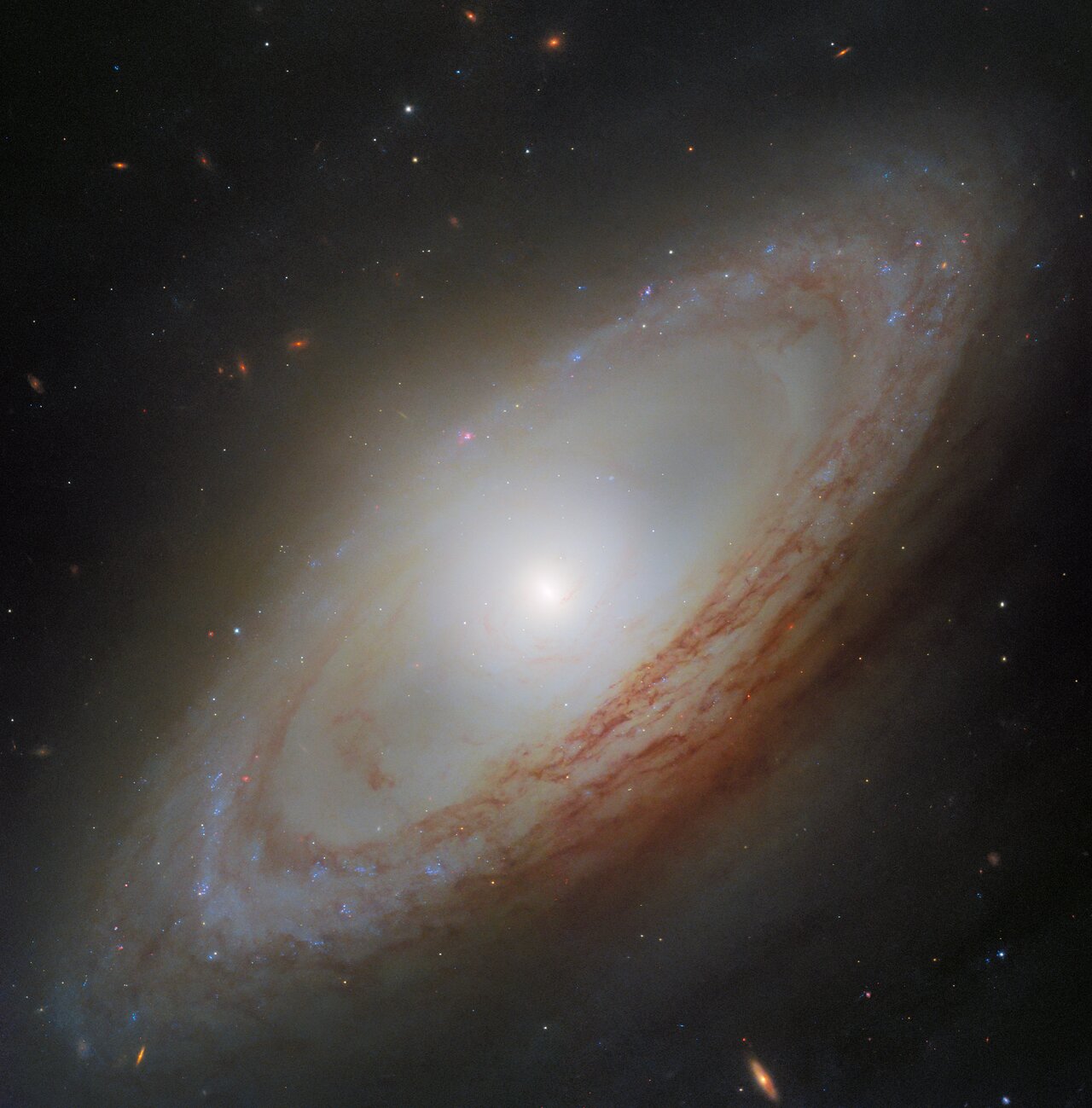
ALT A spiral galaxy viewed at an angle, with a bright central bulge and winding spiral arms. The arms form a ring around the galaxy, without appearing to reach its center. Prominent red-brown dust lanes weave through the arms, which are also dotted with bright blue and reddish regions of star formation. The galaxy is set against a dark background scattered with stars and faint distant galaxies.

ALT A crowded field of galaxies on a black background, with one large star just right of center. Three areas are concentrated with larger white hazy blobs on the left, lower right, and upper right above the single star. Scattered between these areas are many smaller sources of light; some also have a hazy white glow, while many others are red or orange. Different galaxy shapes are detectable, like spirals, ovals, and arcs.

ALT Clumpy, irregular, cloud-like dwarf galaxy in a roughly rectangular shape is speckled with small, bright, blue points of light and larger, light pink patches throughout. Dark brown and milky white areas are also smudged throughout the center of the galaxy. The galaxy appears against a mostly black background lightly dotted with tiny white, blue and red stars and galaxies.


ALT 3-panel image of the Cat’s Head Nebula, a filament of dust that stretches from the bottom to almost the very top. It has a narrow, irregular shape that resembles a cat sitting with its back toward the viewer and its tail extending downward. The cat’s head is turned toward the right, revealing a glowing eye. Each image’s bottom left corner has a label. From left to right: Hubble WFC3; Webb NIRCam; and Webb MIRI. In Hubble’s visible light, the filament of dust is dark brown and opaque with a glowing red eye. The top half of the background is blue and the bottom half ranges from yellow to dark orange. The middle near-infrared image shows the filament as orangish-brown with a yellow eye. The background is mostly blue and has many yellow and blue points of light. The right mid-infrared image shows the filament as bluish-gray and its eye as white. The background is mostly red and scattered with yellow and blue points.


ALT Two galaxies are merging. Near the top is a spiral galaxy with thick arms in fiery oranges, whites, and reds. At the bottom is a faint, hazy bowl-shaped galaxy marbled with grainy white ribbons and hot pink specks. Where the two shapes collide in the center, the galaxy appears chaotic, like a firework photographed the moment it explodes.

ALT The PMR 1 “Exposed Cranium” nebula at center in mid-infrared light. The outer bubble is approximately circular in shape and has a bluish tint. Inside the inner bubble are clouds, which are colored off-white and look like a compact collection of tendrils. A vertical dark lane extends roughly down the center of the nebula, making it seem as though there is a left lobe and a right lobe. Material appears to be erupting out the top of the nebula, and this effect is mirrored to a lesser degree at the bottom, opposite end. The nebula lies against the black background of space, which has stars and galaxies spread throughout.

ALT A lecture hall filled with audience members facing a presenter at the front. A presentation slide is projected on the wall, showing a graph labeled "Impact on the SED." Attendees are seated, some taking notes on laptops or phones. The room has a wood-paneled wall.


ALT A dense field of stars surrounded by wispy clouds of gas and dust. Pale blue and grey clouds form an intricate web across the scene, with darker clouds of dust concentrated toward the lower right. Numerous bright stars appear in shades of blue, white, and orange. The background of space, clearest at the left, middle, and edges, is black.

ALT On the left is a large image of a star cluster and nebula, which takes up two-thirds of the view. Wispy filaments of pink-purple fill the middle, curving left and right on either side of the center. The filaments on the right side form a dramatic loop that seems to extend toward the viewer. At lower left, additional filaments are yellowish. Two prominent, bright stars near the center show Webb’s eight-point diffraction spikes. Dozens of fainter stars are scattered across the image. In the bottom third, three small areas are circled and labeled 1, 2, and 3. On the right is a column of three smaller boxes labeled 1, 2, and 3, showing enlarged sections of the full image that align to the numbers in the larger image at left. A pair of faint stars are shown in box 1, while boxes 2 and 3 each highlight a single faint star. The background in the top two images looks light brown, while the background in the third is dark gray.