

A research institute & Deemed University for Natural Sciences, Mathematics, Computer Science & Science Education, under the Department of Atomic Energy.
Mumbai, India
Joined October 2017
- Tweets1.6K
- Following141
- Followers46.3K
- Likes145



Pinned Tweet
Your next chapter in fundamental research could start here.
Applications are now open for TIFR Graduate School GS-2027, the nationwide entrance examination for PhD and Integrated MSc-PhD programmes at TIFR centres across India.
From understanding living systems to exploring the laws of nature, building intelligent systems and advancing mathematical sciences, GS-2027 offers research opportunities across a wide range of disciplines.
Programmes include:
Biology | Chemistry | Computer Science | Learning, Information & Data Sciences (LIDS) | Mathematics | Physics | Applied Computational Math | Physics of Life | Science Education
📝 Exam on 13 Dec 2026
🗓️ Apply by 25 Oct, 11 PM
Fee Waiver Deadline: Oct 11, 11 PM
Ready to apply?
Scan the QR code or visit: tifr.link/gs-admissions
Explore the programmes, eligibility requirements and FAQs before applying.
#TIFRGS2027 #GraduateSchool #PhD #Research #Science #HigherEducation #ScienceCareers #Admissions

Some questions take years to answer. They’re worth pursuing.
Ready to take the next step in research? TIFR Graduate School 2027 offers opportunities for aspiring students to pursue graduate studies across disciplines in the sciences and mathematics.
Explore research opportunities at the Tata Institute of Fundamental Research (TIFR), discover programmes relevant to your interests, and find the eligibility criteria and application details for GS-2027.
🔗 Explore programmes and admissions: tifr.res.in/academics/gs_adv…
Your research journey could start with a question. Find out where it could take you.
#TIFR #TIFRGraduateSchool #GraduateAdmissions2027 #PhDAdmissions
"One of the most exciting aspects of science is the possibility of unexpected discoveries."
What does it take to pursue those discoveries?
Somnath Biswas, faculty at TIFR's Department of Chemical Sciences, shares his research, outlook and advice for aspiring scientists in The Journal of Physical Chemistry Letters’ special issue featuring Future Leaders in Physical Chemistry.
Explore his insights into ultrafast science, scientific curiosity and the value of persistence: tifr.link/cf8hc2
#TIFRScience


#PhDinPerspective (1/2) How do protons and neutrons, and the nuclei they form, emerge from the fundamental physics of quarks and gluons?
This is one of the challenges at the intersection of nuclear physics and quantum chromodynamics (QCD). Although QCD describes the strong interaction, calculating the properties of multi-particle nuclear systems directly from the theory is computationally demanding.
In his PhD at TIFR’s Department of Theoretical Physics, Debsubhra Chakraborty, supervised by Prof. Nilmani Mathur, developed and explored computational methods to make these calculations more efficient and their results more reliable.
His work tackles several connected challenges: reducing the enormous number of repeated calculations in lattice QCD, extracting energy levels from noisy simulation data, and using wavelet methods to organise spatial information more efficiently.
In one benchmark, an optimised algorithm reduced the time needed for a specific nuclear correlation-function calculation by nearly 28× compared with the original method.
#TIFRScience


2
13
1,605
(2/2) These tools also enabled investigations into how the binding of light nuclei changes with quark masses, and how quark-mass and gluonic contributions enter nuclear binding—an exploratory question that requires further study.
The broader goal is to understand how the properties of atomic nuclei emerge from the fundamental theory of the strong interaction.
Congratulations, Debsubhra, on completing your PhD at TIFR! He will continue his research as a postdoctoral associate at the MIT Center for Theoretical Physics – A Leinweber Institute.
#TIFRScience #PhDinPerspective


3
267
Ankona Datta, faculty at the Department of Chemical Sciences @tifrscience has been awarded the James Hoeschele AsBIC Award, which recognises outstanding mid-career researchers in biological inorganic chemistry across the Asia-Pacific region.
The award recognises Ankona's work in pushing the frontiers of molecular imaging and metal ion sensing by strategic and elegant employment of bio-mimetic and coordination chemistry, acheiving research excellence in the field.
Prof. Datta will be honoured at the 12th AsBIC Conference in Jaipur, where she will also deliver an award lecture.

Prof. Mahan Mj has received the inaugural KRS Sastry Prize, instituted and administered by @iiscbangalore. The 2026 prize recognises his fundamental contributions to geometry, groups, dynamics and probability, including his work on Cannon–Thurston maps.
Prof. Mahan Mj is a faculty at the School of Mathematics, TIFR, Mumbai.


What does a legacy in computer science look like?
Join us as we celebrate the life and work of Prof. Rangaswamy Narasimhan, a pioneer of computer science research in India and a distinguished member of the TIFR community.
Over two days, researchers from India and abroad will come together to discuss contemporary directions in learning, information, and theoretical computer science, and share reflections on Prof. Narasimhan’s influence as a colleague, mentor and collaborator.
📅 10–11 December 2026
📍 Homi Bhabha Auditorium, TIFR, Mumbai
🎟️ Entry by registration only
🔗 Register: tifr.res.in/rncentenary/
#TIFRScience #Narasimhan100 #ComputerScience

What happens when seemingly different areas of mathematics start talking to each other?
At the School of Mathematics, researchers in the Random Geometry group explore connections between probability, geometry, and dynamics. Their work brings together objects that can look very different and reveals structures that emerge across them.
The group was recently featured by ICM TV ahead of the International Congress of Mathematicians, held in July. The resulting film offers a glimpse into the people, ideas and conversations shaping research in random geometry at TIFR.
🎥 Watch the full video on ICM's YouTube: youtu.be/CmUaAQRgMqE
#TIFRScience #RandomGeometry #ICM2026
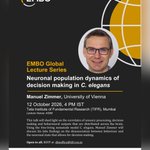
How does the brain turn sensory information into decisions?
At this @EMBO Global Lecture Series talk, Manuel Zimmer (@univienna) will discuss how neuronal activity relates to sensory processing, decision-making, and behaviour.
Using the free-living nematode C. elegans as a model, he will present his lab’s findings on how behavioural states and the neuronal states underlying decision-making can be distinguished.
📅 12 October 2026 | 4:00 PM IST
📍 AG66, TIFR, Mumbai
The lecture is open to all.
📩 RSVP: dbsoffice@tifr.res.in
#TIFRScience #EMBO #EMBOGlobalLecture #Neuroscience #Neurobiology

Bridging the classroom and the research lab.
How can contemporary research reshape the way chemistry is taught—and how can classroom learning, in turn, connect students with the questions scientists are exploring today?
The Department of Chemical Sciences, TIFR, Mumbai, invites chemistry educators from UGC-affiliated colleges to a workshop bringing together teaching practice, research perspectives and direct interaction with TIFR scientists and students.
The programme spans chemical education, chemical biology, experimental learning, sustainability and green chemistry, thermodynamics, quantum mechanics, and emerging directions in chemistry education.
📅 24 November 2026 | 10:00 AM
📍 AG66, TIFR, Mumbai
For details and registration, scan the QR code or visit tifr.link/j2k4h9

What happens when art meets engineering—and technology becomes more than a tool?
In the third TIFR Art & Archives Colloquium, historian of science and technology Jahnavi Phalkey traces a fascinating journey from the Bauhaus to contemporary immersive experiences, exploring how artists, engineers and scientists have collaborated across disciplines—and how those collaborations have shaped new ways of making, knowing and engaging with technology.
From László Moholy-Nagy and the Bauhaus, to 9 Evenings and Experiments in Art and Technology, the Anand Project in India, Ars Electronica, and today's immersive worlds of TeamLab, Outernet and Sphere, the lecture asks us to look beyond technology itself: What happens when technology becomes a medium for artistic research, public engagement and social imagination?
🎥 Watch the full lecture on the TIFR YouTube channel: tifr.link/aaac3
Leading a research group involves far more than designing experiments and analysing data. It means building teams, navigating people and ideas, fostering creativity, and creating an environment where good science can thrive.
The Lab Leadership Course for Group Leaders in Biological Sciences, supported by @EMBO, is a 3-day, campus-oriented course designed to help researchers develop the skills needed to lead effective and empowered research teams.
If you are ready to develop your skills as a leader of a team or research group, then this course is for you. Your training and experience so far have given you excellent technical and research skills, including careful observation, data collection, hypothesis development, planning, experimentation, and critical thinking.
This 3-day course will build on those skills and teach you how to use those 'research tools' to work effectively with your people. The course will also enhance your leadership with practical tools from psychology, social science, human behavioural science, and the business world. You will learn how to lead with empathy to empower your people to get innovative, reproducible research done.
📅 17–19 November 2026
📍 TIFR, Mumbai (Days 1 & 2) & @iitbombay (Day 3)
🔗 Learn more & apply: tifr.link/kck18r
#TIFRScience #ResearchLeadership #BiologicalSciences #ResearchCulture #EMBO #IITBombay #LifeSciences

#PhDinPerspective Where should we look for new fundamental physics?
The answer may depend on how closely we look.
The Standard Model describes an extraordinary range of phenomena, yet leaves many important questions open. For Susobhan Chattopadhyay, these questions became the subject of his PhD in the Department of Theoretical Physics at TIFR, under Prof. Amol Dighe, with Dr. Sandeepan Gupta as co-supervisor.
His thesis, “New Physics Across Scales: From Heavy to Ultralight Degrees of Freedom”, explores possible extensions of the Standard Model at very different energy scales.
One part asks what the Higgs potential can tell us about higher-energy physics. Using the geometry of field space, Susobhan studied how scattering amplitudes and unitarity constraints relate to the scale at which an effective field theory ceases to be valid. The work revealed a possible continuous path connecting HEFT to the Standard Model without passing through SMEFT, a “backdoor to the SM,” while leaving open whether such a path can be realised in a fully consistent theory at the highest energies.


A second project approached the Higgs hierarchy problem through cosmology. The model proposes that different regions of an eternally inflating universe can have different electroweak scales. Regions with the highest vacuum energy expand faster and dominate in volume, selecting a non-zero Higgs scale much smaller than the cutoff.
At the other end of the scale, Susobhan studied massless neutrinos interacting with ultralight dark matter. With two additional light sterile neutrinos, these interactions can give neutrinos effective “refractive” masses. A dark-matter halo inside the Sun could alter solar-neutrino survival probabilities, producing a distinctive flat region between about 2 and 15 MeV in the dark-LMA region. DUNE, Hyper-K and JUNO can test these features.
His interest in particle physics began with the 2012 Higgs discovery. After studying electrical engineering, he switched to physics to work on Higgs physics. He will continue in effective field theory as a postdoctoral researcher at the University of Utah.
Congratulations, Susobhan, on completing your PhD at TIFR.


What do spin glasses, evolving populations, neural networks, and the dynamics of disorder have in common? They can all be studied through an “overlap.”
At the 19th Madan Lal Mehta Lecture, Prof. Bernard Derrida, Professor Emeritus at the Collège de France and Ecole normale supérieure, will explore how this deceptively simple measure of similarity reveals surprisingly rich patterns across complex systems.
From spin glasses and disordered systems to evolutionary models, the lecture will connect ideas spanning statistical physics, probability and collective behaviour, and examine how universal patterns emerge from systems that are anything but simple.
📅 24 September 2026 | 4:00 PM
📍 AG66, TIFR Main Campus, Colaba
Come for the overlaps. Stay for the unexpected connections.
#TIFRScience #TIFRMLMlectures

Today at @tifrscience, @cern Director General Mark Thomson took us on a journey through the remarkable achievements of the LHC, the science of the Higgs boson, and CERN’s exciting plans for the future—including the High-Luminosity LHC and the proposed Future Circular Collider.
A screening of the documentary "The Peace Particle" and a subsequent panel discussion moderated by @TifrArnab followed.
The evening gave the audience a glimpse into how we explore the smallest scales to understand the biggest questions about our Universe.
TLDR; From the Higgs boson to the mysteries of dark matter, the experiments at CERN tell us that particle physics has plenty of questions left to ask.
#TIFRScience #CERNatTIFR #LHC


A new @NatureRevPhys review led by researchers at @tifrscience surveys how van der Waals Josephson junctions—built from atomically thin 2D materials—are unlocking advances in superconducting qubits, topological phases & quantum sensing.
🔗 doi.org/10.1038/s42254-026-0…


van der Waals Josephson junctions for quantum science and technology dlvr.it/TV38Nt
1
8
1,798
Precision counts when you're upgrading for 5× the collision rate of the High-Luminosity LHC.
The #CMS endcap calorimeters are being replaced by the High Granularity Calorimeter #HGCAL: ~27,000 silicon modules that must run for a decade with no chance of repair. Each sensor connects to its readout board through hundreds of hair-thin wire bonds. So how do you verify ~200 channels per board without touching a single fragile bond pad?
#CMS #HGCAL #HiLumiLHC #DetectorPhysics #TIFRScience #CERN


A team at @TIFRScience, working with Matt Noy (CERN) & the #CMS HGCAL Collaboration, designed & developed a system that injects charge capacitively, mimicking the very signal each electronic channel is built to detect — no contact, no damage.
It was prototyped at TIFR on single channels first, then scaled up to cover a full hexaboard. That full system was commissioned at @CERN in March 2025 & used to test ~600 hexaboards, successfully identifying missing & faulty connections that no other available test could have caught. It's now part of #HGCAL quality control at centres across the collaboration.
#DetectorPhysics #TIFRScience #CERN


1
8
846
1/ @tifrscience welcomed the #GS2026 batch of 67 students into its PhD & Integrated MSc-PhD programmes across the Colaba campus and HBCSE. The orientation day gave them a glimpse of what lies ahead—labs, lectures, art, accelerators and more!
#TIFRScience #TIFRwelcomesGS2026


2/ Prof. Jayaram Chengalur (Director, TIFR) gave students a warm welcome and words of encouragement, celebrating the start of a remarkable path in science. Prof. Rudrajyoti Palit (Dean, Graduate Studies) followed and walked them through the workings of the Graduate Studies Office.
#TIFRwelcomesGS2026


1
3
555
Prof. Deepak Dhar (INSA Distinguished Professor, @ictstifr) has been awarded the 2026 #DiracMedal by #ICTP, Trieste.
A pioneer in statistical physics, Prof. Dhar’s work on self-organised criticality and the famous sandpile model has transformed how we understand abrupt events in complex systems—from earthquakes to traffic jams and financial crashes.
He shares this year’s honour with Bernard Derrida, Marc Mézard, and Haim Sompolinsky for foundational contributions linking statistical physics to AI, neuroscience, and non-equilibrium systems.
The Dirac Medal is one of the most prestigious international awards in theoretical physics. Prof. Dhar spent four decades at the Department of Theoretical Physics, TIFR, Mumbai, and is only the second India-based scientist to receive this prestigious global award in theoretical physics—the first being Ashoke Sen. We are proud to count both in the TIFR community.
#TIFRScience #AwardAlert


Sabyasachi Mukherjee (Faculty, School of Mathematics, TIFR) delivered an invited lecture at the 2026 International Congress of Mathematicians (ICM), held this year in Philadelphia, USA.
The ICM is widely regarded as the most prestigious event in the global mathematics community, held once every four years. Being invited to speak at the ICM is a significant recognition of mathematical excellence and impact.
Dr. Mukherjee’s talk, titled “Algebraic Correspondences and Schwarz Reflections: Where Rational Dynamics Meets Kleinian Groups”, introduced new perspectives connecting two distinct branches of dynamical systems: one dealing with how complex shapes evolve under repeated transformation (often resulting in complex and chaotic patterns), and another exploring how symmetries act on surfaces (especially those that are curved or distorted in intricate ways).
Dr. Mukherjee's work brings these areas together into a common mathematical framework, revealing deep patterns that bridge geometry, complex analysis, and statistical physics.
More: icm2026.org/event/ac193975-5…
#TIFRScience #Mathematics #icm2026
