

Professor at Rutgers, director of a cognitive & network neuroscience lab – neuroimaging, connectivity, cognitive control, NeuroAI. Author of Brain Flows
Rutgers University-Newark
Joined July 2013
- Tweets1K
- Following849
- Followers3.8K
- Likes2.3K




Pinned Tweet
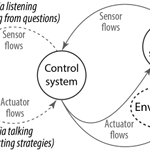
Inspired by Edinburgh’s legacy of big ideas (e.g., Hume), on a train leaving the city, I crafted a book proposal about big ideas in network neuroscience—how brain flows generate representations that compose our minds. The rest is history, and this book: shorturl.at/dSfwB

Michael W. Cole retweeted

In his review of Michael W. Cole’s @TheColeLab new book, “Brain Flows,” Daniel Graham highlights how Cole makes a compelling case for why dynamic movement of brain signals matters, despite missing mention of relevant theoretical and single-cell work.
thetransmitter.org/reviews/w…

Daniel Graham gives an honest assessment of my just-published book (Brain Flows). Check it out!
He mentions researchers I underemphasized. The book stands on the shoulders of giants, and it’s unfortunate I didn’t have room to acknowledge them all!
thetransmitter.org/reviews/w…
I wrote an essay for Princeton University Press's Ideas! The essay dovetails with the core ideas in my just-published book "Brain Flows: How Network Dynamics Compose the Human Mind"
The essay:
What Brains Are For
press.princeton.edu/ideas/wh…

I was interviewed at Rutgers University about my just-published book "Brain Flows: How Network Dynamics Compose the Human Mind" (press.princeton.edu/books/eb…)
The interview:
sasn.rutgers.edu/news/cognit…

Michael W. Cole retweeted
In this episode of Brain Inspired, @TheColeLab explains how "brain flows" are the fundamental units of brain function and cognition.
thetransmitter.org/brain-ins…

Michael W. Cole retweeted
In his new book, @TheColeLab examines how the movement of neuronal activity between neuronal populations shapes just about everything the brain does.
thetransmitter.org/cognitive…

My latest Neural Flows post!
"Emotions as global low-dimensional brain flow patterns"
Based on the book Brain Flows: How Network Dynamics Compose the Human Mind
neuralflows.substack.com/p/e…

Do brain connections just carry information between regions, or do they transform it?
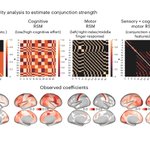
Lab's latest out in Nature Neuroscience, led by Lakshman Chakravarthula: "Network geometry shapes the transformation of task representations across the human cortex"
colelab.org/pubs/Chakravarth… 1/n

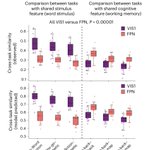
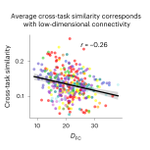
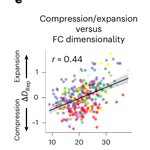
Together, these results suggest the brain's network geometry is a computational substrate, not just wiring: low-dimensional connectivity compresses representations for generalization, while high-dimensional connectivity expands them for task-specific implementation 18/n
1
3
144
Thanks to first author Lakshman Chakravarthula
and coauthors Takuya Ito and Alexandros Tzalavras!
The paper: nature.com/articles/s41593-0…
colelab.org/pubs/Chakravarth…
19/n
