

Looks like we need to take some to the train station!
Washington
Joined April 2022
- Tweets73.2K
- Following7.5K
- Followers8.6K
- Likes14.9K



Pinned Tweet
Seattle found the cure for empty storefronts: free rent… and a race-and-sex checkbox.
The city's Seattle Restored program is offering six months rent-free in vacant shops, plus a $2,500 stipend, liability insurance and internet.
The scoring sheet literally asks: "Is the business Woman and/or Black, Indigenous, or Person of Color (BIPOC) owned…?"
Target zones: Belltown, Pioneer Square, the Chinatown-International District and the downtown core.
Who already left those streets: Nike, The North Face, Lululemon, Vans, Saks OFF 5TH, Hard Rock Cafe, and Amazon Fresh on Pike.
Meanwhile the city's Storefront Repair Fund reimburses up to $5,000 per broken-window incident, up to three times a year. Smashed glass is now a line item.
An Oct. 26 Chamber/Downtown Seattle Association survey: 47% of businesses seriously considered moving out in the past year. Business climate rated 39/100. City Hall responsiveness: 26/100.
And the track record? Per KOMO, only 33 of 100 pop-ups ever turned into long-term leases.
Nobody fled downtown because the rent wasn't free. Businesses told the Chamber their top problems were public safety and taxes, 64% each. Fix those and the storefronts fill themselves. No checkbox required.
#Seattle #WAPol
thepostmillennial.com/news/s…

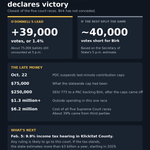
King County Superior Court Judge Sean O'Donnell declared victory Wednesday in the closest Washington Supreme Court race on the ballot. He leads Court of Appeals Judge Ian Birk by about 39,000 votes, or 1.4%. The secretary of state said about 75,000 ballots were still uncounted at 5 p.m. If those split like the rest, the Seattle Times figures Birk would still come up short by about 40,000 votes.
Birk has not conceded. He has not said anything publicly.
This was the most expensive of the five court races, and the only one that stayed tight. Democrat-backed candidates won the other four last week by double digits. That includes two of Gov. Bob Ferguson's appointees, Justices Colleen Melody and Theo Angelis, plus Chief Justice Debra Stephens and King County Judge Jaime Hawk, a former ACLU attorney.
Why this seat matters
The state's new 9.9% tax on household income over $1 million is already in court. Voters just rejected a repeal. A Klickitat County Superior Court hearing is set for Feb. 5. Any ruling is likely to go straight to the state Supreme Court. Senate Majority Leader Jamie Pedersen, who helped write the tax, said of the five court races, "We don't win unless we win all five."
If the tax stands, the state estimates more than $3 billion a year from about 25,000 households, starting in 2029. If it falls, the shortfall Ferguson says starts with a "b" gets deeper. The fight turns on a 1933 ruling, Culliton v. Chase, that treated income as property and blocked a state income tax. Pedersen has said there is no in-between: either income taxes are not property taxes, or the new tax is unconstitutional.
O'Donnell is the one new justice who was not the Democrats' pick. Birk had the party's backing, including Ferguson. Labor backed Birk too. O'Donnell had the state Republican Party, and he also had endorsements from Democrats including U.S. Reps. Adam Smith and Marilyn Strickland and former Govs. Christine Gregoire and Gary Locke. Birk's campaign called O'Donnell a closet Republican on a partisan agenda. Dozens of judges called those attacks false. O'Donnell said he has "no agenda in this job other than to do justice." Birk carried King County by 18 points. O'Donnell won anyway.
The late money
On Oct. 22, while mail ballots were already out, the Public Disclosure Commission suspended enforcement of the usual last-minute contribution caps. For a statewide race, that cap had been $75,000.
After that decision, SEIU 775 put $250,000 into a PAC called Beware the Attack on Our Courts, which spent money boosting Birk and hitting O'Donnell. O'Donnell called it "shocking" that the commission made the call while voting was already underway.
The Washington State Standard put outside spending in this one race at more than $1.3 million. The Seattle Times, citing the PDC, said the five Supreme Court races together cost $6.2 million, and about 39% of that came from third parties. O'Donnell said he hopes the state will "reflect on how and why so much outside money flooded into this race and work to ensure judicial races remain non-partisan."
What to watch
- The last ballots, and whether Birk concedes
- Counties certify by Nov. 24
- The Feb. 5 income tax hearing in Klickitat County, then the appeal to this court
- O'Donnell's six-year term, replacing Justice Charles Johnson, who had to retire at 75
The court that will hear that tax case just changed by one vote. The other four seats went the other way. When that 9.9% tax reaches this bench, do you think the 1933 income tax ban still has a chance?

Interior just put selling federal land into its official five-year plan. Before anybody in Washington panics or cheers, look at who actually runs what out here.
Washington has about 12.2 million acres of federal land. Roughly 9.3 million of it is Forest Service, which answers to the Agriculture Department, not Interior. Gifford Pinchot, the Okanogan and the rest of the national forests aren't in this plan as written.
Interior's piece here is about 2.4 million acres. Most of that is national parks, the "nationally significant" kind the plan says Interior will focus on. The BLM share is about 429,000 acres.
The plan names no parcels, no acreage, no prices and no timeline. Republican Ryan Zinke's office says he's "firmly opposed." Democrats take the House in January.
And the most obvious buyer, the state of Washington, is staring at a shortfall Ferguson says runs into the billions.
What to watch:
Interior naming actual parcels
Any land sale bill in Congress
Ferguson's December budget
If Interior offered Washington some BLM ground, would you trust Olympia to keep it open for hunting and grazing?
apnews.com/article/trump-pub…

This is absolute madness. The voters have spoken and the AG should support the voters

Washington voters said it plainly. 56% voted yes on I-638.
Now come the lawyers.
The ACLU and the state teachers union sued to stop it before it takes effect Dec. 3.
Guess who has to defend it? AG Nick Brown.
The union's lawyers are from his old law firm. The union endorsed him. Last year he led attorneys general backing trans athletes in girls' sports.
His office says it will defend the law "regardless of our personal views."
We'll be watching, Nick.

1
6
373
Washington kept spending about $250 million a year on kids' health coverage. Its reports to the feds showed less. So the feds cut the grant.
The state's federal CHIP allotment fell from roughly $250 million a year to about $133 million, per nonpartisan Senate staff. The Health Care Authority admits it underreported CHIP spending from 2020 to 2025.
CMS flagged it in January 2024. Sen. Chris Gildon says budget writers only learned about it a month ago, when staff caught it.
Senate staff put the damage at $654 million through 2031. HCA says that's "incorrect" and puts the gap at about $54 million this fiscal year if CMS doesn't fix the allotment. Budget chair June Robinson told Axios lawmakers may need around $100 million next budget.
What to watch
• Whether CMS corrects the allotment
• What the governor's December budget sets aside
• Whether HCA explains to lawmakers in January why the 2024 warning never reached them
Should HCA have to answer for that in a public hearing before lawmakers write a dime into the budget?
#waleg
thecentersquare.com/washingt…

The Supreme Court just heard a plan to cap most misdemeanor bail at $200. Prosecutors say some defendants could walk for $20. The Legislature does not get a vote.
Should nine justices write that rule, or should lawmakers?

Washington's Supreme Court spent Tuesday morning on a plan that would cap bail at $200 for most misdemeanor crimes. If judges also have to accept a 10% deposit, some defendants could walk out for $20.
This is not a bill. The Legislature is not voting. Public defenders asked the court to rewrite the rules itself.
The hearing lasted more than two hours. The courtroom was packed. Justices are not expected to announce a decision for weeks.
What the rules say now
Under the current court rule, bail for a misdemeanor is set at $500. For a gross misdemeanor, it is $1,000. A judge can set a different amount for good cause. Judges now set bail based on a "likely failure to appear" in court.
What they want instead
The proposal would cap bail at $200 for most misdemeanors when the issue is whether the person will show up. DUI, domestic violence, charges with a sexual motivation, and unlawful firearm use would be excluded. There is no cap proposed for felonies.
The standard would get harder too. Judges would have to find a "high likelihood of willful flight from prosecution," not just a likely failure to appear. The Washington Superior Court Judges' Association says that bar is difficult to meet at a first appearance. The association urged the court to reject the plan, arguing it "sharply" constrains judicial discretion.
The proposal also creates a "strong presumption" that a defendant can post 10% of the bail amount with the court, and get that money back if they follow the rules. Ten percent of $200 is $20. Jefferson County Prosecuting Attorney James Kennedy told the justices people would be more likely to commit more crimes if they can get out of jail for $20.
The proposal would also give an accused person at least one chance to appear out of custody before the court can impose bail.
Who lined up where
The plan came from public defense offices in King and Snohomish counties, the Washington State Office of Public Defense, and the Washington Defender Association. The ACLU of Washington supports it. Defenders argue poor people sit in jail before trial because they cannot afford bail, even though they are presumed innocent.
Prosecutors and crime victim advocates opposed it. King County Prosecutor Leesa Manion said the change would effectively cut court-ordered bail by 90% and lead to a "significant" number of people bonding out. She argued bail bond companies help make sure defendants come back to court.
Kennedy was blunter. "When I-5 public defenders say 'jump,' this court responds with 'how high.'"
A letter from Republican legislators said the court was going "beyond procedural rulemaking" and raised "serious separation of powers concerns." That is the part that should bother people who care about who writes the law in this state.
What to watch
• The court's rulemaking committee still has to send a recommendation
• Whether the justices adopt the $200 cap, change it, or reject it
• Whether "willful flight" replaces "likely failure to appear"
• A decision is expected in the coming weeks. No date has been announced.
If judges and prosecutors say this ties their hands, why is the Supreme Court being asked to write the bail rules instead of the Legislature?


"Good news." That's how Gov. Bob Ferguson greeted state schools chief Chris Reykdal's decision not to run again.
"It's time for a change there, really past due for a change," Ferguson said in a Facebook video Tuesday. "Test scores for students are just mediocre, and Washington is not mediocre."
Reykdal's office didn't take it quietly. OSPI told KREM 2 it looks forward to the governor's budget next month making "the investments in our K-12 classrooms that are required by our State Constitution."
So the guy who's run OSPI since 2017 points at the budget. The guy who proposes the budget points at OSPI. Both Democrats. In September Reykdal summed up this year's scores himself: "No additional decline of significance, no gains of significance."
What to watch:
• Ferguson's budget proposal in December
• Whether Reykdal runs for another office in 2028
• Who files for the open superintendent seat
Flat scores nearly 10 years into his tenure. Who do you hold responsible, the superintendent or the governor who proposes the budget?
krem.com/article/news/local/…

That’s about where I would have gone.

🇺🇸 The Oregon dad who stopped a school shooter has revealed what he said to the gunman as he lay dying.
Kaylub Giamanco, 36, had just shot the 16-year-old attacker who killed three children and a teacher at an elementary school in Bend.
The teenager was still alive and trying to speak.
“I didn’t want to hear what he had to say. He had taken lives.”
So Giamanco gave him a
“F–k you.”
He says he never found out what the shooter was trying to tell him.
And he didn't care.
Source: NY Post / Writer: Oliver

So much for the vote of the people.
The state teachers union just sued to stop the girls' sports law Washington voters passed a week ago.
The Washington Education Association, the nonprofit TransFamilies and several parents filed in King County Superior Court Monday night. Their lawyers are the ACLU of Washington, Legal Voice and Pacifica Law Group. The defendant is the state.
They want a judge to block I-638 before it takes effect Dec. 3. They say it violates the state constitution's privacy, equal rights and education provisions.
Voters passed it with about 56%.
So now AG Nick Brown's office has to defend it. His office says it defends new laws "regardless of our personal views about the policy" and will "review litigation as it comes."
What to watch
• Whether a judge blocks it before Dec. 3
• Seattle's school board, which authorized its own legal action the same night
How hard do you think Nick Brown's office actually fights for this one?
#waleg
seattletimes.com/seattle-new…

Even Seattle's school board president says the I-638 lawsuit vote won't stop the law.
"I don't think that this stops the clock anyways," Gina Topp said Monday night. The hope, she said, is to "maybe gain a little bit more time here."
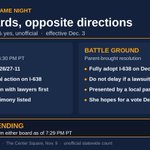
The board went behind closed doors, came back out and voted 7-0. Resolution 2026/27-11 lets the district hire lawyers and take legal action if they think it's warranted. It doesn't say what kind of action. No timeline either.
Board member Joe Mizrahi says I-638 clashes with state privacy and nondiscrimination laws. That's the argument they'll take to a judge.
Voters passed it about 56 to 44, unofficial. It takes effect Dec. 3.
What to watch:
- Does SPS actually file, and where
- Do other districts join (board members say it's possible)
- Dec. 3 effective date
- Battle Ground's parent-backed resolution to implement on time
If the board president admits it doesn't stop the clock, is this a legal question or just a stall?
#waleg
kiro7.com/news/local/seattle…

Same night, two school boards, and they're pointed in opposite directions on the law voters just passed.
Washington passed I-638, the girls' sports initiative, with about 56% yes in the unofficial statewide count. It takes effect Dec. 3. Tonight two boards are meeting to decide what to do about it, and they don't seem to be reading the same ballot.
Seattle: lawyers first, public later
The Seattle School Board called a Special Meeting for 6:30 PM tonight at the John Stanford Center. Per the posted agenda, it goes call to order, then a closed executive session with legal counsel, then one action item. That item is Resolution 2026/27-11, "authorizing legal action regarding" I-638. No public testimony is listed on the agenda.
According to KUOW, the resolution would give Superintendent Ben Shuldiner and the district's lawyers permission to pursue legal action.
Board President Gina Topp told KUOW: "There's some confusion here about how and if the law is legal. When that happens, I think we have a duty as a school board to seek the clarification we need in order to govern."
Clarification is nice. The cheapest kind in Washington happened on Nov. 3, and it didn't need outside counsel. It came in the mail with a stamp.
Here's the part that should sting in Seattle. Brian Anderson of Democrats for an Informed Approach to Gender told The Center Square that I-638 got about 42% in King County. That's a loss locally and a win statewide. The board answers to Seattle voters, but the law answers to all of Washington.
Battle Ground: follow the law, even during a lawsuit
Down in Clark County, the Battle Ground School Board is being asked to go the other way. A parent brought a resolution asking the district to fully adopt I-638 once it's certified Dec. 3. One line says the district "shall not delay, suspend, or refuse implementation" just because a legal challenge has been announced, filed or is pending.
The parent is Sheona Lowe. Her 15-year-old daughter runs cross-country at Battle Ground High and was among about a dozen runners who refused to run against a Camas High athlete who had switched from the boys' team to the girls' team mid-season, according to The Center Square.
"I want to present it with compassion to say we just want you to follow the law that's been written," Lowe told The Center Square. She also said she hopes the board votes Dec. 14, after the law takes effect. So tonight may just be the opening round in Battle Ground.
One agenda wants a lawyer. The other wants a calendar.
Who else is lining up
Let's Go Washington, which sponsored I-638, sent The Center Square a statement from Hallie Herzberg. Districts that let boys into girls' sports after Dec. 3 "will be in violation of the law," she wrote, and the group expects OSPI "to hold every school district accountable."
State schools chief Chris Reykdal earlier said of efforts to change the law, "It's about them trying to change the law. That's a legal process. And so, I really respect that," per The Center Square.
The Gender Justice League is also exploring a lawsuit arguing the verification rules violate students' privacy rights under the state constitution, KUOW and MyNorthwest reported.
Results: pending
As of 7:29 PM PT, I haven't found a verified vote result from either board. When the minutes or a reporter confirm it, I'll post it.
What to watch
1. Tonight's votes. Seattle's Resolution 2026/27-11 after the closed session, and whatever Battle Ground does with the parent's resolution.
2. Counties certify by Nov. 24.
3. I-638 takes effect Dec. 3.
4. Whether anyone actually files a lawsuit, and who pays for Seattle's.
Authorizing legal action and filing a lawsuit are two different acts. If Seattle sues, a public district will be paying lawyers to fight a law the state's voters passed, and the bill goes to the same taxpayers.
Seattle School Board, if you go to court against I-638, will you tell voters what it costs before the first invoice is paid?


Seattle School Board votes to support legal action against the initiative protecting girls’ sports – then gets heckled by women’s rights activists. Deservedly so! Video: @KnownHeretic
6:30 PM tonight.
Seattle School Board Special Meeting.
Resolution 2026/27-11.
Authorizing "legal action" over I-638, the girls' sports measure Washington voters just passed.
In September the same board voted unanimously to oppose I-638.
The posted agenda: call to order, closed executive session with lawyers, then the vote.
No public testimony listed. Why?
I-638 sits at about 56% yes in the unofficial count. Takes effect Dec. 3.
What to watch:
Tonight's vote after the closed session.
Counties certify by Nov. 24.
I-638 effective Dec. 3.
Should a school board authorize legal action against a law the voters just passed?
#waleg
kuow.org/education/2026-11-0…

93% of Everett voters just told their mayor and city council: one elected job at a time.
Prop 1 bans them from holding any other elected office while serving the city. School board, port, PUD, county, state, all of it. The only exception is precinct committee officer.
Other charter votes last week broke the same way, keeping power with voters:
Clark County said yes to a 3-term limit on council, 82%.
Snohomish County said no to stripping party labels off county races, 70%.
Pierce County said no to an appointed sheriff, 68%. Sheriff Swank says he knows people who didn't back him in 2024 who still voted to keep the job elected.
Unofficial counts. Not certified.
Meanwhile the state constitution still lets someone hold two elected offices, and some state legislators also sit on school boards or hold county offices, per the Standard.
What to watch:
Counties certify by Nov. 24.
The Legislature convenes Jan. 11.
Should Olympia live by the Everett rule too?
#waleg
washingtonstatestandard.com/…

The Millionaires’ Tax Won. The Budget Hole Didn’t Leave.
Voters kept Washington’s new 9.9% millionaires’ tax on Tuesday. The next morning, the governor said the state still faces a budget shortfall starting with a “b.”
Billions. He wouldn’t say how many.
Gov. Bob Ferguson told reporters on Nov. 4 that the tax doesn’t solve the immediate budget problem, according to the Washington State Standard and the Spokesman-Review.
“I think for a lot of folks, they may think, hey, millionaires tax, there’s not a budget problem anymore in Olympia,” Ferguson said. “No, we’ve got to stay very focused on the next two years.”
That’s worth remembering the next time somebody talks like passing a tax means the bills are paid.
The money arrives later
The tax takes effect Jan. 1, 2028. Payments arrive the following year.
The next two-year state budget starts in July 2027. That leaves a stretch of bills before this new revenue comes through the door.
Ferguson called 2029 “a true light at the end of the tunnel.” But that money also depends on the tax surviving a legal challenge he expects to reach the state Supreme Court.
A forecast is not a deposit. A disputed tax is not cash in the checking account.
What the forecast actually says
In September, state chief economist Dave Reich projected the tax would produce $3.5 billion in the next two-year budget and $9.4 billion in 2029–31, according to reporting published by OPB and the Washington State Standard.
Those estimates were higher than June’s projections of $2.7 billion and $6.9 billion. They can change again.
Even that improvement didn’t erase the projected deficit for the fiscal year beginning next July or resolve the larger shortfall facing budget writers.
Senate Ways and Means chair June Robinson, a Democrat, put it plainly: “I think we need to find ways to reduce current spending so that we can balance in fiscal year 2028.”
Republican Sen. Chris Gildon warned that much of the forecast increase “comes with an asterisk” because the tax isn’t collected until 2029.
Different parties. Same immediate problem: the spending plan needs work before the new money arrives.
Keep the governor’s promise handy
Back in June, Ferguson told KOMO the budget situation was “dire.” He also said, “I won’t be proposing new taxes.”
That was his pledge then. His December proposal will show how he intends to handle the shortfall now.
Taxpayers shouldn’t have to guess whether “no new taxes” leaves room for a new fee, a higher charge or another bill with a friendlier name.
Three things to check
First, the actual gap. Ferguson has described a shortfall in the billions without publicly giving the figure in these reports. His proposal should show the amount and the assumptions behind it.
Second, who pays. The governor and the Office of Financial Management prepare the proposal.
House and Senate budget writers then shape the final plan. Watch which spending gets reduced and which costs get passed along.
Third, the next documents. The November revenue forecast and December budget proposal are the checkpoints. Compare total spending, proposed reductions and new revenue. Don’t settle for the press-release version.
Washington voted to keep a tax. It did not vote the budget problem out of existence.
Governor, before your December budget lands, will you tell taxpayers the actual number behind that “b”?

We the people voted. Why do politicians forget that they are supposed to work for the people?

"We are going to take our state back. We're going to start planning for how we overturn these bad initiatives and how we go back to loving everyone with gender inclusivity the way we have for decades," said Washington's Rep. Pramila Jayapal.
komonews.com/news/politics/m…

Readers added context they thought people might want to know
Washington has had Democratic control of the governorship and legislature for decades. Voters approved only one of three citizen initiatives this election: I-638 on girls' sports (56% yes); the others failed.
ballotpedia.org/Party_control_…
results.votewa.gov/results/public…
ballotpedia.org/Washington_202…
Confirmed by GA SOS: post-election checks flagged ~388 more Election Day check-ins than ballots in Seminole County. County says all cards were accounted for; EMS simply failed to finish processing the last precinct’s card, so results stayed “unofficial/incomplete.” Completing it flipped HD 154 from a ~58-vote Dem lead to a ~262-vote GOP lead.
Raffensperger called the oversight unacceptable and is investigating procedures. Certification still due Monday. Safeguards worked.

🚨 MEMORY CARD WITH HUNDREDS OF UNCOUNTED BALLOTS JUST FOUND — AND IT FLIPPED A GEORGIA HOUSE RACE 🚨
Per Cleveland 19 News and multiple outlets: In Seminole County, GA, post-election checks caught a massive discrepancy — ~388 more voters checked in on Election Day than ballots that were actually counted.
They found a memory card that never got properly uploaded. Democrat Harry James was leading the longtime Republican incumbent Gerald Greene by 58 votes. After adding those ballots, Greene jumped to a 262-vote lead.
Georgia Secretary of State Brad Raffensperger opened an investigation and called the failure “unacceptable” because it literally changed who was winning.
This is the exact kind of “the thing that never happens” that keeps happening with electronic systems and memory sticks. Paper ballots + same-day counting would have made this far harder to miss.
How many other memory cards are still sitting in drawers? 🔥

Bait, Switch, Raise Prices.
The New Starlink Business Model?
Apparently, the new business model is pretty simple: Get customers to sell your product for you, dangle a referral bonus, promise unlimited service, and celebrate how you’re bringing connectivity to rural America.
Then, once you’ve helped them grow their customer base, send out a notice saying your area is oversold and your monthly price is going up.
That’s exactly what this Starlink price adjustment feels like.
The notice says the Residential plan will increase to $156 per month, beginning with the next billing cycle in 30 days. The explanation? Too many people in the area are using the service, leaving less network capacity available.
Wait a minute. Isn’t growing your customer base the entire point of offering referral incentives?
Customers become your unpaid sales force, helping expand your market. Then, when demand grows beyond your capacity, those same customers get handed the bill.
And here’s the kicker: Rural customers often don’t have many alternatives. They need connectivity, and companies know it.
I’m all for capitalism, competition, and companies making a profit. But there’s something fundamentally wrong with encouraging customers to recruit their neighbors, rewarding them for growing your business, and then penalizing everyone with higher prices because the business grew.
Apparently, the referral bonus is for helping them grow. The price increase is for having helped them succeed.
That’s one heck of a customer loyalty program.
🤖 Made with AI

Why in the actual hell do voter’s keep voting for more taxes?
Seattle voters doubled the city's transit levy this month.
The Seattle Transit Measure sales tax goes from 0.15% to 0.3% for up to 10 years, raising about $138 million a year. That's just the city's piece, on top of the other sales taxes already on your receipt.
The city's estimate for a median two-person household: about $58 a year, up from $29.
City Hall promises about 275,000 bus trips a year, 95,000 more than the current measure buys. More service is the sales pitch. Now comes the part taxpayers should watch.
Doubling the tax is the easy part. Who at City Hall reports back on whether riders actually got those 95,000 extra trips?
axios.com/local/seattle/2026…
