

Weekly RoCur (Rotating Curator) @AmstatNews Committee on Women in Statistics #WSDS Learn & sign up: https://xitter.twitterapi.xyz/t.co/aV1Fcdxd5c This week:
Everywhere!
Joined February 2013
- Tweets5.2K
- Following341
- Followers18.3K
- Likes1.5K





There's still time to catch the invited panel session!

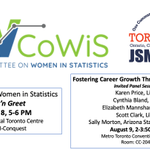
Come meet fellow @WomenInStat at #JSM2023 on August 8th and check out our panel on Career Growth on August 9th. See y'all in Toronto!


Today at #JSM2023!
Come meet fellow @WomenInStat at #JSM2023 on August 8th and check out our panel on Career Growth on August 9th. See y'all in Toronto!
Come meet fellow @WomenInStat at #JSM2023 on August 8th and check out our panel on Career Growth on August 9th. See y'all in Toronto!
Experiencing burnout? Check out this webinar hosted by @ASA_CNSL_P2P. Register at bit.ly/3NjJXwd

Do you feel like you may be experiencing burnout?
We are having a FREE webinar with speakers @sallycmorton and Tara Maddala on May 18, 1-2pm ET. Register at bit.ly/3NjJXwd
Comment below with questions for the speakers👇

This week really flew by! Thanks again for having me. If you want to stay in touch, follow me over on @SarahLotspeich.
After a brief hiatus yesterday, I'm back and excited to talk about #collaboration! My favorite part of any job is what i call “see a need, fill a need.” (A phrase I borrowed from this guy in the 2005 movie "Robots", which scored a 64% on Rotten 🍅 but a 100% in my ❤️.)

2
3
Real talk 🗣: I've wanted to be a statistician since 11th grade, which is pretty early. I was drawn to data and their ability to help us answer questions. And, dare I admit, captivated by the idea that you could reduce questions to a p-value (it was 2011, it was another world).
1
12
☀️ Good morning #stats and #datascience Twitter! I thought I'd kick off Day 2️⃣ by talking about how I got into statistics and how we can work to get more people into it, too.
3
With that, I'm signing off for the night! My probability class has their second exam tomorrow. Good vibes full of continuous random variable and multivariate distribution knowledge appreciated! ✨
8
👩🎓 Methods for censored outcomes started >300 years ago 🤯 (@ John Graunt), but biomedical challenges introduced a new statistical one: censored covariates. After graduation, I brought my zest for robustness and familiarity with incomplete data to help tackle this challenge!
1
How to analyze 📈: We can efficiently combine audited and unaudited into inference using full-likelihood, and we add in robustness! As a bonus, our approach to logistic regression with error-prone can be used with our optimal design!
📄: tinyurl.com/smlebiom
How to audit 🔍: Sending auditors to sites is common and effective but also challenging (especially in an international cohort). Our "self-audits" are a creative way to maintain high quality at lower cost.
Read more about our collab with @CCASAnet in 📄: tinyurl.com/selfaudits
1
Who to audit👫: We can design our audits with our questions in mind! Optimal designs target subjects to audit that will maximize statistical efficiency for our planned analysis.
Want to learn more?
📄: tinyurl.com/optmlearxiv
3
I sought answers to three important questions to get the most bang for our audit buck! 💰
1) Who to audit?
2) How to audit them?
3) How to analyze partially audited data?
Luckily, partial audits (of just a subset of people or records) are helpful, too! Partial audits (or two-phase designs) introduce #missingdata by design. But we can work with that! For example, we can use a full-likelihood or weighted approach.

So what can we do? Well, validation is an important way to gauge data quality. We did data audits, allowing us to learn the relationships between error-prone and error-free data. But audits are expensive, so we can't validate everyone.
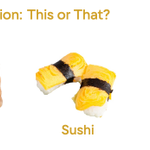
My dissertation focused on methods for misclassified outcomes. If classification problems ask "this or that?," then misclassification happens when we mistake "this" for "that" (or vice versa). See below for a real-world example of how difficult classification can be... #sushicat

4