

growth @ kalshi
Joined April 2022
- Tweets4.1K
- Following1.5K
- Followers6.3K
- Likes20.1K








Eli Hren retweeted

Some products are ready before the rules are.
Kalshi CEO @mansourtarek_ wanted to trade on events the way people trade stocks.
He spent years working with regulators before @Kalshi could launch in 2021.


Eli Hren retweeted

Systems help our best-in-class marketing team run smoothly. A fleet of always-on software pushes us to move faster/more reliably than the rest.
But as our team grows, so does our need for good tech.
We’re hiring another Engineer for our Growth team. Join us — why be 2nd best?
Eli Hren retweeted

For me it was hanging out with Ben in the office. He is always so kind, pleasant and welcoming to be around.
Ben is awesome!

Eli Hren retweeted

Before the Midterms, I kept on telling people that I thought the 2026 Midterms were the “easiest election cycle to predict.”
Not that picking the exact seat count for Democrats and Republicans in the Senate, House, and Governor was easy (I underestimated Democrats by forecasting 249 Democratic House seats, 54 Senate seats, and 29 Governor seats), but directionally, I thought the market and the models were underestimating Democrats (which I was right).
Here’s why I was so confident in a blue tsunami in 2026:
1. Worse R environment than 2018
2. 2025 election results
3. Candidate quality differential
4. Campaign quality differential
5. Early vote tea leaves
#1: Because this was the 2nd Trump Midterm, I thought it made absolute sense to set 2018 as one’s “base case” of what the 2026 Midterms would be.
But what was different from 2018?
Well, Trump’s approval was much lower, inflation was worse, and Republicans didn’t have as a strong of a reason to turnout.
In 2018, I thought Republicans’ closing message to turnout was actually decent. Trump would say at his closing rallies, get out and vote for “Kavanaugh, the caravan, and common sense.”
The 2018 Midterms came right after the Kavanaugh hearings which did energize Republicans, and the immigration issue was put more into picture with the “caravan.”
Also, the economy was roaring. Even though Democrats did well, it was not a blue tsunami like 2006.
In 2026, Trump’s approval was much lower, the perception of the economy was much worse, and immigration was way less salient of an issue.
Unlike 2018, where I thought Republicans had a decent closing message, it was unclear to me what was going to motivate the marginal Republican voter to get out.
For this reason, I thought Republicans’ floor was a D+10 generic ballot with the potential of it being a lot worse.
#2: In 2025, the polls vastly underestimated Democrats (especially in NJ Governor), and Hispanics swung sharply to the left. Many pollsters were making the same mistakes that the 2025 VA and NJ polls were making, so I thought it was pretty reasonable that polls would underestimating Democrats again in 2026 (not the opposite like in 2024)
+ the political environment had gotten worse for Republicans in Nov. 2026 compared to 2025
#3: Chuck Schumer did an exceptional job of recruiting Democratic Senate candidates in Alaska, Ohio, North Carolina, etc, and the most “electable” Democrats generally won their primaries.
The same cannot be said on the Republican side, but I do think the Democrats just did a very good job, and the idea that Republicans just had really bad candidates is probably overplayed. I think the national environment had a much bigger impact
#4: It was very challenging to find a winning message for Republicans these Midterms, but I really think they leaned way too much into the transgender issue and repeated the they/them ad to their detriment.
Democrats were on message with their ads focusing on the issues that voters demonstrated they prioritized (e.g., cost of living, corruption)
I would be interested to see what ads Republican candidates who over performed ran (e.g., Pete Ricketts in NE).
#5: Smart people who were looking at the early vote indicated that it was looking really good for Democrats (especially in states like NC).
Knowing that Democrats were “banking their vote” in Southern states and Republicans were not made me more confident in my “blue tsunami” hypothesis. I did not buy that Republicans would have record turnout on Election Day to offset the Democratic early vote advantage. That didn’t even happen in 2024.
Anyway, would love to get other people’s thoughts. I don’t think 2028 or future election cycles will be as easy to predict as 2026 was.
Eli Hren retweeted
Single stock perps (SSPs) are here. And they're a truly great product. You don’t need to pay rollover fees like with futures, they’re simpler to trade than options, and you can go short just as easy as you can go long.
This is one of the most consequential products we’ve launched and I couldn’t be more proud of the team that worked for over a year to bring them to life. Just this morning, since the stealth launch, our users traded over $300m.
Grateful to be the ones bringing these to America in a regulated way 💚


Eli Hren retweeted

Last night, the power to decide what America sees changed hands.
I have spent a ton of time in DC over the last few months. The elites were certain the markets were off. I heard many variants of “no chance markets are right about X” and “I’ve been in politics for a decade. ‘These people’ don’t really know much.”
Last night, ‘these people’ beat the elites.
Prediction market favorites won 479 of the first 487 races. That’s 98%.
The elites live in a bubble. They theorize, write, ideate, and mistake credentials for an understanding of lives they’ve never lived. They don’t see and feel what the everyday man, on the ground, sees and feels.
Knowledge is not exclusive to the elites but scattered across millions of people.
Someone knows their hometown better than any national pundit. Someone has followed a local race passionately for months. Someone has followed a local race dispassionately for months. Someone notices a shift in their community before it makes the headlines. Someone is shaped by an incident at work. Someone is shaped by what’s getting harder or easier for their families.
Each holds a piece of the picture that no expert can see in full.
And for the longest time, that knowledge had no way to reach the rest of the world.
For generations, election night meant turning on the TV and waiting for a handful of people to tell you what happened.
Prediction markets change that.
You don't need a title, a large following, or an editor to publish you. All you need is a perspective and the conviction to back it.
That changes who holds power over information.
Anyone can see the market. Anyone can contribute to it. Anyone can question it. No title gives you the final word. No gatekeepers can filter your view.
Sometimes the signal can be wrong. But anyone can challenge the consensus and improve it.
And when people consolidate their knowledge together, something remarkable happens: millions of individual perspectives become a signal that we all can learn from.
Over the last few months, the people showed up on Kalshi to tell the world what they were going to do.
Last night, the megaphone was passed to them.


Eli Hren retweeted
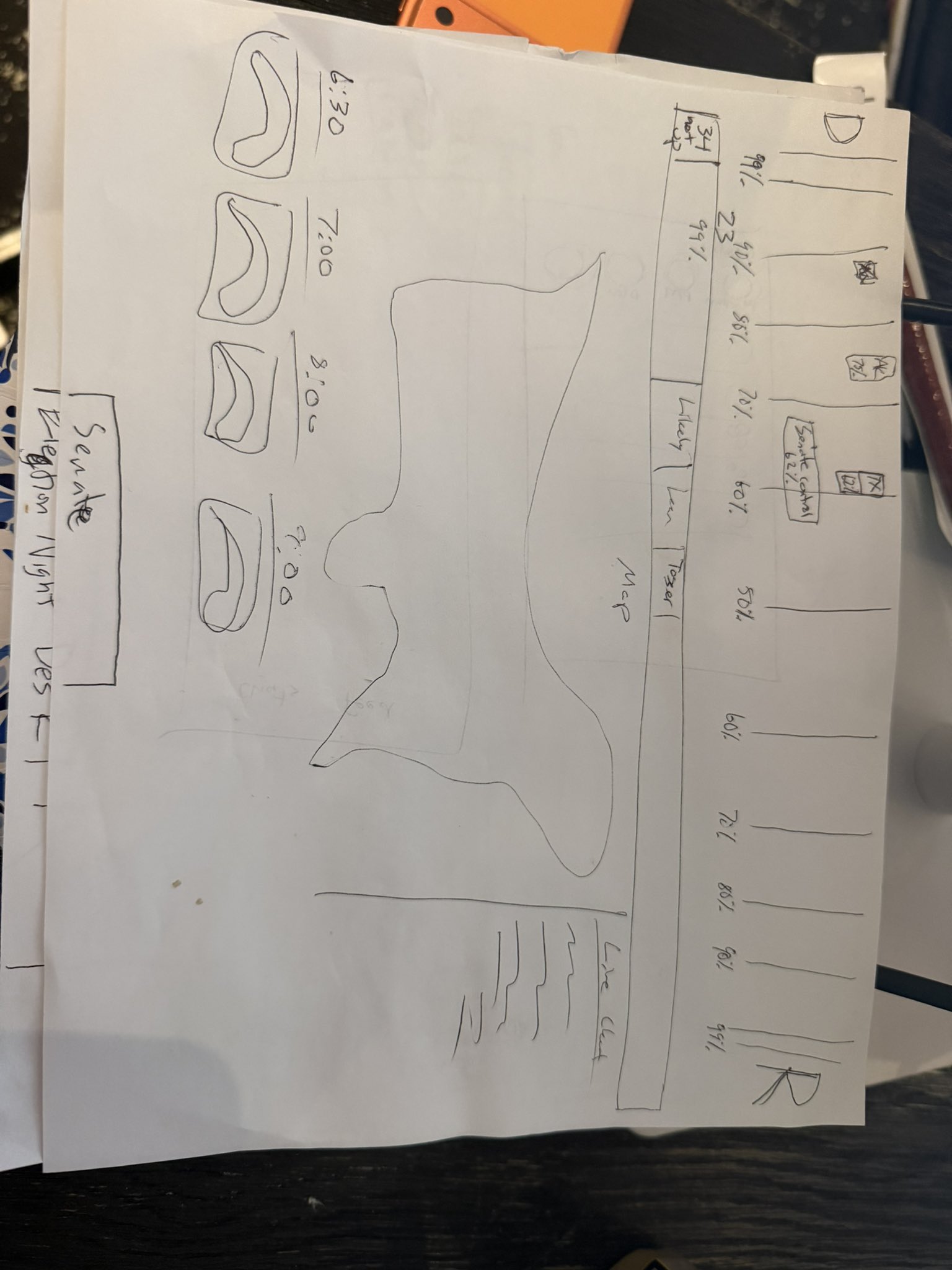
The Kalshi Midterms Hub “field view” started as a low-tech sketch from a Saturday 10 days ago at Kalshi HQ.
Tonight, millions of people followed it to monitor the live election results.
Huge shoutout to the product team for making this come to life in a beautiful way
Eli Hren retweeted
The NYT STARTED their needle at 8:37pm
Kalshi was already at 99% house, 98% Senate
The future of news is real time and markets based 💚
