

Common sense, IT historian trying to prevent repeating mistakes from prior years... Lover of Logs….Tesla, Apple, BloombergTV fan
Boston
Joined February 2011
- Tweets21.5K
- Following1.4K
- Followers907
- Likes81.8K









Ashish “Logmaster” retweeted

🚨 SHOCKING: Brand-new Democrat already blowing the whistle on his own party
Don Leonard just flipped Ohio’s 15th (a Trump +10 seat) and says senior House Democrats straight-up threatened him: back Hakeem Jeffries for Speaker or they’ll make his life a “living hell” in Washington and make sure he loses his next election.
They told him to “wear the team jersey” and “be a good team player.”
Translation: They don’t want representatives. They want obedient votes.
The same party that screamed “No Kings” 👑 is already strong-arming its own freshmen into total submission.
Ashish “Logmaster” retweeted

🚨 HOLY CRAP! 60 Minutes was FORCED to air this
“[President Trump] will go down in the annals of Iranian history as the most-celebrated foreign leader that changed the ballgame and changed the world as a result!”
That’s the truth! 🔥
Ashish “Logmaster” retweeted

We're introducing the Gemini Decisions API in @GoogleAIStudio, powered by our new Gemini Decision 1 model.
Instead of generating a text response token by token, Gemini Decision 1 evaluates your input (across text, images, audio, video, and PDFs) against up to 1,000 questions to make fast, confident decisions in a single pass, with zero output tokens billed.
Here's a look at how it works 🧵

Ashish “Logmaster” retweeted

Thanks to @elonmusk & @SpaceX, the City of Memphis finished its Fiscal Year ahead of budget for the first time in a long time.
The City is tracking roughly $5.6 million ahead for the current year.
Memphis Mayor Paul Young said this week that SpaceX generated $54 million in taxes for the City and County this year.

Ashish “Logmaster” retweeted

AWS Emulator is here!
Building API emulators has been huge for Amazon teams this year. We let agents run against dependencies over and over in a feedback loop, all in the local env. The most popular one internally emulates AWS APIs: it's 100% built by agents and now open source.
Software factory: aboutamazon.com/news/aws/how…
Blog: aws.amazon.com/blogs/aws-ins…
Source code: github.com/aws/aws-emulator
Evals: github.com/aws/aws-emulator-…
User guide: docs.aws.amazon.com/emulator…

Ashish “Logmaster” retweeted

Food stamp advocate SELF-DESTRUCTS as Rep. Brandon Gill presses her on why taxpayers pay for Coca-Cola.
She tries to dodge the question. Then Gill pulls out the receipts, and she sits there in stunned silence.
GILL: “Should SNAP dollars be spent on sodas?”
WITNESS: “I am happy to talk about hunger and nutrition, but not dictate what Americans should or should not eat or may have access to.”
GILL: “I’m asking if tax dollars should be used to pay for sodas.”
“Do they need sugary sodas to survive?”
WITNESS: “Some of them do…”
GILL: “You think they need Coca-Cola to survive?”
“I’m giving you the opportunity to say yes or no.”
WITNESS: “I will not answer for individuals and their… choices.”
GILL: “What does SNAP stand for?”
WITNESS: “It’s a Supplemental Nutrition Assistance Program.”
GILL: “What’s nutritional about Coca-Cola?”
WITNESS: “I am not a nutritionist.”
Then Gill asks who’s paying her, and she freezes like a deer in headlights.
GILL: “Is your organization funded by organizations that make money from food stamps?”
[awkward silence]
GILL: “Do organizations who profit off of food stamps fund your organization or businesses?”
WITNESS: “I mean, in the, in the, I, I can’t comment to that.”
GILL: “Does General Mills fund your organization?”
WITNESS: “I don’t have access to that information.”
GILL: “I do. It’s right here. They do fund your organization. […] Yes, and they’re profiting off of your advocacy. Do you think that that’s a conflict of interest?”
[more silence]
GILL: “I think most people think that’s a conflict of interest. I know you don’t want to answer.”
Always follow the money.
CONTEXT: USDA’s own study found soft drinks were the #1 purchase in SNAP households, beating milk, ground beef, and everything else in the store.


Ashish “Logmaster” retweeted

What if we could manipulate UI at the speed of thought?
Built this voice coffee ordering system with @typesafeai Jev. The drink and any updates show up while I’m still mid-sentence, ~200 ms from word to screen.
Feels pretty magical!



Ashish “Logmaster” retweeted

Shopify's CEO gives his AI agents their own computer.
Tobi Lütke just shared wrapvm: a full desktop VM built for agents.
• A real Linux desktop your agent can see and control
• Its own Chrome, already wired up for browser automation
• Computer-use tools so it can click through any app
• One machine per project folder, so agents never touch your real computer
• You watch everything live from your browser, and sound can be recorded too
Your agent gets a sandbox to break things in. Your laptop stays yours.
github.com/tobi/wrapvm

Ashish “Logmaster” retweeted

🚨 Jay Leno has released a new episode breaking down the Model Y L.
You can watch it here: youtu.be/388LHOaGGrc?is=aEgg…

Ashish “Logmaster” retweeted

The Soviets put a cat, a pigeon, guinea pigs and fish into ZERO GRAVITY. The footage is incredible.
During the Space Race, Soviet scientists took animals aboard aircraft to see how they reacted to weightlessness.
The pigeon tries to fly. The cat has absolutely no idea what to do with itself.
Actual science, conducted with the most confused test subjects imaginable.
Writer: Oliver
Ashish “Logmaster” retweeted

Taiwanese semiconductor analyst Andrew Lu’s take on the recent scandal involving Jensen Huang:
Why the US Seized on the Scandal to Draw Its Sword: Three Strategic Objectives
The purpose of this scandal is by no means to expose an affair. It is to force through three critical objectives that had made no headway in the tech war between the US and China because Jensen Huang opposed them.
The first cut: Completely destroy the legitimacy of Jensen Huang's lobbying against sanctions in Washington
Over the past two years, the loudest and most influential business leader in Silicon Valley opposing a total ban on chip exports to China has been Jensen Huang. He has told the White House the same thing all along: "Cede the Chinese market to Huawei, and the only one that ends up dead is the American tech industry."
But the moment US intelligence labels the woman named as Huang's affair partner "a spy working for China's Ministry of State Security who sought to steer the US toward easing its chip controls," every bit of lobbying he has done for looser controls takes on an entirely different political meaning. It becomes a national security matter, raising the possibility that a foreign spy used a secret relationship to exert influence.
Huang can no longer say a single word in defense of the Chinese market before Congress or the White House. If he does, he will be branded as someone who "fell for an intelligence operation and still hasn't come to his senses."
The second cut: Reverse the H200 export approvals for China and sever the link between Chinese shell companies and Southeast Asian smuggling networks
Look at the timing of the two reports.
On November 8, the very day the Jensen Huang scandal broke, The New York Times published an investigation for which its reporters went in person to dozens of Chinese companies that the US Commerce Department had approved to handle Nvidia's H200 chips. New Matrix in Beijing was one of them. According to the report, the registered addresses of companies approved to buy the chips turned out to be empty "ghost offices," and some of the companies had close ties to entities on US sanctions lists and to firms under contract with the Chinese military.
One exposé says Nvidia's CEO was having an affair with a female spy from Megaspeed, the Singapore company that handled the chip smuggling. The other says the Chinese companies Commerce approved to buy H200s are nothing but shell companies trading on behalf of the Chinese military. The aim of these two reports is clear. They are meant to pressure the Trump administration and the Commerce Department into fully revoking or freezing H200 export approvals for China and, going further, to force a sweeping overhaul of the loophole that let chips be diverted through data centers run by third parties in Singapore and elsewhere in Southeast Asia.
The third cut: Put Nvidia on a national security leash through congressional oversight and an independent investigation
As the world's largest company by market cap and the dominant force in AI, Nvidia has until now enjoyed broad autonomy in how it runs its business. But in the wake of this incident, the three congressional committees responsible for China, foreign affairs, and intelligence have begun examining Nvidia's internal security measures directly. They have even pressured Nvidia's board into forming an independent investigation committee to look into the company's own founder and CEO.
In effect, Washington's national security establishment has planted a watchdog right inside Nvidia's board. From now on, the goal is to make sure that everything, down to where each and every one of Nvidia's high performance chips ends up, conforms strictly to US national security strategy. It also means there is no more room for skirting the edge of the rules or releasing chips with specs specially tailored to regulatory thresholds.
Conclusion
"The scandal was a detonator set off right on cue. The real goal was to plug the holes chips were leaking through."
Jensen Huang made the fatal mistake of letting his guard down in his private life and personal relationships. In the end, he fell into a honey trap, the textbook tactic of intelligence warfare, and was compromised. America's national security and intelligence agencies ruthlessly exploited the weakness his private life had exposed. As a result, they solved three thorny problems in a single stroke: Nvidia's lobbying at the White House to ease restrictions on China, the flow of H200 chips into Chinese shell companies, and smuggling routed through Singapore.
The closed congressional hearing set for November 18 will be the decisive turning point at which the US moves in earnest to tighten its sanctions on China's AI compute even further.
Ashish “Logmaster” retweeted

Two years ago I open sourced my DIY CNC machine, which cost me £2,655.80 and 9 months of my spare time. The Fusion 360 project, the drawings, the bill of materials, the STLs, the wiring diagrams and the Mach3 profile, all for free.
People ask why I didn't sell the plans... the answer is simple. Selling the plans would have defeated the whole point of the project, shutting out the very people I built it for.
My goal was to build a capable, sturdy machine for as little money as possible. Industrial-grade larger footprint machines are well out of reach for most hobbyists and small woodworking businesses. With a few minor trade-offs, you can build my machine for a fraction of the price, with nothing more than basic workshop tools.
10,000+ downloads later, people all over the world send me photos of the machine I designed, now fully built and operational in their own workshops.
That's what I love about open source. It's for people. Nobody needs permission or a subscription to build their own tools. You can repair them, upgrade them, and write your own software, because you know them inside and out.
This fills me with joy like nothing else.

ALT This is the alt text for the photo of you with the CNC, the one Content wrote for the LinkedIn post: Gareth (thehardwareguy) stands in his wooden workshop next to the DIY CNC machine he designed and built, then open sourced. It has an aluminium gantry on linear rails, a water-cooled spindle in the middle and an open electrical cabinet full of wiring behind it. A large MDF spoilboard covers the bed, which sits on a sturdy timber frame.
Ashish “Logmaster” retweeted

This Deepavali, a lamp worth lighting: Smriti, @mid_org's record of India’s civilizational heritage, now holds over 11 lakh manuscript records and 1 lakh inscriptions, free to search, in one place.
That is roughly a tenth of the 1 crore+ manuscripts India’s national survey has mapped, and about a third of the 3 lakh inscriptions estimated to survive. To our knowledge, no other open platform brings Indian manuscripts and inscriptions together, at this scale.
When we, @Shreyas_mysuru, @SudarshanHS, @RahulDewanV2 & I, started on this journey a year ago, the intent was: a dataset that is public & free. What we have managed so far is owed to our donors, teammates, volunteers, custodians and partners.
This year, there are two priorities:
1. A platform for researchers and enthusiasts to add to and correct the knowledge base.
2. Fresh digitisation grants to partner institutions, for which we are raising a corpus of ₹15 crore.
A request to every donor: be our ambassador. Every hour spent fundraising is an hour not spent digitising. If you would like to help or volunteer, please write to pooja@midf.org.in or DM @midf_org.
तमसो मा ज्योतिर्गमय।
smriti.midf.org.in


Ashish “Logmaster” retweeted

Announcing inventory release 1.3
A pain-reduction tool for Linux and *BSD system administrators.
It lists all your packages from every installer, incuding: apk, apt, bun, cargo, conda, dnf, emerge, eopkg, flatpak, gem, go, guix, homebrew, nix, npm, pacman, pip, pipx, pkg, pkgsrc, pkgtools, pnpm, rpm, rpm-ostree, snap, swupd, tdnf, tlmgr, urpmi, uv, xbps, yarn, yum, zypper. It normally tries to skip packages in your system base, but you can override this.
New in this release:
Added LuaRocks support for configured Lua installations and rock trees.
Added opam support across named and local switches.
New -s/--shell option emits a shell script to install inventoried packages.
Treat nonfinite and out-of-range timestamps as unknown dates.
Report installed versions of Homebrew casks.
Exclude JavaScript infrastructure directories from inventory.
Exclude uninstalled APT packages from inventory.
Identify Conda base environment by its reported root prefix.
Fix empty inventory and backend table reports.
gitlab.com/esr/inventor

Ashish “Logmaster” retweeted

Long layover in Tokyo? A local will show you their town for free.
At Narita Airport, over 200 volunteers who live nearby, some of them students, have signed up to take travelers out of the airport and into their hometowns. The program came back on October 1 after stopping for COVID.
You book online. An English-speaking guide meets you.
A little later you're at a temple over 1,000 years old, on a street that smells like grilled eel. Or walking through a village where they film samurai dramas, in a rented summer kimono. Or inside a sake brewery.
The guide costs nothing. You just pay your own train fare and lunch. Plan on 3 to 5 hours.
It's called the Narita Airport Transit & Stay Program.
Five hours at the gate, or five hours with a local in Japan?
Ashish “Logmaster” retweeted

NVIDIA just fixed text-to-SQL’s biggest problem!
the release is called Auto Ontology, and it targets the reason an agent can write valid SQL against a company database and still return the wrong number.
the database stores columns, and the agent has to guess what they mean. a column called extendedprice might hold revenue, and two systems in the same company can define revenue differently.
Auto Ontology gives the agent an ontology, a schema that maps business concepts to the columns that hold them and defines how they relate, before any query is written. it drafts that schema from your database metadata instead of making you write it, and a human certifies it.
the ontology holds three things:
→ terms: business concepts like customer, order, or revenue, with descriptions and synonyms, mapped to the exact columns that store them.
→ SQL attributes: reviewed expressions like a margin or a rolling total, reused so every measure is computed the same way each time.
→ relationships: how tables join, including bridge tables, inferred from keys and the data itself.
to draft these, it profiles columns, samples values, extracts terms table by table, and mines past query history for SQL attributes. everything lands in Postgres, with embeddings in pgvector.
at query time, the agent maps the question to certified terms, follows relationships to find the joins, and writes SQL. it checks filter values against the real data, repairs the query if a check fails, and returns the answer with its SQL and steps.
when the data can't support a question, the agent says so. in NVIDIA's demo, a question about return on ad spend on a sales database with no ad data gets a clarifying reply offering revenue instead of an invented number.
so the ontology tells the agent how to compute an answer and also which questions have one at all.
as the architecture in the image shows, an ingestion service compiles the ontology from your source databases, and any agent harness reaches it through MCP, CLI, or REST API. it supports ten engines including Postgres, Snowflake, Databricks, and DuckDB, runs on Nemotron by default or any OpenAI-compatible endpoint, and is Apache 2.0.
check it out on GitHub: github.com/NVIDIA/auto-ontol…
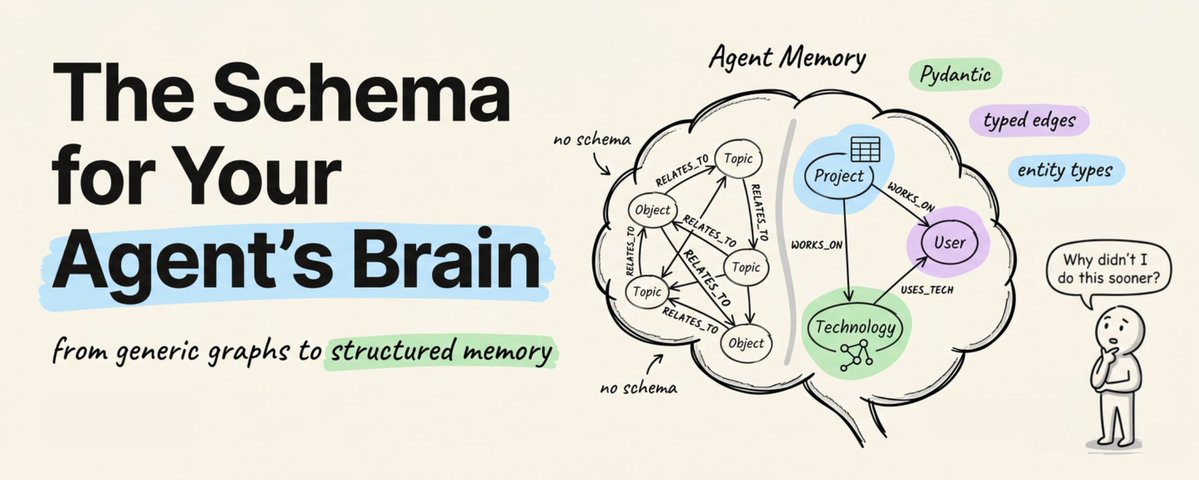
the same principle of defining a schema before the model extracts anything also decides whether agent memory works. I wrote about that in the article quoted below.

ALT NVIDIA Auto Ontology GitHub README: green NVIDIA mark, shortened intro, Discover and Ground, key features, and the AI-Q agent harness architecture diagram

Ashish “Logmaster” retweeted

Computer use is over.
Introducing PHONE USE!
github.com/lxe/phoneuse
My real actual iPhone on my desk via Bluetooth and AirPlay connected to my Linux machine.
Textualization OCR happens out of band so we don't use screenshots all the time. There are recipes for all interactions. Agent skill for your robots.
You literally can just do anything now.
