
Professor of Medicine at @UChicago. Decoding the human microbiome. https://xitter.twitterapi.xyz/t.co/v7TIGaAfYu
Chicago
Joined November 2012
- Tweets9.7K
- Following484
- Followers7.3K
- Likes7.4K






Why does every AI Bio company sounds exactly like Theranos?
"a CRO but really fast" (with no tech innovation, no experience in biology) sounds a lot like "a blood test but from a really small amount"

Public trust in science is critical, especially now. This trust relies on the idea that “science” means real claims we can test and revise.
So when a @ScienceMagazine editorial describes a “unifying life force” as part of science, it's a problem

"In Lakota science, there are four parts—matter, energy, relationality, and a unifying life force" That @ScienceMagazine, arguably the world's preeminent science journal, would publish this is mind boggling.

What is biology research for?
Expanded version of my PLOS Biology Perspective, with very recent developments from arXiv and bioRxiv. This field is moving fast.
blekhman.substack.com/p/what…


The authors didn't do anything wrong here - they clearly disclosed their AI use
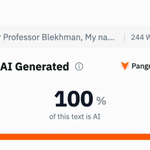
But, as a reviewer/editor, I just cannot bring myself to read AI-generated papers. I don't reject the paper, I just step down as a reviewer. I simply can't justify spending any of my time reading it


It's time, calling for a “Rebuild American Science Act”:
- Double the NIH & NSF budgets
- Limits on executive interference
- End forward funding
- Rebuild the research training pipeline
- Full transparency of success rates
- Permanent H-1B fee exemption for universities
Reviewing a grant proposal online and this is the first question I'm asked. Folks, I think we solved peer review

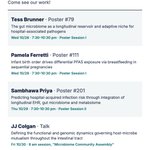
The Blekhman Lab is at the Cold Spring Harbor Microbiome meeting next week 👇
Come see presentations by Tess Brunner, JJ Colgan, Pamela Ferretti, and Sambhawa Priya (@sambhawa_priya)!

This is actually completely routine in academia - many universities have these programs periodically.
This is because of tenure. The only way a tenured professor can retire is voluntarily, so universities have to pay an incentive to free up salaries and lines. Very common.

It's over. The higher ed dam has broken: Clemson is offering a voluntary separation program (VSP) to 452 eligible faculty and staff. Eligible employees who accept the offer will receive a lump-sum payment equal to nine months of their base pay.

10
2,568
Some of my thoughts about the surge in AI-generated papers, why this feels like a completely new kind of problem, and what this means for how we evaluate science in biology.
Out now in PLOS Biology:
journals.plos.org/plosbiolog…

Fascinating/terrifying to read the comments on the "mathocalypse" on Tao's blog. If you think biology is safe - maybe safe for now, but I definitely see a "biocalypse" in the next 2-3 years
terrytao.wordpress.com/2026/…

3
4
1,054
My inbox is being flooded with fully AI-generated emails from prospective students. I tried to work out why I can't bring myself to read them, and ended up with some thoughts and advice for writing cold emails in the age of AI.
My new post:
blekhman.substack.com/p/why-…
What am I missing? Looks like a PhD rotation-level project with marketing hype.

Claude has discovered a previously unknown enzyme system hidden in the DNA of bacteriophages. Beside the enzyme’s gene sits a long array of repeating DNA—a structure that looks somewhat similar to CRISPR.
We don’t yet understand what this system does, but only a handful of known systems share its features, and all of them are able to cut, copy, and paste DNA. Historically, the discovery of such programmable systems has helped revolutionize medicine. CRISPR, for instance, is now the foundation of genetic medicines. But it will take much more work to learn what this system does, and whether it can be put to similar use.
Read more: anthropic.com/news/claude-di…

We have to stop using "paper count" as a useful scientific metric. More writing output no longer means more knowledge gained
washingtonpost.com/education…

The AI Discourse in Academia is Toxic. It Doesn’t have to be.
My new post:
blekhman.substack.com/p/the-…

Cool list, but I wouldn't call it biology - very narrow to synbio/protein engineering
A real biology Millennium list would include aging, development, immune prediction, host-microbe causality, disease (!). Fun thought exercise though

In light of the progress in mathematics, we at Edison Scientific and FutureHouse have assembled a set of Millennium Problems for Biology. They are chosen to be very hard to solve but very easy to validate in a simple laboratory environment. Any of these, if solved, would mark a major advance in biotechnology, and most of them would contribute materially towards curing disease. These are, in some sense, the “last reasonable eval” for AI in biology. This was work primarily by @MichaelaThinks and myself, with contributions from many others.
Short descriptions below. The full descriptions of the problems with acceptance criteria are at the Bio Millennium Problems website, linked in the next post. Share more if you have ideas. If they meet our criteria, we’ll add them to our list (with attribution and permission).

This is the future of scientific papers.
Instead of a PDF, the paper is an AI agent that you can talk to, ask questions, run analyses.
No more digging through supplements - just ask the paper: "what's the p-value cutoff in Fig 3B? Re-run at 0.01"
nature.com/articles/s41586-0…
