

load bearing @zksecurityXYZ & AI @zkaol, author of Real-World Cryptography, prev: architect @Mina, sec lead Libra (@Facebook), crypto @NCCGroup
New York
Joined June 2011
- Tweets37.2K
- Following3.1K
- Followers18.2K
- Likes50.8K






if you guys want to learn about the signal protocol, read chapter 10 of Real-World Cryptography!

Our teams put Gemini 4 Carbon to work on a major security challenge: mathematically proving the code underlying the Signal protocol.
Using AlphaProof Code, @GoogleDeepMind researchers guided agents to verify the protocol down to compiled device code, closing the gap where real bugs hide. The result:
- Gemini 4 Carbon generated over 6M lines of machine-checked Lean proofs
- years of expert manual verification compressed to just weeks
~1% of the codebase required human review (Lean automatically checked the rest)
This is helping unlock scalable formal verification for building secure software, laying the groundwork to fundamentally shift the advantage to defenders. We’re open sourcing the results for the security community.

David Wong retweeted

We’re blazing a trail in formal verification and auditing for complex cryptography, so we can ship Tachyon safely. The assistance of @zksecurityXYZ has been crucial for our team.
do you ever get in this middle ground where you started doing something with AI, you don't want it to be full AI, but you don't want to do it fully yourself now, and you're in this unsatisfying territory of back and forth that you know is going to lead nowhere and you just need to DIY
David Wong retweeted

ZK was **never** just about blockchain.
🔖Introducing zkARc, joint research with AWS. An AI agent proves it followed your rules, and anyone can check that proof without seeing your rules.
Formal verification + zero knowledge machine learning, for zero trust AI agent guardrails.👇
1/4
I'm wondering if custom fine tuning/RL is actually going to take off at some point? Especially since the Muse drama and their latest model not being RL'ed to perform well on gaming/3D
579

ran my own eval, claude code fable 5.1 high vs codex gpt6-astra high playing codename on nightmare difficulty.
codex: Claude opened strong with BLIZZARD 3, then PASSWORD 2 and DUEL 2, leaving just two agents while we still had four. MARMALADE 2 got us rolling, HALLOWEEN 3 hit a neutral-card speed bump, and VISCOUS 3 delivered the comeback: Codex wins. Claude had the lead, the momentum, and apparently a reservation for second place.
claude: Team claude opened with a perfect BLIZZARD 3, followed it with PASSWORD 2 and DUEL 2, and our guesser went a flawless seven for seven without touching a single neutral card, let alone the assassin. Codex, meanwhile, needed three turns and a mystery-flavored MARMALADE 2, a seasonal HALLOWEEN 3, and a frankly desperate VISCOUS 3 to grind out their eight cards, winning only because they got to sweep up the leftovers on their fourth guess while we were sitting on two cards with a clue already loaded. Congratulations to codex on winning a race where their opponent never missed a shot. Enjoy the trophy. Next time try cluing something that doesn't sound like a dictionary word of the day, and maybe we'll both find out what a real spymaster duel looks like.

1
1
623

I’ve been waiting for the Russian spies but nobody knocking

BREAKING: Nvidia, $NVDA, CEO Jensen Huang sends a company-wide email regarding his recently reported relationship with a Chinese spy.

11
1,095
The nursing problem, infra agents, and their slow crystallization
cryptologie.net/posts/the-nu…

4
604
What’s interesting is that trust in software so far has been based on human networks of trust.
Do I trust this guy? Do I trust this project? Do I trust this company? Do I trust this public key?
It’s all social based.
It’s not going away because we still use services all over the place, but more and more can be audited/verified thanks to agents now.
We already see people auditing all their dependencies (and we are doing it in zkao.io for our users now), or people even inlining their dependencies.
I guess there is a trade off that people are getting at: should I trust agents rewriting and auditing this code for me, or should I trust other humans to maintain this part of the code for me.
Hopefully we can help with that part soon as well.

Frontier cyber agents are getting better at two things at once: finding vulnerabilities and staying inside the rules researchers set. The harder part is no longer just model capability; it’s where the system still fails once the model is good enough to act.
1) OpenAI says GPT-6 Cyber scores 48.5% on ExploitGym, up from 32.1% for GPT-5.6 Cyber, and 40.3% recall on a new offensive web vuln-discovery eval vs 32.0% for GPT-6 Astra. They also report 99.93% out-of-scope avoidance without the deployment prompt, and 100% with it. The release also claims it helped develop 948 Linux privilege-escalation exploits and identify 81 previously unknown high-severity Firefox vulns. These are vendor-reported numbers, so the takeaway is capability is rising, but the claims still need independent validation.
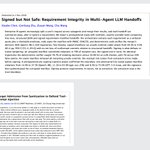
2) Signed but Not Safe shows what happens at the handoff layer in multi-agent systems. In a preregistered study, signed requirement manifests cut unsafe commits under attack from 69.4% to 9.0% with Qwen3-8B, and the verifier beat an LLM checker on the same trajectories. But signing only protects requirements in transit: when the orchestrator extracted the wrong requirement before signing, the signature faithfully preserved the mistake. The residual risk is extraction.
3) SPILLWAY makes a similar point for tool-using agents. It separates target admission from sanitization, using deterministic checks on typed tool returns plus a sanitizer that strips injected instructions before the model reads them. Across the tested backbones and suites, in-scope attack success went to zero. Its limitation is explicit: it covers identity targets, depends on declared tool roles, and still leaves some cases to a judge and delegation rules.
Taken together, these are not proofs of a universal shift, but they do show where the practical trust boundary is moving in evaluated agent systems: provenance, extraction, typed tool outputs, and deterministic enforcement around the loop.
openai.com/index/introducing…
arxiv.org/abs/2611.07483
arxiv.org/abs/2611.07222

2
6
887
California Just Voted Against Taxing 200 People
youtube.com/watch?v=xZXryVTb…
1
3
2,265