

Quant Data Scientist | Statistical Modeling | Financial Analyst | Qualitative Research | Python, R, Stata, SPSS, Excel. DM for Professional Research Assistance.
Kampala Uganda
Joined May 2015
- Tweets45.2K
- Following914
- Followers5.6K
- Likes10.1K









Life is shaped by three realities: the time we are given, the choices we make within it, and the things we must learn to let go of.
Good morning, this Thursday, 12th November 2026.
#thursdaymorning #ThursdayThoughts
1
62

David Soita Masinde. retweeted

📌📌
The NGO sector employs more Ugandans (500,000) than our Public Service (375,000) ~ Why govt’s plan to lift ban on 10 NGOs is good news monitor.co.ug/uganda/news/na…


𝐅𝐫𝐨𝐦 𝐄𝐦𝐩𝐭𝐲 𝐌𝐚𝐫𝐤𝐞𝐭 𝐒𝐭𝐚𝐥𝐥𝐬 𝐭𝐨 𝐭𝐡𝐞 𝐅𝐥𝐨𝐨𝐫 𝐨𝐟 𝐏𝐚𝐫𝐥𝐢𝐚𝐦𝐞𝐧𝐭
Not long ago, residents in Buyaga heard ambitious plans for a massive avocado processing factory capable of handling tens of thousands of tons of fruit every day.
Fast forward to today, and Ugandans walking past local market stalls struggle to find a single avocado, with prices jumping from UGX 500 to as high as UGX 5,000.
Now, the same lawmaker behind that vision, MP Dennis Namara, is asking the country to trust his blueprint for reforming how Parliament elects the Leader of the Opposition, a transition that critics view with deep skepticism.
You cannot build a 30,000-ton avocado factory when a single avocado costs UGX 5,000 at the market stall, and you cannot trust the same math to rewrite Parliament’s rules.
When a politician’s agricultural math fails on the farm, why are we letting him engineer the future of Uganda’s parliamentary opposition?

75
When evaluating a major parliamentary bill, should we look only at the legal text, or also at the political positioning and track record of the lawmaker behind it?
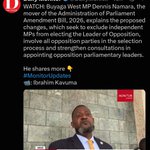
Buyaga West MP Dennis Namara is currently championing the Administration of Parliament Amendment Bill, 2026, which proposes excluding independent MPs from electing the Leader of the Opposition and altering how opposition leaders are chosen.
While supporters frame the bill as a procedural update aimed at strengthening party consultations, critics are raising questions about both the viability of his proposals and the political calculations driving them.
In ongoing public commentary, skeptics argue that Namara’s visibility and influence owe less to the practical strength of his policy arguments and more to his alignment with the Patriotic League of Uganda (PLU).
To bolster their doubts about his policy feasibility, commentators point back to his earlier announcement of an avocado processing factory in Buyaga requiring 30,000 tons of fruit every day, a target critics note lacked a realistic national supply chain, storage, or transport network, especially as domestic scarcity has pushed retail avocado prices from UGX 500 to between UGX 4,000 and UGX 5,000.
From this perspective, some observers suspect that the 2026 parliamentary bill is less about institutional reform in the national interest and more about strategic political positioning ahead of a future leadership transition.
Conversely, proponents of the legislation maintain that formalizing party-based selection criteria and broadening consultations among opposition parties are necessary steps to improve legislative order and accountability.
Do you view the Administration of Parliament Amendment Bill as a genuine effort to streamline parliamentary leadership, or do you see it as strategic positioning tied to broader transition politics? Share your thoughts below.
53
𝐔𝐧𝐝𝐞𝐫𝐬𝐭𝐚𝐧𝐝𝐢𝐧𝐠 𝐭𝐡𝐞 𝐃𝐢𝐟𝐟𝐞𝐫𝐞𝐧𝐜𝐞 𝐁𝐞𝐭𝐰𝐞𝐞𝐧 𝐂𝐮𝐥𝐭𝐮𝐫𝐚𝐥 𝐂𝐚𝐩𝐢𝐭𝐚𝐥 𝐚𝐧𝐝 𝐏𝐨𝐥𝐢𝐭𝐢𝐜𝐚𝐥 𝐂𝐚𝐩𝐢𝐭𝐚𝐥
Bobi Wine's journey provides an interesting illustration of two concepts in political sociology: cultural capital and political capital.
Cultural capital includes recognition, reputation, artistic achievement and the social connections acquired through participation in cultural industries.
Political capital involves influence, legitimacy, organisational relationships and the capacity to mobilise support for political objectives.
Bobi Wine entered politics with considerable cultural recognition already established. This helped distinguish his political journey from that of many conventional political entrants.
His international celebrity connections may further expand his cultural capital. But the important question is whether these resources are being converted into stronger political organisation and institutional influence.
The two forms of capital can reinforce each other, but they are not interchangeable.

60
𝐁𝐎𝐁𝐈 𝐖𝐈𝐍𝐄: 𝐏𝐎𝐋𝐈𝐓𝐈𝐂𝐀𝐋 𝐑𝐄𝐈𝐍𝐕𝐄𝐍𝐓𝐈𝐎𝐍 𝐎𝐑 𝐀 𝐑𝐄𝐓𝐔𝐑𝐍 𝐓𝐎 𝐂𝐄𝐋𝐄𝐁𝐑𝐈𝐓𝐘?
Bobi Wine's appearance alongside his wife, Barbie Kyagulanyi, at the Hollywood Bowl for the 30th anniversary celebration of the Fugees' The Score is an interesting development in his evolving public identity.
We should not make the mistake of interpreting attendance at an entertainment event as evidence of abandoning politics. Politicians are entitled to enjoy entertainment, maintain friendships and participate in international social life. There is nothing inherently contradictory about that.
However, Bobi Wine's journey presents a more interesting question. He entered politics after establishing himself in Uganda's music industry. He moved from being an entertainer who challenged the political establishment to becoming one of its most prominent challengers.
Now, operating internationally, he is increasingly visible in spaces associated with global political and entertainment elites. Will this environment strengthen his political influence, or gradually pull him towards the celebrity culture he once left behind?
There is another dimension worth considering. Many of the musicians who shared Uganda's entertainment industry with Bobi Wine remain far removed from the exclusive international spaces he now accesses. The industry that helped create his public identity has not necessarily distributed comparable opportunities to everyone who contributed to it.
This illustrates a wider reality about success: people can emerge from the same environment but eventually occupy dramatically different social and economic positions.
My concern is not that Bobi Wine is enjoying international recognition. It is whether that recognition will translate into stronger political organisation, meaningful international advocacy and tangible progress for the people whose hopes helped propel his political career.
Celebrity can open doors, but political leadership is ultimately measured by what happens beyond those doors.

74
Bobi Wine left Uganda's music industry to pursue politics. Now he is appearing in exclusive international entertainment circles.
There is nothing wrong with enjoying success. But an important question remains: will international celebrity strengthen his political mission, or gradually become an alternative to it?
Access is not achievement. Recognition is not political transformation.

Bobi Wine's transition from Ugandan musician to opposition politician created a distinctive political identity, but his growing presence in international celebrity circles raises questions about how that identity will evolve and whether international social recognition will strengthen or gradually compete with his political mission.
This is fundamentally an examination of what happens when a person moves between two systems of recognition.
The entertainment industry rewards visibility, popularity, cultural influence, networking and access to influential personalities.
Politics, particularly opposition politics, demands organisation, constituency engagement, ideological consistency, institutional building and sustained accountability.
These worlds can complement each other. Celebrity can open doors that conventional politicians struggle to access. International cultural connections can generate attention for political causes.
But there is also a potential contradiction: the social rewards of celebrity are immediate and personally gratifying, while political transformation is difficult, uncertain, collective and often personally costly.

80
Will Bobi Wine use his international visibility as an instrument of political influence, or will the international celebrity environment gradually become a more attractive alternative to the difficult work of political organisation at home?
One of the most interesting contradictions in modern politics is that people sometimes enter politics to challenge established systems of privilege, only to find themselves gradually welcomed into the exclusive social environments that privilege creates.

78
𝐑𝐄𝐆𝐔𝐋𝐀𝐓𝐈𝐍𝐆 𝐖𝐈-𝐅𝐈 𝐇𝐎𝐓𝐒𝐏𝐎𝐓𝐒 𝐈𝐍 𝐔𝐆𝐀𝐍𝐃𝐀: 𝐓𝐇𝐄 𝐓𝐄𝐂𝐇𝐍𝐈𝐂𝐀𝐋, 𝐋𝐄𝐆𝐀𝐋 𝐀𝐍𝐃 𝐄𝐂𝐎𝐍𝐎𝐌𝐈𝐂 𝐂𝐎𝐌𝐏𝐋𝐄𝐗𝐈𝐓𝐘 𝐎𝐅 𝐃𝐈𝐒𝐓𝐈𝐍𝐆𝐔𝐈𝐒𝐇𝐈𝐍𝐆 𝐏𝐑𝐈𝐕𝐀𝐓𝐄 𝐈𝐍𝐓𝐄𝐑𝐍𝐄𝐓 𝐒𝐇𝐀𝐑𝐈𝐍𝐆 𝐅𝐑𝐎𝐌 𝐂𝐎𝐌𝐌𝐄𝐑𝐂𝐈𝐀𝐋 𝐑𝐄𝐒𝐀𝐋𝐄
The central issue in Uganda's proposed regulation of public Wi-Fi hotspots is not whether the Uganda Communications Commission (UCC) has the authority to regulate telecommunications services.
It is whether the regulatory framework can establish a sufficiently precise, technologically realistic and legally defensible distinction between private internet sharing and the commercial provision of internet access.
The distinction between private and commercial Wi-Fi is considerably more complicated than simply determining whether someone allows another person to connect to their router.
From an information technology perspective, a Wi-Fi network is fundamentally a mechanism for distributing network connectivity across multiple devices.
The same router, wireless access point, broadband subscription, DHCP server, NAT gateway and internet connection can support a household, a family business, invited visitors, tenants, customers or paying subscribers.
The underlying technology does not automatically change when the person connecting to the network changes.
What changes is the relationship between the subscriber, the network operator, the users, the service provider and, potentially, the commercial purpose for which connectivity is distributed.
That is where regulation becomes complicated.
A household can share its internet connection with relatives, visitors and neighbours without necessarily operating an internet service business.
A restaurant can provide complimentary Wi-Fi to customers. A landlord can provide connectivity to tenants. A shopkeeper can recover part of the internet subscription cost from people using the connection.
Another individual can deliberately establish a hotspot business, charging customers according to time, bandwidth or data consumption.
Technically, these arrangements may use almost identical equipment and network configurations. Legally and economically, however, they may represent different activities.
The regulatory challenge is therefore to distinguish the nature of the service being provided, not merely the technical architecture through which internet connectivity is delivered.

Regulating Wi-Fi Hotspots in Uganda | Understanding Public Hotspots
A public Wi-Fi hotspot provides internet access beyond a private household, often in shops, restaurants, hotels, and other shared spaces.
The key distinction is how the connection is used. Home internet is acquired for personal or household use. Commercial resale occurs when a subscriber uses a home or business internet bundle or package to supply internet access to other users as a service.
#ConnectedUg2030 #DigitalUganda
@MoICT_Ug @JustineLumumba @UCC_ED @Bbossa

78
𝐓𝐇𝐄 𝐌𝐔𝐓𝐄𝐁𝐈𝐋𝐄 𝐄𝐒𝐓𝐀𝐓𝐄 𝐃𝐈𝐒𝐏𝐔𝐓𝐄: 𝐀𝐑𝐄 𝐖𝐄 𝐏𝐑𝐀𝐂𝐓𝐈𝐒𝐈𝐍𝐆 𝐖𝐇𝐀𝐓 𝐖𝐄 𝐇𝐀𝐕𝐄 𝐒𝐏𝐄𝐍𝐓 𝐘𝐄𝐀𝐑𝐒 𝐓𝐄𝐀𝐂𝐇𝐈𝐍𝐆?
I have spent many years within the Institute of Banking and Financial Services, where we have been involved in advancing important conversations around financial literacy, savings, investment, responsible financial management and preparation for retirement.
These are not merely academic subjects. They are principles intended to help individuals and families achieve financial security, protect their resources and prepare for the future.
That is why the developments surrounding the estate of the late Professor Emmanuel Tumusiime-Mutebile, former Governor of the Bank of Uganda, are particularly sobering.
Nearly five years after his death, a family dispute over his estate has reached the High Court. The proceedings involve allegations concerning estate administration, disputed property transfers, undisclosed assets and inheritance rights. These allegations must be determined by the courts, and we should not prejudge the parties involved.
However, there is a much wider lesson here that deserves attention.
Our financial literacy conversations have traditionally emphasised earning, saving, investing, borrowing responsibly and preparing for retirement. But perhaps we have not given succession planning, inheritance preparedness and intergenerational wealth preservation the attention they deserve.
I find this particularly uncomfortable from a professional perspective. The Institute operates within a governance environment associated with the Bank of Uganda, whose Governor serves as its patron. The late Professor Mutebile was therefore not merely a prominent national figure; his office was closely connected to the institutional environment within which these financial principles are promoted.
The contradiction is not that a financial expert or prominent individual cannot experience family disagreements. Nobody is immune to the complexities of family relationships. Neither does the existence of litigation automatically establish that succession planning was absent.
The deeper question is whether we are sufficiently preparing ourselves and our families for the inevitable transition that follows death.
Who knows where the assets are? Are ownership records properly maintained? Is there a valid will? Are beneficiaries adequately considered? Are executors or administrators clearly identified? Can the family preserve the estate without turning inheritance into a prolonged legal contest?
These questions matter to ordinary households, but they become even more consequential where individuals have accumulated extensive properties, businesses, investments and financial interests.
We should teach people that retirement planning is not simply about surviving financially after leaving employment. It is also about preparing for incapacity, death, estate administration and the orderly transfer of responsibilities and wealth.
A lifetime of accumulating wealth should not leave a family struggling to understand how that wealth should be managed.
I would have wished that the legacy of someone who occupied such an influential position in Uganda's financial sector would offer an exemplary illustration of orderly succession. Instead, the current dispute provides a sobering reminder of how much more seriously we need to approach this subject.
Perhaps one of the most important lessons we can draw is that financial literacy must move beyond teaching people how to make money. We must also teach them how to preserve it, transfer it and protect the people who depend on it.
What do you think? Should succession and inheritance planning become a much stronger component of financial literacy education in Uganda?
66
Wealth accumulation is an achievement. Wealth preservation is a responsibility. Succession preparedness is foresight.
The financial literacy agenda should prepare people not only for earning, saving, investing and retiring, but also for death, inheritance, continuity and the orderly transfer of wealth between generations.

1
44
𝐓𝐇𝐄 𝐅𝐈𝐍𝐀𝐋 𝐓𝐄𝐒𝐓 𝐎𝐅 𝐅𝐈𝐍𝐀𝐍𝐂𝐈𝐀𝐋 𝐖𝐈𝐒𝐃𝐎𝐌 𝐌𝐀𝐘 𝐁𝐄 𝐖𝐇𝐀𝐓 𝐇𝐀𝐏𝐏𝐄𝐍𝐒 𝐀𝐅𝐓𝐄𝐑 𝐃𝐄𝐀𝐓𝐇
We spend years encouraging people to save, invest, acquire property and prepare for retirement.
Yet one of the most important financial transitions receives insufficient attention: the transfer of wealth after death.
The estate dispute involving the late Professor Emmanuel Tumusiime-Mutebile is a sobering reminder.
I would have wished that a figure of such prominence in Uganda's financial sector would leave behind a succession experience that others could study as an example of orderly intergenerational wealth transfer.
That is not a conclusion about whether he had a will or whether his estate arrangements were inadequate. The facts must be established through the legal process.
But the wider lesson is unavoidable: financial literacy should not stop at wealth accumulation. It must address the governance of wealth beyond the lifetime of its creator.
Do not spend a lifetime building an estate without giving serious thought to the arrangements that will govern it when you are gone.
45
𝐓𝐇𝐄 𝐌𝐔𝐓𝐄𝐁𝐈𝐋𝐄 𝐄𝐒𝐓𝐀𝐓𝐄 𝐃𝐈𝐒𝐏𝐔𝐓𝐄: 𝐀 𝐒𝐎𝐁𝐄𝐑𝐈𝐍𝐆 𝐋𝐄𝐒𝐒𝐎𝐍 𝐅𝐎𝐑 𝐅𝐈𝐍𝐀𝐍𝐂𝐈𝐀𝐋 𝐋𝐈𝐓𝐄𝐑𝐀𝐂𝐘 𝐏𝐑𝐀𝐂𝐓𝐈𝐓𝐈𝐎𝐍𝐄𝐑𝐒
I have spent many years within the Institute of Banking and Financial Services, an institutional environment in which we have consistently engaged with financial literacy, savings, investment, retirement preparedness and responsible financial management.
Our message has always been that financial security requires planning, discipline and informed decisions.
The developments surrounding the estate of the late Bank of Uganda Governor, Professor Emmanuel Tumusiime-Mutebile, therefore present an uncomfortable moment for reflection.
Nearly five years after his death in January 2022, a family dispute over the administration of his estate has reached the High Court. The proceedings include allegations concerning undisclosed assets, disputed property transfers and inheritance rights. These remain allegations awaiting judicial determination.
What makes this particularly sobering is the professional and institutional symbolism. The Governor of the Bank of Uganda serves as patron of the Institute within its governance framework.
Here we have a prominent financial-sector figure whose professional world was closely associated with financial stability, economic management and institutional leadership, yet his estate is now the subject of contested succession proceedings.
I am not suggesting that the existence of litigation establishes that the late Governor failed to make succession arrangements. That would require evidence we do not presently have.
My concern is the broader lesson.
For years, we have taught people how to earn, save, invest and prepare for retirement. But financial preparedness must not end with securing an income after employment. It must also include wills, inheritance arrangements, asset documentation, business continuity and the orderly transfer of responsibilities.
A person can spend a lifetime accumulating wealth and still leave behind unresolved questions about its management and distribution.
The real measure of financial success is not simply what we accumulate while alive, but whether we prepare adequately for the continuity of what we leave behind.
Perhaps it is time financial literacy programmes gave succession planning the same seriousness as savings and investment.

63
The true measure of wealth is not only what you leave behind, but also how well you prepare those who must manage it after you.
We have spent years teaching financial literacy. Yet the estate of a celebrated financial leader is now in court. What happened to succession preparedness? Wealth must be planned for beyond one's lifetime. [Interpretivism]
Accumulating wealth and preserving it are different achievements. The Mutebile dispute brings that distinction into focus. Families and institutions need continuity beyond individuals. Financial success must include succession readiness. [Critical Realism]

Nearly five years after Governor Emmanuel Tumusiime-Mutebile’s death, a bitter family battle over his vast estate has reached the High Court.
@DanAyebare
#NBSUpdates
62
The Mutebile estate dispute should prompt serious reflection among financial literacy practitioners, banking professionals, institutional leaders and wealthy families about whether the principles of savings, retirement planning, inheritance and succession are being practised with the same seriousness with which they are taught.

78