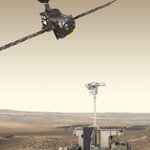
Inspector Mars gadget 🕵️♀️
Our rover also needs legs to land on Mars. European industry fast-tracked these sturdy legs 🦿
They will be the first part of the #ExoMars spacecraft to touch the martian surface in 2030 🔴
esa.int/media/about-us/direc…
📸: Sener
Human for scale 🧍
Chiara meets Amalia 🤝 @esa ExoMars rover engineer Chiara Lombardi stands next to Amalia, a twin model of the Rosalind Franklin rover, after it drove off its landing platform.
This will be one of the most critical moments of the mission when the rover reaches Mars in 2030.
🛞 Amalia tackled slopes, boulders and Mars-like gravity, driving onto simulated martian terrain more than 20 times during a two-month test campaign with @Thales_Alenia_S at @ALTECSpace 🇮🇹
Europe's most sophisticated robot arm has a shoulder, elbow and wrist, along with built-in brain and eyes 🦾
With a reach of up to 2.4 metres, the Sample Transfer Arm performs a large range of movements with millimetre precision 🎯
Here's a closer look at its gripping hand: esa.int/media/about-us/direc…
📸: @esa/@LDO_Space
🔴 There is hot news coming from Mars.
For the first time, orbital data is revealing signs of young volcanism. Deep down, Mars might not be geologically dead, just sleeping.
@esa’s Trace Gas Orbiter detected hydrogen chloride, a gas that escapes from volcanic vents on Earth: esa.int/articles/news-media/…
🤖 Made with AI
The new finding combines atmospheric and geological analysis with a bit of intuition.
This is where Daniel Mège, a planetary scientist with a passion for volcanism and jazz, storms into the room to confirm what the science community had long suspected: Mars is not geologically dead.
blogs.esa.int/to-mars-and-ba…
Radiation watcher ☢️
Astronauts on a return mission to Mars would be exposed to at least 60% of the recommended radiation dose limit.
Radiation measurements from TGO confirm the paradoxical finding that travelling during solar maximum is the best time to go.
🎉 To wrap up a Mars-velous decade, we celebrated with the teams ten years since the Trace Gas Orbiter arrived at the Red Planet.
esa.int/Enabling_Support/Ope…
26 years of continuous human presence in space. 🌍🚀
Since 2 November 2000, the @Space_Station has never been without a crew.
And now, Sen's cameras are on board too, sharing live views of Earth from orbit.
26 years of humanity in space. Here's to the next chapter.
👋 Meet Mars!
🔴 Here are seven things you might not know about our planetary neighbour.
🎙️ Narration: AI-generated voice.
🤖 Made with AI
🌕 One last stop for our Moon month!
@esa Lunar Projects Group Leader Sara Pastor joins #ESAExplores to talk about Europe’s lunar ambitions and how what we learn at the Moon could help prepare us for Mars. 🚀🎧
Still up for one more Moon story? 😉 Tune in 👇
podbean.com/pw/pbblog-i4r3m-…
😱 In space, no one can hear you scream...
🕵️ Can you guess where in the Solar System we took this image? Hint: @esa’s Trace Gas Orbiter captured it on an autumn day.
🎃 #HappyHalloween
📸: @ESA/@ESA_TGO/CaSSIS/@unibern
And for more information about how space reshapes an astronaut's brain 👉 esa.int/Science_Exploration/…
[🇫🇷 version FR👇] This colorful, almost tropical-looking picture 🦜 is actually a scan of my brain, taken before I left Earth… In microgravity, where there is no familiar sense of up or down, the brain has to learn to interpret signals about movement, balance and orientation differently.
🧠 ESA’s Brain-DTI experiment uses advanced MRI scans to study changes in astronauts’ brains during a long-duration space mission. By comparing scans taken before and after the mission, researchers can study how the brain rewires itself to adapt to microgravity and living in 3 dimensions, and how it begins adapting back after the space mission. I had three MRIs at a @DLR_en facility during the first 15 days after my return, and will have one more in about six months.
Brain-DTI helps scientists better understand what’s behind space motion sickness (which I’m happy to say I didn’t experience!), balance and disorientation, and the knowledge gained is also helping people affected by balance disorders on Earth. Go science! 🔬
📸 @esa /@NASA (1), Diana Giraldo (2), ESA – M. Cowan (3, 4)
Cette image colorée, aux couleurs presque tropicales 🦜, est un scan de mon cerveau, réalisé avant mon départ pour la Station… En micropesanteur, où nos repères habituels de haut et de bas disparaissent, le cerveau doit apprendre à interpréter différemment les signaux liés au mouvement, à l’équilibre et à l’orientation.
🧠 L’expérience Brain-DTI de l’ESA utilise l’IRM pour étudier les changements qui se produisent dans le cerveau des astronautes au cours d’une mission spatiale de longue durée. En comparant les images réalisées avant et après la mission, les chercheurs peuvent étudier comment le cerveau se réorganise pour s’adapter à la micropesanteur et à la vie en trois dimensions, puis comment il commence à se réadapter une fois de retour sur Terre. J’ai fait trois IRM dans les locaux du @DLR_en dans les 15 jours qui ont suivi mon retour, et j’en ferai un dernier dans six mois !
Brain-DTI aide les scientifiques à mieux comprendre les mécanismes à l’origine du mal de l’espace (que je suis heureuse de ne pas avoir connu !), ainsi que des troubles de l’équilibre et de la désorientation. Les connaissances acquises contribuent également à aider les personnes souffrant de troubles de l’équilibre sur Terre. Vive la science ! 🔬
#εpsilon • @esaspaceflight • @Space_Station • @ESA_fr • @belspo •
🌕 From laser ranging and lunar rovers 🤖 to cargo landers and Artemis missions 🚀, we’ve explored how Europe is helping shape the future of Moon exploration.
Missed anything from our Moon month? Catch up with our wrap-up 👇 esa.int/Science_Exploration/…