

Choose disfavour where obedience does not bring honour. I do math. And was once asked by R. Morris Sr. : "For whom?" @halvarflake@mastodon.social
Joined June 2008
- Tweets68.1K
- Following3K
- Followers48.3K
- Likes44.1K







Pinned Tweet
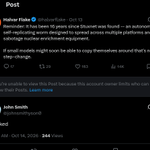
I will have to print & frame this tweet :-))

If you watch one talk this month, make it this one. Profoundly insightful on the complexity threat to security by @halvarflake given at NATOs CYCON.
Video:
err.ee/836236/video-google-0…
And slides:
docs.google.com/presentation…


Halvar Flake retweeted

2/ seL4 17.0.0 hipped ~15 security fixes. Several were in verified configurations, including two critical ones:
* Arm hyp: debug registers weren’t trapped, so a guest VM could halt the system
* x86: user-set NT/DF (!!) flags survived kernel entry, causing a fault
We were religious about UX latency at optimyze, and the lack of focus on a low latency user experience at Elastic drove me bonkers, making me think "why do you hate your users so much".

UX latency is the most frustrating (lack of) advancement in computing over the last ~50 years.
IBM, way back in the 80s, found that user productivity shot up *exponentially* as system response time dropped. The "Doherty Threshold" was defined as ~400 milliseconds; the maximum amount of tolerable UX latency before interrupting user flow state.
It's unbelievable how many modern operating systems (*cough* win11) violate this threshold constantly.
Literally all you need to do as a Dev is pay attention. Add a "Doherty Threshold" to your test suite. There's so many different profiling tools, and especially with how good models are, really no excuse. Sure, some stalls are unavoidable, but that's when you pull out other UX tricks to at least give the illusion of responsiveness.
Crazy how much vintage computing hardware feels immeasurably more responsive despite having thousands of times less overall performance.


Halvar Flake retweeted

UX latency is the most frustrating (lack of) advancement in computing over the last ~50 years.
IBM, way back in the 80s, found that user productivity shot up *exponentially* as system response time dropped. The "Doherty Threshold" was defined as ~400 milliseconds; the maximum amount of tolerable UX latency before interrupting user flow state.
It's unbelievable how many modern operating systems (*cough* win11) violate this threshold constantly.
Literally all you need to do as a Dev is pay attention. Add a "Doherty Threshold" to your test suite. There's so many different profiling tools, and especially with how good models are, really no excuse. Sure, some stalls are unavoidable, but that's when you pull out other UX tricks to at least give the illusion of responsiveness.
Crazy how much vintage computing hardware feels immeasurably more responsive despite having thousands of times less overall performance.
Halvar Flake retweeted

Anthropic pre-IPO broker call was absolutely WILD. The party line was:
•We are or plan on imminently destroying: hyperscalers, every other lab, SpaceX, biotech, robot cos; for fun
•Chipmakers may survive at our pleasure
•$1tn ARR by 4Q28
•Fuck investors it’s capex time
Halvar Flake retweeted

En toute hypothèse, je souscris entièrement à la conclusion d’InformNapalm « Face à de tels défis, un simple appel à « l’esprit critique » ne suffit plus. Les démocraties modernes doivent s’orienter vers une mise en lumière systématique et proactive des réseaux d’influence étrangers ». 12/13
Halvar Flake retweeted
Cette enquête de type CYBINT (renseignement d’origine cyber) est publiée par la communauté internationale de renseignement InformNapalm, en collaboration avec le groupe de « hacktivistes » 256 Cyber Assault Division et le groupe d’analyse Ukrainian Militant. 2/13 informnapalm.org/ua/protesty…

Halvar Flake retweeted
Great work by the Depi team, as always! 👏
Impressive exploit chain, starting with a prompt injection in Codex and ending with a path to compromise OpenAI npm release pipeline.
Full tech details so others can learn from the research. Not just a video showing the final result. 👇
Halvar Flake retweeted

Every capitalist and businessman knows he has been on a generational 5 year run thanks to outside bets he took many years before that. If he is ousted, it's because some extremely nefarious people have power and unimaginable things went down in backrooms. xitter.twitterapi.xyz/__tinygrad__/status/21…


Halvar Flake retweeted

This got totally buried cause it came out the same day as Navier Stokes.
But I think this is super interesting evidence about what the true major source of algorithmic progress is.

Pretraining progress seems to be coming mostly from data improvements.
@who_is_jerbear and I pretrained combinations of year-representative open model recipes and data corpuses across 2019 to 2025 at various small scales.
Data improvements contributed 3.24x as many compute multipliers as model improvements did (12.0x vs 3.7x).
And the gains stack independently - a better dataset helps every architecture about equally, and vice versa.
Here are full results, plus what we think this means for the future of AI progress:
dwarkesh.com/p/pretraining-p…

Halvar Flake retweeted

I need some people for this asap: jobs.ashbyhq.com/openai/be7b…

Halvar Flake retweeted

Really interesting (and worrying) polling on French pensions
The electorate estimates that for every pensioner we have 6 workers.
In reality it's 1.8/1... Even in 1960s we weren't close to 6/1.
Melenchon's supporters think its 13/1.

Halvar Flake retweeted

Claude Code suddenly made a "Claude Docs" artifact for me to access via claude[.]ai/artifact/... instead of creating a local document, when working on a local project, and without asking for my permission/consent to do so
This is utterly inacceptable, and increases the risk of exposing private data even more than what's already happening due to using Anthropic models for inference in the first place
Don't f:ing open up more attack surfaces without f:ing asking the f:ing user first for f:ing sake, I'm really god damn pissed off right now
Halvar Flake retweeted

Why was Marin 535B-A23B the size it was? Why 8 of 384 experts? Why GatedNorm, sconv, XSA? Why linear learning rate? All of these factors were driven by tradeoffs between timelines, compute efficiency, MoE router stability, etc. Read about the rationale of each design decision:

Sharing the thought process behind the architecture for Marin 535B-A23B, which finished pretraining on 18T tokens last week: openathena.ai/blog/marin-535…
Earlier this year the Marin project had 6 full-time employees at Open Athena, a mix of AI veterans and people newer to the space, like me. I learned a lot from the team as an IC. Since then we got our B200 GPU stack running in a month, scaled up 300x on GPU to a 535 billion parameter model, publicly forecasted the run, live-streamed the entire thing, and made it through pretraining slightly better than predicted with zero instabilities.
In the blog I call out specific contributions on architecture- but the broader gratitude is to the ecosystem. 2 years ago this would have been inconceivable on a first large scale attempt. Now it’s possible, in large part due to published work from Llama, DeepSeek, Qwen, Gemma, Olmo, Cohere, Nemotron, Arcee, Inkling, Mistral, Microsoft AI, Kimi, Muse, academia, and many others. The recipes are out there. A small team with big dreams (and some funding) can train a big model. (And if you have doubts on that, you can copy our fully open recipe from data to code).
Of course, training a model does not produce a binary outcome. I am proud of how far we’ve come and optimistic about how much more there is to explore! The team has grown recently and will be taking the model through SFT and RL soon, sharing the findings along the way.


Halvar Flake retweeted

Welcome to Hotel Calif, where Brotli might lead to memory corruption. But who would use wifi with a phone in lockdown mode 😜

Welcome to Hotel Calif. We're in lockdown mode. You can check in, but you can never leave. Broccoli is served around the clock.
The Brotli bug apparently affected iOS and macOS too. Apple released version 27.2.1 yesterday, fixing this bug among other security issues.
This is an important security update. If you haven't updated yet, now's a good time. The demos show what we were able to do with it.
Halvar Flake retweeted

Introducing e-means, an algorithm beating k-means in 10x fewer epochs.
With order of magnitude wall-clock speedups, e-means is released in FAISS and needs no hyperparameter tuning beyond k. It is robust to various scales and datasets. Still skeptical ? Just try e-means [1/10]🧵
Halvar Flake retweeted

This is very level-headed take on recent AI math breakthroughs youtu.be/2GsuvsEg28o?si=Czju…. James Maynard and Ben Green focus on the actually math in some of the results (mostly number theory).


