

Psychology Prof @NYUPsych | Author of @PowerOfUsBook (https://xitter.twitterapi.xyz/t.co/bG3QVlNURs) | Director of NYU Center for Conflict & Cooper | Keynote Speaker @TheLavinAgency
New York, NY
Joined April 2011
- Tweets22.9K
- Following1.8K
- Followers70.9K
- Likes62.9K





Pinned Tweet
Social media discourse is driven by false #polarization
Analyzing 1.7 million social media posts, a series of controlled experiments, and a large global survey covering 40 countries (total N = 49,222), we find that
(1) strong ideologues post their opinions significantly more often than moderate individuals
(2) extreme attitudes are posted more often than moderate attitudes.
(3) This general pattern replicates robustly across 40 countries
(4) the opinions that users post are more hostile and toxic than the beliefs they keep to themselves.
Across studies we find extreme opinions are overrepresented on social media by at least 6% and up to 22% compared to their true prevalence in our samples.
osf.io/preprints/psyarxiv/7z…
This project was led by @small_schulz and @ClaireRobertson and includes @H_Sjastad @AshuAshok @LisaFOswaldo @junghwanyang @simonsaysnothin and @andyguess

Jay Van Bavel, PhD retweeted

Already 1 in 4 PhD dissertations has a fully AI generated abstract

To the details: with @DShvadron and @HansenZhang13, we've examined a near-census of 226,000 US STEM PhD dissertations since 2019. We ran all their abstracts, and a subset of full texts, through @pangram.
Fact 1: AI writing has grown rapidly since 2023. At least 29% of US STEM PhD dissertations filed in 2026 contain AI-generated writing, despite that prior to the ChatGPT era it was zero.
Think about it for a moment. Over 1-in-4 dissertations evidently now has a fully AI abstract. This is a 300-1000 word summary of a student's PhD research, and it predicts more AI in the body.
That is a startling number!

This feels true in academia--I think the faculty who use AI effectively will benefit, but it might come at the cost of hiring new research assistants or graduate students.
I had a student at my lab meeting last week who is experiencing this in another lab.


8
583
Jay Van Bavel, PhD retweeted

One of the most-viewed PNAS articles in the last week is “Education reduces dementia incidence and mitigates genetic risk.” Explore the article here: ow.ly/aEr05105sXN
For more trending articles, visit ow.ly/SONz5105sXL.

ALT Two-panel figure with graphs of incidence by birth date. Part A shows a sharp decline. Part B compares the sharp decline for males and females.
People engage in "empathy offloading" to AI Chatbots.
When people see AI as capable of empathy, they become less willing to empathize with the suffering of others, even without realizing it.
But when people learn that someone has received emotional support from large language models (LLMs), they engage less with others’ mental states and offer fewer empathic responses and more social judgment.
While empathic AI might may provide emotional support, it can weaken our ethical and emotional commitments to fellow human beings.
sciencedirect.com/science/ar…

Religious participants exhibit in-group neural synchrony while watching neutral and religious videos
And synchrony values predicted religious orientation with an accuracy of up to 92%
These results suggest that neural synchrony is a potential signature of group cohesion beyond explicit behavioral measures:
pnas.org/doi/10.1073/pnas.26…
This is a similar finding to our own research, where we find neural synchrony in teams which predicts collective performance: academic.oup.com/scan/articl…

Your Politics May Shape More Than You Think
We summarize 9 findings about how political identity affects behavior, relationships, and perception, including:
1. College conservatives party more than liberals—which explains why they are happier
2. If people think a chatbot has a political bias, it becomes less persuasive
3. There is a growing divide on the political left and within the Democratic party between liberals and leftists
4. Demographics are not destiny when people are choosing candidates
5. Health outcomes in the USA are increasingly politically polarized
6. People underestimate other people’s receptiveness to different political opinions
7. Politically polarized teams produce better work on Wikipedia
8. Preference for extreme political allies is associated with higher levels of out-group animosity
9. There are 3 drivers of polarization in low to medium income countries
Read more in our latest newsletter:
powerofusnewsletter.com/p/9-…


More evidence of data fraud from Francesca Gino. This is at least five cases of fraud she committed (and she is being sued for another in court as we speak).
I would not personally trust anything she published unless another author handled the data and can independently verify the findings (same goes for Dan Ariely's research at this point).
Thanks to @AdamMGrant and David Hofmann for helping expose this one and issuing an expression of concern for their paper. We need more coauthors coming forward and working to correct the scientific record.


New on Data Colada: strong evidence of fraud in another paper co-authored by Francesca Gino. No fancy forensics needed. datacolada.org/141

Jay Van Bavel, PhD retweeted

New paper by Hallgeir Sjåstad, Jareef Martuza, and @jayvanbavel that every academic should read: "Avoiding the worst leaders is more important than getting the best"
Abstract:
Society and organizations invest heavily in selecting the best leaders 1, and existing research shows a positivity bias by focusing on the bright side of leadership 2–4. Yet, according to Popper 5, the central question of institutional design is not who should rule, but how to prevent bad leaders from doing too much damage. This raises the question of which approach is more consistent with human psychology: Aim for the best leaders, or avoid the worst? We provide robust evidence for an “avoid-the-worst” principle in human leadership preferences. Although text analyses indicated that the top 100 business schools emphasize good leadership far more than the prevention of bad leadership, actual employee experiences from 9.9 million Glassdoor reviews show that people mentioned their leader 70% more often in the negative than positive section, and negative leader mentions predicted company ratings 1.5 times more strongly. Providing causal evidence, five high-powered experiments across 40 countries (N = 51,433) revealed that people were more willing to sacrifice time and money to avoid a bad leader than obtaining a good leader—across morality and competence, hypothetical and incentivized choice, ideology and culture. People care more about avoiding the worst leaders than getting the best.
Link below.

Glad you liked it. Here is our paper: Pre-print:
osf.io/preprints/psyarxiv/8g…

Jay Van Bavel, PhD retweeted

We're hiring! New York University expects to have several tenure-track faculty positions in Computer Science and invites qualified candidates of all levels and research areas to apply: apply.interfolio.com/195724
Have you had to endure a bad boss?
What makes them so difficult, how can you spot them a mile off, and how can you avoid hiring them in the first place?
New research argues that it's far more important to avoid bad leaders than try and find the best ones. The damage they do can be terrible and they tend to encourage bad leadership traits in others as well.
I was on this show with @work_matters to discuss how to avoid horrible bosses and what to you can do if you're stuck with one.
abc.net.au/listen/programs/t…

There has long been speculation that markets crowd out or corrupt societal moral values.
But new research finds that market-oriented societies have a greater aversion to unethical behavior, higher levels of trust, and are not significantly associated with lower levels of morality
"our results suggest that being or becoming more market oriented does not cause moral deterioration."
sciencedirect.com/science/ar…

Academic fraud is widespread
In a record-breaking retraction, a scholarly publisher pulled 1,400 conference papers in one day
Many of these papers were from "paper mills" that sell authorship to the highest bidder. Trices for authorship ranged from US$43 to $400 for a first-author slot and $11 to $200 for a last-author slot.
nature.com/articles/d41586-0…

Attraction to politically extreme users on social media
One driver of segregation is political acrophily—people's preference for others in their political group who have more extreme (rather than more moderate) political views.
Acrophily is associated with higher levels of out-group animosity and is more pronounced among conservatives on Twitter/X.
academic.oup.com/pnasnexus/a…

Jay Van Bavel, PhD retweeted

Victims can be villains. Villains can be victims. But our minds resist seeing people as both.
@paulbloomatyale & I explore our moral psychology and its allergy to moral nuance in this new piece in the @NewYorker:
newyorker.com/culture/open-q…
Jay Van Bavel, PhD retweeted

How much of the polarization we see online reflects what people actually believe, and how much is amplified by the systems shaping what we see?
A thought-provoking conversation with Professor @jayvanbavel on how social media algorithms reward outrage, how AI can reinforce existing beliefs, and what this means for trust and human relationships.
When digital environments reward outrage and reinforce certainty, how do we distinguish individual choice from behavior shaped by the systems around us?
If you’ve had a sneaking suspicion that your algorithm is feeding you content specifically designed to enrage you, you might be onto something. Social media algorithms reward moral outrage, giving extreme voices more visibility than they might otherwise have and distorting our perceptions of what other people actually believe.
Meanwhile, AI chatbots are increasingly telling us what we want to hear, reinforcing our existing beliefs, while remote work and digital communication can come at the expense of the everyday interactions that build trust and strengthen relationships.
I shares ideas for bringing people together and pushing back against loneliness and isolation in an increasingly digital world. By creating healthier social norms within organizations and encouraging leaders to prioritize meaningful connections with their teams, we can start breaking down the walls that divide us and rediscover the power of us.
I discuss this topic and more on the Behavioral Grooves Podcast (and get out and vote today!)
bgpodcast.substack.com/p/the…

People argue endlessly about this online, but the results are common sense:

Moderate-affiliated candidates overperformed in swing areas; left-affiliated candidates overperformed in the most Democratic areas & underperformed in others
economist.com/graphic-detail…

1
10
2,283
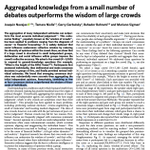
Aggregated knowledge from a small number of debates outperforms the wisdom of large crowds
This study asked a live crowd (N = 5,180) to respond to general-knowledge questions (eg "What is the height of the Eiffel Tower?")
Participants first answered individually, then deliberated and made consensus decisions in groups of five, and finally provided revised individual estimates.
Averaging consensus decisions was substantially more accurate than aggregating the initial independent opinions. In short, small groups beat the wisdom of crowds.
Combining as few as four consensus choices in small groups outperformed the wisdom of over 5,000 individuals.
The key was reasoning together--that aspect of collective deliberation allowed small groups to make more accurate estimates than massive crowds.
nature.com/articles/s41562-0…

Psychologist Gordon Flett conducted a study asking parents a straightforward question: Do you believe your children ever feel like they don’t matter?
Only 8% of parents thought that was likely. But when the children themselves were asked the exact same question, a staggering 35% reported that they either felt they didn’t matter or were deeply unsure of their value.
This psychological signaling gap isn’t unique to parenting; it is a blindspot across almost every modern institution:
-In the workplace: How many leaders assume their employees know they are valued, while their teams feel like invisible, interchangeable cogs?
-In the classroom: How many educators assume their students know they are seen, while those students sit in detached isolation?
-In our homes: How many partners assume appreciation goes without saying, while the relationship quietly starves from a lack of mutual recognition?
We interviewed @John_RMiles about these issues from his new book "The Mattering Effect: Creating a Life of Worth and Meaning". You can read the full interview below:
powerofusnewsletter.com/p/th…

Jay Van Bavel, PhD retweeted

It's important not to get so focused on what's happening in someone's brain that we forget to ask what's happening in their life.

Spending time outdoors provides opportunities for physical activity, exposure to natural light, and social contact.
Over the past 20 years, outdoor time among boys has declined sharply and been replaced by computer-based leisure.
"The implications of the observed declines in outdoor time may extend beyond recreation, contributing to population-level increases in sedentary behavior and greater disconnectedness from the natural world."
This was based on an analysis of the American Time Use Survey, a nationally representative survey of the US population using diary data from 14,235 individuals aged 15 to 19 from 2003-2023 pnas.org/doi/10.1073/pnas.26…

