

staff writer @TheEconomist. prev in China
London
Joined June 2013
- Tweets490
- Following4.1K
- Followers1.8K
- Likes17.7K





Pinned Tweet
DeepSeek and Moonshot distilled Astra. Let them
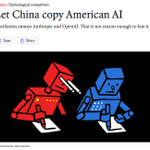
In @TheEconomist this week, we argue that distillation is good for consumers and good for America.
The biggest losers are China's AI labs. They are sacrificing long-term innovation for short-term gains


Nvidia is Preparing to Oust CEO Jensen Huang
wsj.com/business/nvidia-is-p…

Jensen Huang must go
We argue in @TheEconomist that his position is untenable
"Like many powerful leaders, he came to believe that he was too important for the normal rules to apply to him."
But he is not the only one. Howard Lutnick has failed to stem the flow of chips to China. More heads should roll


Lutnick knew.

SCOOP: Commerce Secretary Howard Lutnick was sent a highly classified memo warning about Nvidia CEO Jensen Huang's relationship with suspected Chinese spy Alice Huang.
Lutnick oversees the agency charged with keeping sensitive U.S. technology out of the hands of American adversaries. The warning raises questions about how the department weighed potential security risks as it cleared advanced Nvidia chip sales to China-affiliated entities.
W/@MarcACaputo
axios.com/2026/11/10/lutnick…

6
1,418
Earlier this week Nvidia said the relationship was not unusual. I am surprised they denied it so forcefully. Was the board asleep at the wheel?


And now official confirmation from Jensen himself to the Nvidia board (!!!)
nytimes.com/2026/11/08/techn…


1
7
1,247
Another sign of Japanification. Muji’s success in China resembles its approach in Japan as consumers seek to “downgrade with dignity” ft.com/content/e0484ec6-f370…

China is making progress on autonomous wet labs. The lack of deep-pocketed VCs is pushing firms to quickly commercialise and integrate their solutions into industrial supply chains
economist.com/china/2026/11/…


China’s stock markets are the great global exception
economist.com/finance-and-ec…
from The Economist

379

Anthropic says it stopped distillation on its own platform on September 19. Is it possible that the very large jump in OpenRouter traffic is related?


End of history update: Secretary of the Suzhou Municipal Committee, met with Chinese freestyle skiing athlete Eileen Gu, who came to Suzhou to attend the Vogue Fashion Power event


China’s universities are rich. But they're getting squeezed
economist.com/china/2026/10/…
from The Economist


Bit of a narrative violation. China's public spending growth on education and sci-tech is slowing, mainly driven by local governments' poor finances:

This month China's government released new guidelines for its innovation policy. They include this line:
"Construct a technology monitoring, risk warning, and emergency response system to ensure that artificial intelligence is safe, reliable, and controllable."
nda.gov.cn/sjj/swdt/xwfb/100…
2
435
An AI bust would be pretty bad for China’s economy. Data-centre inputs are probably ~40% of ytd export growth, and of course the second order effects of a generalised slowdown in foreign consumption would hit exports further


Chinese firms have emerged as the biggest losers of the faltering global AI trade, a setback for Beijing’s efforts to use stock markets to supercharge its ambition of technological supremacy bloomberg.com/news/articles/…
Distillation campaigns being responsible for 5-7% of Anthropic's revenue is mad. Revealed preference would suggest that distillation is q important for Chinese progress ft.com/content/11632d03-358c…

Beijing implemented its rare-earth controls on paper before Trump took office. It may not exercise these powers right away, but it’s giving itself the tools to close off its frontier models. Probably because it thinks it will need to use them at some point
Beijing just took a big step towards closing the Chinese frontier. The rules could give China's government the power to restrict AI developers from releasing their most advanced open-weight models.
It proposes banning exports of AI technologies that autonomously generate and modify malicious code. It also wants to restrict exports of AI-assisted vulnerability-discovery technologies. Giving a model away for free, ie open-weight, could qualify as an export.
Crucially, the rules distinguish between technologies already in the public domain and those not yet released. It specifically exempts existing open-source models. But new releases could potentially trigger export controls.
Providing foreign customers with access to models through APIs (ie, closed models) is generally exempt, whereas restricted models being served overseas could require a licence.
Beijing promises essentially automatic licensing for open-source releases, allowing developers to publish almost immediately after notification. But it's unclear whether this applies to those capabilities proposed for outright export prohibition.
If intelligence generalises, how can China's AI labs distinguish between a smart model and one that has the capabilities proposes for restrictions?
mofcom.gov.cn/zwgk/zcjd/art/…
1
1
309
Implications:
Investors worried about cheap Chinese models hurting returns from AI capex. Might be less of a concern
AI safety advocates might applaud controls on cyber-capable models
Many middle powers have been betting that Chinese open-weight gives them an outside option to American AI. Probably not now
A lot of CN messaging has focussed on open-weight being a gift to the world. Already we were seeing a nuancing of this language (see below), expect much more so now

More striking if subtle shifts on open source AI in the Chinese discourse—
The prominent scholar Zheng Yongnian (previously a pretty full-throated advocate of open source) now says:
"We cannot simply say that closed models are good and open models bad, or vice versa. Openness and closedness are themselves relative concepts..."
"If we ignore these boundaries and insist on unrestricted openness, managing the risks becomes a major problem. Governments can use artificial intelligence, and so can non-governmental groups. Constructive forces can use it, and destructive forces can use it too. A balance needs to be found here."
h/t @JFarquhars92862 sinification.org/p/gung-ho-d…

216